@larnal29 Thank you for getting in touch. The best way to reach us regarding an order is to email [email protected]. Looking forward to hearing from you
@DaisyJulius Sorry for the trouble you are having and thank you for your emails with further details. Please let us know how the trouble shooting goes and if there is anything else we can do to help. For support, please email [email protected].
PsychoPy 3.2 also adds USB2TTL8 support to the Parallel out Builder Component, removing the need to use custom code to write to a USB2TTL8 device. Simply select "USB2TTL8" from the component's Port address and the first detected USB2TTL8 is used. Happy Days indeed!
I forgot to tweet that this study involved a LOT of responses by a @BlackBoxToolKit actuator on a @labhackers millikey response box.
I can confirm both devices are happy to run to at least 1/2 million presses (only about 115,000 of which made it into the final paper)
LabHackers Device Manager version 1.5.0 is now available for download. https://t.co/PQChazV7lO
Users of the MilliKey LH-8 can now assign a modifier key to any two of the eight response buttons. Prior to version 1.5 buttons 7 and 8 were always mapped to a modifier key.
LabHackers Device Manager version 1.4.0 is now available for download. https://t.co/zYANyG8gw4
This is a maintenance release that fixes several minor issues, including updating MilliKey MH \ LH button colors in the application and device memory.
Have a great weekend.
PsychoPy 3.1.0 released with better Keyboard handling and a range of other features.
Also providing a recommended download for your system (finally)
https://t.co/KuKfqHNTPy
Nice! The new #USB2TTL8 integration looks great. You can use the SET_TTL action to write to, or the TTL_INPUT trigger to read from, a USB2TTL8 device. Handy for experiments that require access to digital i/o and there is no parallel port available. https://t.co/Ei7GB2iRzX
Experiment Builder 2.2.1 is now available on the support forum- updates include enhanced EEG integration, support for generic serial port devices, a new blink trigger and more: https://t.co/Yq5M6mbARy #EyeLink
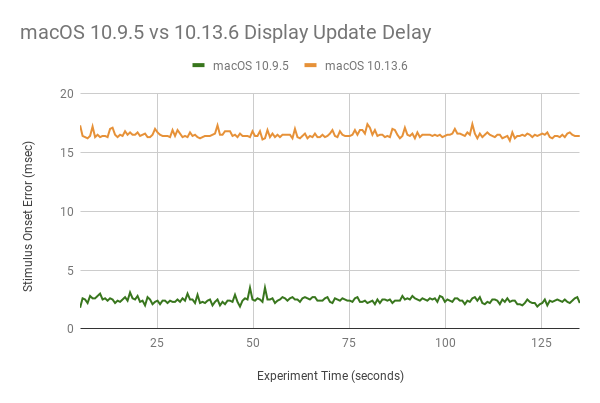
Tested stimulus onset timing of macOS using a #MilliKey DeLux light sensor and @PsychoPy script. macOS 10.13.6 (+?) seems to add one frame delay to actual vs reported stimulus onset times. Anyone know of a fix?
More at https://t.co/VVkJAyLO4k
#macOS#psychology
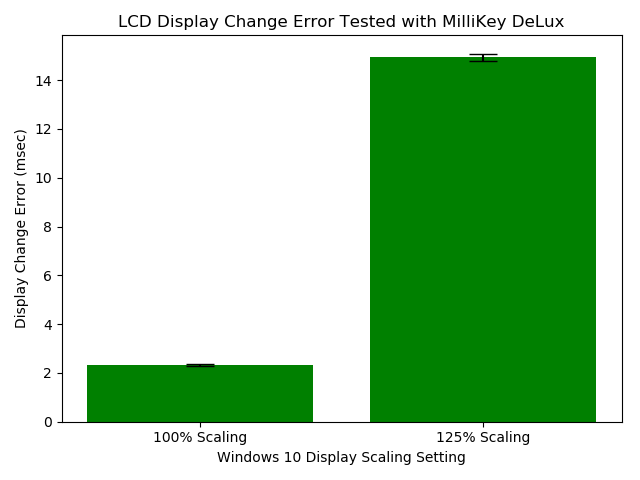
Tested Windows 10 display timing using a #MilliKey Delux light sensor and a @PsychoPy script. Looks like the Windows 10 Display Scaling setting must be set to 100% or an extra 1 frame delay is added. Anyone else seeing this; anyone care? ;)
Read more at https://t.co/XvtVq293kc.
@psychopy Would be interesting to look at the difference between the 'time stamp error' and the 'delay' of a event when using new Keyboard or iohub.
I think they will be different: event delay > time stamp error, where delay = time getKeys() returns event minus actual event time.
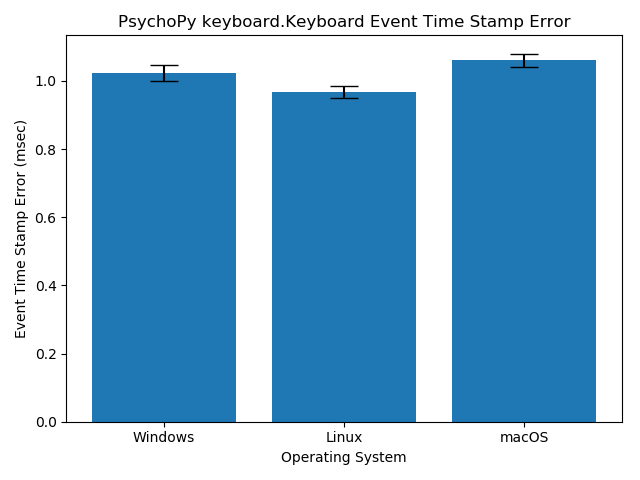
Time stamping accuracy of the PsychoPy3 keyboard.Keyboard class being developed looks great on Windows, Linux, and even macOS. ;) Nice!
Tested using a 1000 Hz #MilliKey response box. Check out https://t.co/5TEOyCj3yN for more details.
@psychopy
@psychopy That is correct, the MilliKey timing procedure / results can only be generalized to other 1000 Hz USB keyboards & response devices that also have a known, fixed, 0 msec keypress debounce interval.
@psychopy These are uncorrected numbers, so yes these delays are overestimated by ~ 0.3 msec on average. Do you think it better to subtract this from reported numbers or keep them uncorrected? Given it is a fraction of a msec, may as well just keep it in was my thinking. Opinions?