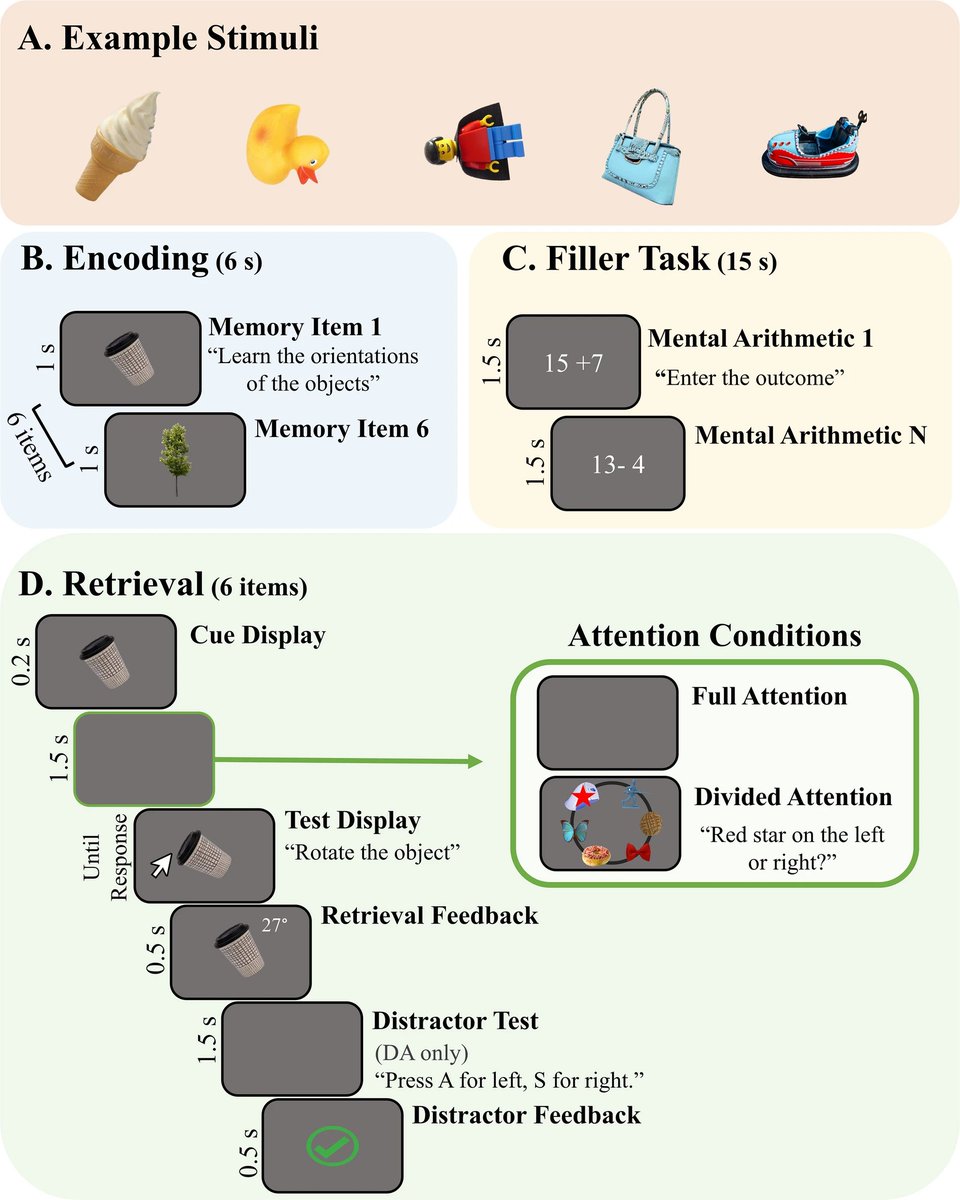
Excited to share our new paper on how distraction affects memory retrieval.
Using a continuous report paradigm, we show that distraction reduces whether memories are accessed but not how precisely they are represented.
https://t.co/vUDNw0VtyN
New paper out in JEP:General, led by uber-productive grad student Ricardo Morales Torres: We use behavior and RNNs to show that object semantics protect visual working memory against visual interference but increase susceptibility to semantic interference
https://t.co/ZwoBd8DYws
New review/theory paper out in PBR with Julie Bugg, Chris Nuno, and Changrun Huang. We muse about the "puzzle of profitless pre-cues" - why is it so hard to get people to engage proactive control from trial-to-trial? We hope it stimulates more research!
https://t.co/0bbv1hkdlw
🚨 I'm hiring! 🚨 @DukeIDLab
is looking for a new lab manager at Duke! If you love research on social identity, working with kids & adults, & mentoring undergrads, this one’s for you. 💡✨
🗓️ Priority deadline: March 31; Please share! 💙
Apply Here! https://t.co/vhWGvTWp1f
New paper from the lab now out online. Changrun Huang asked whether people use informative pre-cues to up-regulate cognitive control in the spatial Stroop task. Surprisingly, they do not, and we rule out some possible reasons for this:
https://t.co/XXLzYjmtIb
Check out this new review w/ John Serences
We consider how and why visual cortical working memory codes can transform away from the sensory-evoked code
Free before Nov. 27: https://t.co/aagwSNTTzt
🚨 Call for Papers! 🚨
Thrilled to guest edit (w/ Luca Moretti & Julie Bugg) a special issue in JEP: Learning, Memory & Cognition.
“Conflict adaptation across single-task and multi-tasking paradigms” 🧠⚡
🗓️ Deadline: Oct 1, 2026
👉 https://t.co/n5imR0RdKp
More in the 🧵
The Dept. of Psychology at the U. Wisconsin–Madison has an opening for an Assistant Professor in the area of Computational Neuroscience and/or Cognitive Science, with an emphasis on artificial intelligence (AI).
Domain of behavior or cognition is open. Details at ...
Come work with us! The Neuroscience Institute and the Department of Psychology at Princeton University are searching for a tenure-track Assistant Professor in the area of human cognitive neuroscience, to be hired jointly in Psychology and Neuroscience: https://t.co/J51o21uDfQ
For fans of flexibility, new paper out in QJEP! Domain-specific cognitive flexibility: Shift-readiness adaptations for task- and attention-switching are non-transferrable https://t.co/tlRPRyMCIH
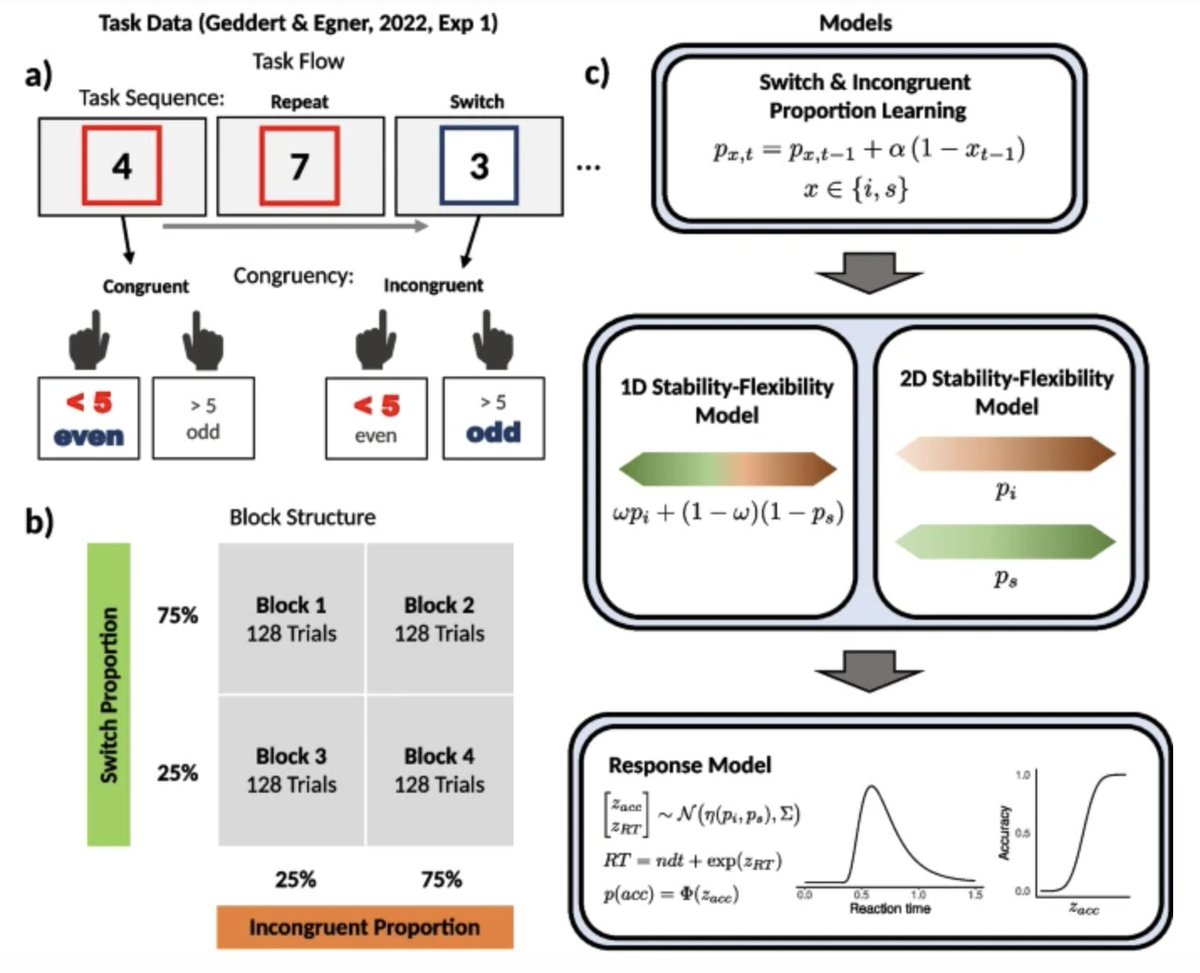
New paper, fronted by @RaphaelGeddert and Seth Madlon-Kay, in Psychonomic Bulletin & Review: "Modeling of control over task switching and cross-task interference supports a two-dimensional model of cognitive stability and flexibility".
Free read link: https://t.co/Kl1lvhdkNv
Since the hotel bar is closed, you may as well check out some posters! #CNS2025: find our excellent grad student Jim Zhang at poster A91, "Neural correlates of concurrent demands on cognitive stability and flexibility".
We are currently seeking nominations for a new Editor-in-Chief at @Psychonomic_Soc journal, AP&P, whether it be you or a colleague you'd like to nominate! For details, see our announcement at https://t.co/ZP7KuO5w6y
This work is now out! Check out our paper on generalizable brain network model of surprise. Grateful for @monicarosenb for being the most supportive mentor!
@JMGrohNeuro@taha_morshed@OLab_Duke The most reliable observation from the human cases reported in that paper (there are also dogs!) are what Berger refers to as "1st-order waves" (large amplitude, 10-11 Hz) and "2nd-order waves" (small amplitude, 20-30 Hz). He's not using alpha/beta labels.