Inspired by poker, John von Neumann developed the idea of bluffing in a mathematical way.
This work led to the birth of game theory, the study of strategic decision-making between rational players.
Today, game theory is widely used in economics, political science, philosophy, and computer science.
Von Neumann realized that probability alone cannot fully explain games like poker because players also choose strategies.
In zero-sum games, he showed that players can adopt strategies that minimize their possible losses.
He first presented these ideas in 1928 and later expanded them in the famous 1944 book Theory of Games and Economic Behavior, written with economist Oskar Morgenstern.
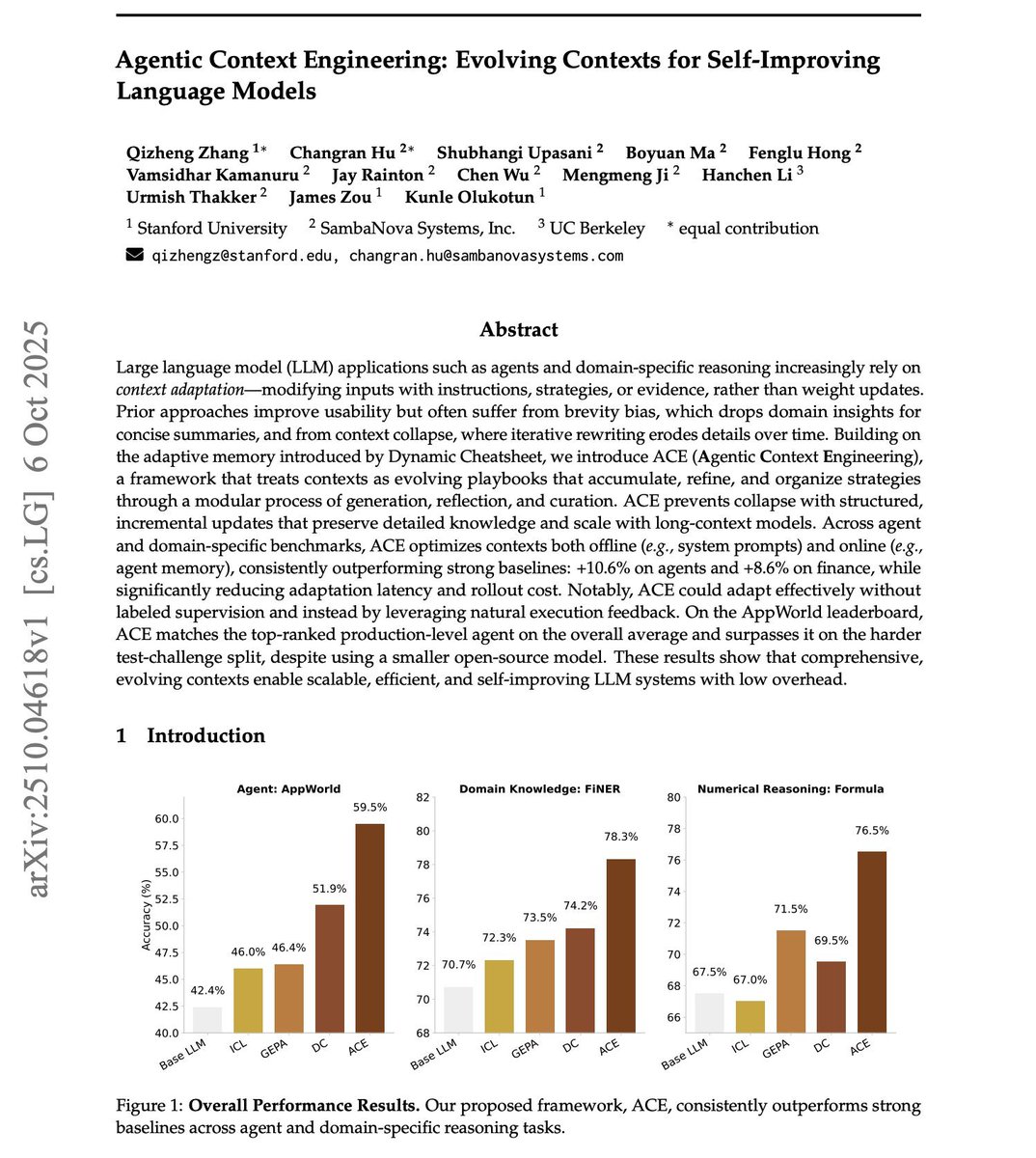
Stanford just made fine-tuning irrelevant with a single paper.
It’s called Agentic Context Engineering (ACE) and it proves you can make models smarter without touching a single weight.
Key takeaways (and get the 23 page PDF):
One of nature's most intelligent and curious creatures, the octopus is everything your organization needs to be: smart, endlessly adaptable, and highly resilient. Its eight tentacles work in concert, but each can also think for itself.
In their new book, "The Octopus Organization," AWS executives Phil Le-Brun and Jana Werner aim to help you achieve that same balance of cohesion and autonomy and guide your organization toward a living, breathing system—one that learns, adapts, and thrives.
Break away from a broken model of transformation and embrace continuous change. The book is available today.
https://t.co/zDE1bGZY47
2025 is coming to an end 🥹
here are my most used AI Tools This Year:
Replit - Build mobile apps
Antigravity - Best AI for coding
Arcads AI - Marketing for apps
Higgsfield AI - Stunning AI videos
Gemini 3 - AI image editing
Perplexity AI - Web search
Lovable - AI Websites
Grok-4.1 - Deep research tasks
Typefully - Social media manager
Gamma AI - Generate presentations
So, what was your favourite AI tool in 2025?
Top 9 Free Stanford AI Courses,
Covering machine learning, AI, NLP, and more!
Get the high-quality PDF with clickable links:
Subscribe to my newsletter at https://t.co/jTnaNRaV2d
1) Machine Learning (CS229)
The legendary ML course by Andrew Ng:
https://t.co/s20E1TtueQ
2) Machine Learning from Human Preferences (CS329H)
Reinforcement learning meets human guidance:
https://t.co/duEIOXBlSF
3) Deep Learning (CS230)
Neural networks, CNNs, RNNs by Andrew Ng:
https://t.co/NtLJmp4VpT
4) Natural Language Understanding (CS224U)
How machines grasp meaning and context:
https://t.co/4FqL19YJUq
5) Reinforcement Learning (CS234)
Building intelligent agents and reward-based systems:
https://t.co/MhNTIKWy3w
6) Deep Multi-Task & Meta Learning (CS330)
Teaching models to learn efficiently across tasks:
https://t.co/obwMesCCaY
7) Artificial Intelligence: Principles & Techniques (CS221)
Fundamental concepts that power modern AI:
https://t.co/zKqnCxhebY
8) Machine Learning Theory (CS229M)
The math and logic behind algorithms:
https://t.co/OLlnJzHjNj
9) NLP with Deep Learning (CS224N)
Transformers, embeddings, and modern language models:
https://t.co/FHuU4mXz5N
The AI skills gap never came from lack of talent.
It came from lack of access.
Degrees take years.
They cost a fortune.
By the time you graduate, the field has moved on.
Now you can get Stanford-level AI knowledge for free.
If not now, when?
P.S. Which course will you start first?
♻️ Repost to give your network access to top AI education!
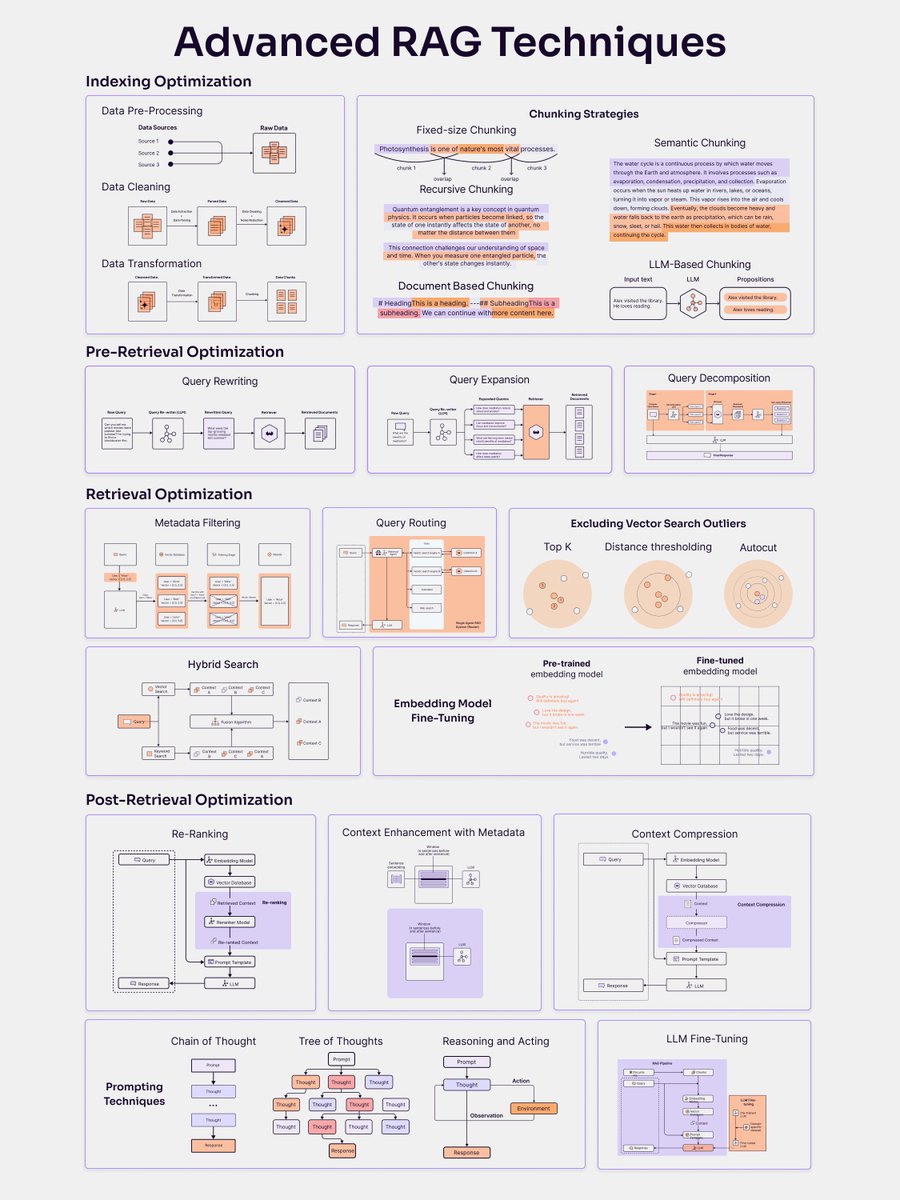
Most RAG systems fail at retrieval.
But there's a clear path to fix all 4 stages.
Start with the basics, and level up with our Advanced RAG Techniques e-book, which walks you through how to optimize each step.
It covers:
→ 𝗜𝗻𝗱𝗲𝘅𝗶𝗻𝗴 𝗼𝗽𝘁𝗶𝗺𝗶𝘇𝗮𝘁𝗶𝗼𝗻
→ 𝗣𝗿𝗲-𝗿𝗲𝘁𝗿𝗶𝗲𝘃𝗮𝗹 𝗼𝗽𝘁𝗶𝗺𝗶𝘇𝗮𝘁𝗶𝗼𝗻
→ 𝗥𝗲𝘁𝗿𝗶𝗲𝘃𝗮𝗹 𝗼𝗽𝘁𝗶𝗺𝗶𝘇𝗮𝘁𝗶𝗼𝗻
→ 𝗣𝗼𝘀𝘁-𝗿𝗲𝘁𝗿𝗶𝗲𝘃𝗮𝗹 𝗼𝗽𝘁𝗶𝗺𝗶𝘇𝗮𝘁𝗶𝗼𝗻
Get the full picture in our e-book 🧡 (oh, and it’s completely free): https://t.co/xkmYp7EWag
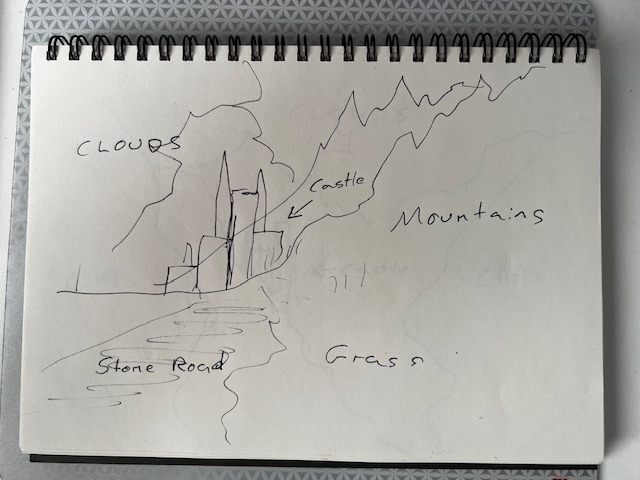
Prompt challenge time: Transform this simple sketch into an epic, cinematic fantasy landscape.
Just upload a drawing into Gemini and use this prompt to make it real (or in this case, unreal).
Show us what you dream up in the replies.
Evolution of Deep Learning by Hand ✍️ As my tribute to Geoff Hinton's Nobel Prize, I drew this animation to illustrate the key idea behind Hinton's major contributions to deep learning over the years, with artistic liberty.
----
100% original, made by hand ✍️
Join 40k readers of my newsletter: https://t.co/fFt8roc8D9
Interested in the future of open education in the context of artificial intelligence? Explore nine new rapid response papers from MIT Open Learning’s AI + Open Education Initiative on actionable insights and unique case studies from a global cohort of voices ➤ https://t.co/Kk9fCVYy2k
Stay tuned for further programming and developments from this initiative, and join our expanding community of practice ➤ https://t.co/4WmLvj7Hsz
#OpenEducation #AcademicNews #ArtificialIntelligence #AI #AIEducation #EdTech #Technology #OnlineEducation #OnlineLearning #LifelongLearning #Education
Chemists can now use generative AI to predict how a DNA sequence will fold into a 3D structure inside the cell nucleus — which influences virtually every aspect of how a cell functions. https://t.co/x4JJwsAYI0