I avoided commenting on the Lindsay Clancy trial because its nuanced and emotional but the implications are enormous so I am going to say something now. A lot of people are calling that one juror who wouldn't join the other eleven irrational. But, that juror is probably the only one asking the right questions imo: where is the evidence that she lacked the capacity to know it was wrong or to stop herself? And, maybe, where do we draw the line on what an ostensibly insane person is allowed to do when the doubt the defense manufactured rests on nothing in the record before the killings? It seems that the entirety of the defense position rests on improbable probabilities and that's a low bar for such a heinous act.
1. Postpartum psychosis is rare, and almost always happens in the first 4 weeks. The idea that some psychiatrists extend the postpartum window to a year is true, but for depression and anxiety. The evidence isn't strong for psychosis, and its latching on to improbability
2. The strongest risk factor for postpartum psychosis is preexisting bipolar disorder or a prior psychotic episode. She had neither before her third child. The real time evidence from her doctors/providers indicate this. The bipolar label that showed up was after significant polypharmacy, and any good psychiatrist will tell you that you cannot diagnose primary disease when multiple drugs could be offending agents. Drug-induced psychosis would show better temporal correlations with her medications and should be a mitigation argument at sentencing. Again, very improbable alignment
3. The proxy for intent is planning, and she clearly planned... she sent her husband to some restaurant they don't normally go to, checked the drive time, texted a specific order at 5:07 pm... she killed her children in sequence. That's demonstrating real time decision making. I don't understand how they circumvented this. Again, very improbable that she was able to make decisions up until it becomes a liability
4. This idea of a "voice" that commanded her is so post-hoc as a defense. The ltierature on command hallucinations show most people don't obey them and the compliance occurs when the voice is familiar. This was a first time voice she only ever reported 2 weeks after killing her kids. And this first time voice asked her to... kill all her children AND she listened to this unfamiliar voice? Again... very improbable
The improbability is so stark that it's almost undeniably a sympathy verdict from the jurors conflated with a misunderstanding of postpartum disease. The easiest way to demonstrate this is to take a father with the same chart, months of documented depression, insomnia, suicidal ideation but no psychosis then strangles his kids after arranging for his wife to be away from the house. 100% guilty.
Everyone knows postpartum disease is real and important. Everyone knows she's sick and needed help, possibly much better management. You can even argue she is insane. What I see to be the most important is where we draw the line of what we allow under the "insanity" rule. Massachusetts forces a binary verdict of guilty or not criminally responsible but this is a case for the third that other states have and which is guilty but mentally ill. We have a responsibility to speak for the unheard voices of these children and future children and say we draw the line at murdering children.
Ranking every B2B data provider in tiers:
S TIER
- Prospeo. This is our default for a general list build.
- Ocean(.)io. Funded company filtering and lookalike search off a seed domain.
- BlitzAPI. Domain to LinkedIn company to contacts to verified emails in one call.
- Instant Data Scraper. Free, and it reaches the markets nobody has indexed.
A TIER
- LeadMagic. The supplemental that catches what your primary missed.
- Google Maps + Serper. The full local market if you query by zip code instead of city.
- OpenWeb Ninja. Up to 499 results per call when pagination caps become the bottleneck.
- Icypeas. Solid third stage in a waterfall.
- SEC EDGAR. Free, and public companies write down what they are worried about.
B TIER
- Apollo. Everyone pulls the same rows, so the data is burnt before you touch it.
- Clay. Excellent orchestration but expensive as a data source on its own.
- Crunchbase. Fine for funding signals but thin on contact data.
- BuiltWith. Narrow use case, and precise inside it.
- Wellfound. Useful for early stage and limited past that.
C TIER
- ZoomInfo. Enterprise pricing for data you can assemble cheaper in 2026.
- Lusha. Coverage falls apart outside the obvious accounts.
- Anyone selling "verified" leads at $0.10 each.
- LinkedIn scraping tools with no verification layer.
Founders: most discovery calls fail before they start, because nobody decided what the call was for.
Here's the structure I teach — minute by minute, with the actual language:
https://t.co/HwXtKC1znt
Down the rabbit-hole it gets worse and worse. Anthropic’s “Save 50%” claim makes even less sense than I thought.
The label suggests that the $200 Max 20x plan gives you four times the usage of the $100 Max 5x plan for only twice the price. We already figurer that out.
But Anthropic’s own website disclosed very different weekly limits in 2025:
Max 5x: 140–280 hours of Sonnet per week
Max 20x: 240–480 hours of Sonnet per week
That is only around 1.7x more weekly usage, not 4x, despite costing twice as much.
So once you hit the weekly limit, you are not saving 50%. You are effectively paying more per expected hour of usage. Save 50% doesnt make any sense at all.
actually someone literally sued Anthropic over this in June. the lawsuit claims that Claude Max’s usage limit marketing is misleading
based on Anthropic’s own weekly estimates in the lawsuit:
5x plan: ~3.5x Pro weekly
20x plan: ~6x Pro weekly
you pay 2x: get ~1.7x more weekly usage
and this is before Fable.
the lawsuit claims Anthropic sells “5x / 20x more usage” but the weekly limits aren’t meaningfully explained in the purchase flow.
*the case is still ongoing so these are allegations, not a court finding yet.
Breaking Claude Code Opus 5 Auto Mode 🔥
1/ Here is a somewhat hilarious attack chain that hijacks Claude Code Opus 5 for a full system compromise via a website
Hint: Security invariants are not optional
🧵
The whole internet was going crazy about the Company Brain, so we asked 149 teams of builders and users about their setup and insights.
All of it now lives in a free interactive ebook - Go check it out!!👇
Eight insurers, four "unrelated" owners, one book: $40.6B of the same private paper, marked by the same manager and reinsured into offshore shells run by the same Guggenheim hands — in one case a Towriss reinsuring a Towriss. Combined, =~one Athene. https://t.co/JtZxhjWz1D
This might be the most important film Forbidden Studios has ever made.
FREE WILSON
A story of love, freedom, conspiracy, and one very complicated marriage.
Coming soon to VHS.
My biggest takeaways from @jjen_abel on the enterprise sales process:
1. Most people think enterprise sales is a five-step process. It’s actually around 15 steps. The classic CRM stages of a sales process (intro, demo, proposal, contracting, close) are a revenue forecasting tool, not how you successfully move a buyer through a decision and close a deal.
2. The “pincer” move for landing the first meeting: Target the executive or the n-1, and no one else. When prospecting into an enterprise account, there are only two valid entry points: the ultimate decision-maker (often the exec in charge of a department or business unit) and the person one step below. The pincer move runs both tracks at once: your company’s founder reaches out to the top, the AE targets the N-minus-one, and you work toward them from both ends.
3. Pitch the alpha, not the problem. Executives receive hundreds of cold messages; the oes that cuts through speaks directly to an unfair advantage they can get access to through your product. “We can save time on document review” won’t get execs very excited. “I can guarantee you a three-day timing edge on regulatory information your competitors will get later” does.
4. A healthy enterprise win rate is 25% to 35% of qualified opportunities, and higher means your price is too low. This number surprises founders who expect to close half of what they qualify. But enterprise buyers need time, organizational maturity, and internal alignment that sellers can’t always control. A significant portion of the market simply isn’t ready yet. Jen notes that roughly 25% of “lost” deals boomerang back within a year, so a no today is rarely a permanent no. Pushing price down to win more deals undermines the market: executives talk, and inconsistent pricing across logos destroys credibility faster than losing a deal does.
5. The intro call is the most valuable intelligence-gathering session in the entire sales cycle. Prospects open up on call one in ways they never will again, because it doesn’t yet feel like a sales process. Jen keeps it explicitly informal (“I don’t even know if we need a full 30 minutes”), lets the prospect go first, and uses open questions about organizational change (“What needs to be different in 2027?”) to surface priorities before ever mentioning her product. Do not record the call, do not show slides, do not demo anything. The more they talk, the more you can frame your eventual pitch around exactly what they told you they need.
6. Treat the demo as a carrot you withhold until you have co-authored it with your internal champion. Most sellers race from intro to demo in one jump. Jen always does a 15-minute “pre-demo prep” call with the champion to co-build the agenda: which features to show, which questions people will ask, and which attendees to include. By the time the group demo runs, the people in the room feel like the product was built specifically for them.
7. Demo 20% of the product—the 20% you know they care about. Showing the full product in a demo is one of the most common ways deals unravel. The moment stakeholders see features irrelevant to their team, they start calculating what they’re paying for that they won’t use, and the tight narrative you’ve spent weeks building collapses. Let the champion guide what to show beforehand, let curious prospects in the room pull you into additional features themselves (“Can it also do this?”), and keep the frame tight.
8. Text your champion for a raw debrief within five minutes of the demo ending. Before the room solidifies a polite consensus, get the unfiltered read: where you lost someone, where you landed, who needs another 15 or 20 minutes. There is always someone in the org who can kill the deal; your job is to find them early and protect alignment.
9. Time-box pilots to two or three days with three or four hand-picked users. Give a small group of power users (not the C-suite executive, who won’t be the daily user anyway) a specific set of tasks, a shared definition of what success looks like, and a 48-to-72-hour window to use your product. Any longer and you’ve added two weeks to your sales cycle with little additional signal. If the product requires deep integration before it can show value, charge for the longer pilot (typically one to two months) and credit the fee back against the contract if they proceed.
10. Your champion going quiet is a signal your deal is falling apart. The champion’s job is to help you navigate the people who might kill the deal, alert you to internal dynamics you can’t see, and keep the process moving when it stalls. If the champion goes quiet, something has shifted inside the organization. An enterprise deal is set up for maximum friction (deal-killers, procurement, legal, sponsor); the person on the inside is the key.
11. Sales is project management. After a strong pilot, email your champion a forwardable package—agreed timeline, price predicated on a signature date, and a kicker if they hit it—so they can loop procurement.
12. The expansion conversation starts the moment you sign. The close is five minutes of celebration and then back to pipeline. The real prize in enterprise is year-two expansion: moving from $100K to $350K, from a single team to multiple business units.
In the fight to defend openness in AI, the Marin project is a precious demonstration of openness in model training, with open code, data, recipes, even experimental results. Releasing AI research openly used to be the norm; I'm grateful for @percyliang's open lab approach.
sharing a new long-form blog post: ai chip architectures
it covers the leading chip architectures (nvidia, amd, tpus, trainium, cerebras, groq) across architecture, scaling (scale-up and scale-out), and software stacks.
it helps build an intuition for the architectures and their trade-offs.
https://t.co/7eZMh3ddZS
the security model behind cloudflare os, gatekeepers, and isolates solves this
point your clanker at this repo and ask it to teach you about the security model
https://t.co/tcx4J3NK1c
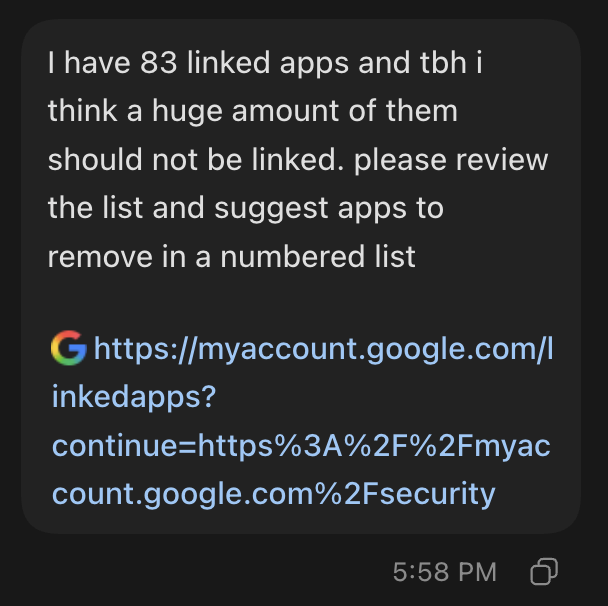
If you care about your privacy:
1. Go to https://t.co/yICN6WAe9R in Chrome
2. Run this prompt in Codex or Claude Code and tell it there's an open tab in your browser
3. Then pick the ones you want to remove and tell AI to do it
Just disconnected half the apps that should no longer have my Google info.
I charge $999 to ask a business owner questions for 45 minutes.
Then Claude does the analysis in 5 minutes.
I call it the AI Tools Assessment.
It finds 3 to 7 off-the-shelf tools that reclaim 5 to 10 hours a week.
It’s the front door to upsells from $3,500 projects to $2,000/month retainers.
Here’s the entire model:
1. The discovery call is questions only. “Walk me through yesterday.” “What tasks do you dread?” “Where does work pile up?” No pitching. A free AI notetaker captures the transcript.
2. Claude runs the entire analysis. Paste the transcript, run one skill, and it pulls the pain points and prescribes the tools in about 5 minutes. It catches patterns you missed on the call.
3. When Claude whiffs on a tool, Futurepedia and theresanaiforthat fill the gaps. Thousands of tools, grouped by industry.
4. The report is 9 slides. Executive summary, effort vs impact matrix, tool recommendations, a 4-day quick win plan, and the financial impact. I open sourced the template free at https://t.co/lprebgu5Q2.
5. I go for the close on the review call. Three questions: which of these is most urgent, do you want to DIY or get help, and what’s your timeline? 50 to 60% of clients ask you to implement it for them.
6. Process redesign sells for $3,500 with zero automation. One e-commerce client had an 18-step ad workflow. We cut it to 9 steps. Fixed the process, didn’t touch AI, charged $3,500.
7. Knowledge systems are $3K builds. A business broker got 400 emails per listing. We trained a custom GPT on the marketing package, and buyers called it the best broker experience they’ve had.
8. You don’t need an audience to sell this. One guy walked into 30 local businesses offering a free 15-minute mini assessment. 5 meetings, 2 clients. The free mini assessment is the hook for every channel.
9. Co-working spaces are the cheat code. Dennis in our community hosted his first free AI office hours this week. 9 people showed up, 2 became warm leads.
10. AI Concierge is the best upsell of all. Two 45-minute calls a month at $1,200 to $2,000. I have 5 clients and my blended rate is about $1,100 an hour at 99.9% net margin.
Sell the diagnosis before the cure. The $999 assessment is a paid discovery call that qualifies the buyer and tees up every upsell on the menu.
every useful AI workspace needs these 4 files (at minimum):
company. md
-What the company sells
-Who it serves
-How it makes money
-What it believes
-What makes it different
customer. md
-ICP
-Pains
-Objections
-Buying triggers
-Questions
-Language
-Fears
-Decision criteria
offer. md
-Packages
-Deliverables
-Pricing logic
-Proof
-Promises
-Claims to avoid
-What counts as a good-fit customer
voice. md
-How the business talks
-How it should never sound
-Phrases it uses
-Phrases it avoids
-Examples of good writing
Context is EVERYTHING when it comes to building with AI.
Elon Musk sent every Tesla employee a memo that took authority away from their managers and handed it to them.
He never asks for more hours. Every rule moves a decision closer to the person doing the work.
Musk: “Excessive meetings are the blight of big companies and almost always get worse over time.”
Companies have a role for everyone who creates process and no role for anyone who removes it. Meetings and approval chains survive because removing them was never anyone’s job.
Musk: “Walk out of a meeting or drop off a call as soon as it is obvious you aren’t adding value.”
Attendance has always been treated as proof of commitment. He made it worthless, and contribution became the only thing that counts in the room.
Musk: “It is not rude to leave, it is rude to make someone stay and waste their time.”
Ordinary manners protect whoever called the meeting. He moved that protection to everyone else sitting quietly with real work waiting on them.
Musk: “Don’t use acronyms or nonsense words for objects, software, or processes at Tesla. Anything that requires an explanation inhibits communication.”
Internal vocabulary converts knowledge into status and charges every newcomer a fee to participate.
A company that speaks plainly can absorb talent at full speed.
Musk: “Communication should travel via the shortest path necessary to get the job done, not through the chain of command.”
Most good ideas die in transit, three levels below anyone with the power to act on them.
Musk: “Any manager who attempts to enforce chain of command communication will soon find themselves working elsewhere.”
The only threat in the entire memo. A manager who insists on being routed through is buying his own relevance with everyone else’s time. Musk put a price on it.
Musk: “Always pick common sense as your guide. If following a company rule is obviously ridiculous in a particular situation, the rule should change.”
Following a bad rule normally shields you. Exercising judgment exposes you.
He flipped which one carries the risk, and every rule now has to earn its place against the person applying it.
Every institution drifts toward protecting its own comfort. The ones that keep building are held together by people who rewrite the rules back down to something a single person can act on.
Nothing on that list requires a budget, a headcount, or a title.
You can run the entire memo from wherever you are sitting right now. Most people never test it and never learn it was permitted the whole time.