Who bears the burden when petrol prices rise?
New e61 research using aggregated, consented and de-identified bank transaction data finds demand for petrol is more price-sensitive than previously thought - and price shocks have the greatest impact on lower income consumers. 1/
Calls to tax gas more are popular across the political spectrum. In this week’s plus61, Adit Maitra and @lachlanvass ask what the design of the PRRT, and what it gets right and wrong, can teach us about the trade-offs any reform must grapple with.
https://t.co/EaiuC8i3hS
Reporting on the Albanese Government's fifth Budget has focused on capital gains tax, negative gearing and trusts. But beneath the headlines, five important stories have largely flown under the radar. In our last budget61 piece on the federal Budget, @SPelinAkyol, Elyse Dwyer (@dwyerel), @NickJGarvin , Matt Nolan (@ZjubNZ) and @lachlanvass unpack three stories buried within the themes of tax, housing and the NDIS – and two stories notable for their absence: JobSeeker and illicit tobacco.
https://t.co/tNeJY5vkXL
@Mark_Graph@AvidCommentator To be fair, the COVID shock is hard to forecast, including its flowthrough impacts over time. What were the forecasts like pre-2020?
There's a big budget story that's bigger than all the tax changes combined. In this week's plus61, Michael Brennan explains why the projected return to surplus rests almost entirely on getting NDIS cost growth down to 2 per cent. That makes the NDIS save probably the single biggest thing this Government can do for the lot of younger and future taxpayers – and the hardest.
https://t.co/nqynbQFDEU
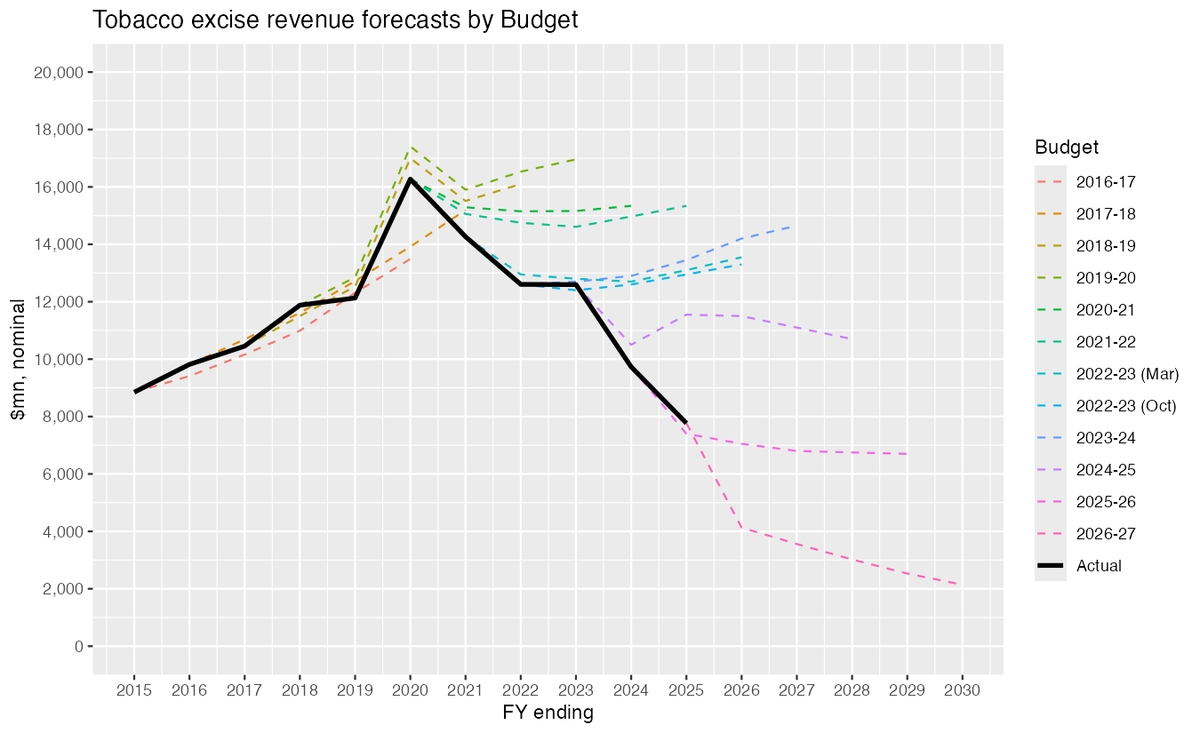
Not as sexy as the various tax changes, but hidden under the hood of tonight's Budget was another downgrade to tobacco excise, with only $14mn provided to improve enforcement
Not as sexy as the various tax changes, but hidden under the hood of tonight's Budget was another downgrade to tobacco excise, with only $14mn provided to improve enforcement
@ChrisEconomist I'm also not 100% sure, I think it comes down to whether (and how much) the provisioning was a decision - one could argue it was as they had made an offer to the states based off of it, but maybe they'd argue it isn't a final decision until the states agree
Tomorrow night's federal Budget is set to be the Albanese government's most ambitious yet. In the latest article in our budget61 series, @lachlanvass and @JackBuckleyEcon have put together a budget watchers insider guide on what to look for when the Budget Papers are released at 7:30pm.
https://t.co/md8Ty1dOXc
@bruce_kangaroo@daveyk317 Apologies I should have said not allowed to import at scale. At the moment there's significant limitations to doing so https://t.co/0J8hgJ042j
Not sure this survey data is reliable. The ATO's own tax data shows the EV FBT exemption overwhelmingly benefits the highest income earners. This is no surprise, it's a design flaw of the policy - a bigger subsidy for those on higher incomes when buying the same EV
@daveyk317@dunce_scotus If we want more second hand EVs why don't we allow them to be imported (we currently don't)? That would seem a less costly approach
@ChrisEconomist Really enjoying this series Chris. A small note, I think UCB and HCB pick up debt foregiveness, but just in a different way - as previously expected cashflows dont occur. This interacts with your previous post about timing things outside the FEs in terms of clever politics
🎙️What do you do when the 'sin tax' causes more bad behaviour? On @Reuters Econ World we look at Australia's cigarette tax and its booming market for counterfeit smokes with @JulianHillMP and @lachlanvass from @E61Institute
Listen here👇
https://t.co/kTDlQrNKlk
Australia is spending billions subsidising EVs through the EV fringe benefit tax exemption. But even under optimistic assumptions, it remains one of the most expensive ways to cut carbon. With costs rising ahead of the Budget, @lachlanvass and Amy Tramontozzi examine the design flaws – and what better policy would look like.
https://t.co/aHOtnW6tPM
@peter_tulip Yep this is what I was originally trying to point out, Bob's article is predominantly about transfers and the increasing universalism of these. Your critique is more about where government intervenes for a market failure