From Australia to #Cuba with Love 2026
Join our collective challenge to travel the distance between Canberra and Havana - 14,886 km - over 8 weeks, starting 13th June. more info:
https://t.co/dfLGHCXcl0
#LetCubaLive#droptheblockade#Aus2CubawithLove
The expansion of US sanctions against Cuba is hurting ordinary people and endangering lives. It is unacceptable that children are dying for lack of essential medical supplies. These sanctions must be lifted immediately.
https://t.co/RNcyANe58z
AFP urged to investigate Australians allegedly involved in Gaza genocide | Pearls and Irritations
‘The referral is supported by a substantial evidentiary dossier prepared by the International Centre of Justice for Palestinians (ICJP), .. cont https://t.co/MKWZNG3HnR
For decades, Cuba’s ELAM has trained doctors from around the world — including the U.S. — with a vision of healthcare as a human right. Samira Addrey and Abeeku Ricks are among hundreds of ELAM graduates from the United States.
Editor: Jihan Hafiz
After years of calling Cuba a DICTATORSHIP, Rubio admits in the House Foreign Affairs Committee hearing, 4 June, that political power in #Cuba depends on consensus decision making. Cuba's system of democracy and representation is explained in my chapter: https://t.co/c9GTG5xi60
ICAP Statement – 8 June 2026
The Cuban Institute of Friendship with the Peoples (ICAP) has condemned the decision by the US government to place ICAP and Amistur S.A. on the OFAC sanctions list.
@BrunoRguezP: El gobierno de los Estados Unidos, en los hechos, está en una posición de quebrantamiento de la paz y la seguridad internacionales y de violación del Derecho Internacional y del Derecho Internacional Humanitario respecto a la República de #Cuba.
@CubaMINREX
🚨🇨🇺 Great news! Cuba has restarted the production of 16 cytostatic drugs for the National Program for Oncological Patient Care, following a major investment process.
It takes place amid severe economic limitations caused by the extreme intensification of the U.S. blockade.
.@CarlosFdeCossio
"The so-called “crisis” in Cuba, which is covered almost daily by major U.S. corporate media outlets—as well as some European and Latin American ones—is a phenomenon of destructive harm induced by the U.S. government, a fact that this biased press no longer denies, yet it glosses over it as if it were a natural occurrence.
These media outlets do not pass moral judgment on the collective punishment and widespread human suffering, much less on the lack of any legitimate excuse to justify the assault on an entire people. They do, however, emphasize the major challenges and difficulties faced by Cuban society and its government in confronting the aggression, as if they were responsible for it.
They speak of Cuba’s problem, when it is well known that the real problem is U.S. aggression against Cuba, which, by the way, did not begin in January 2026.
Put an end to that aggression, and there will be no more talk of Cuba’s supposed problem."
Norma Goicochea, President of the Cuban United Nations Association, warned about the human consequences of further hostility from Washington. “Cubans have the right to live in peace.”
Expreso mi más profunda gratitud a la presidenta de #México@Claudiashein, y a todo su pueblo, por la llegada a #Cuba de un nuevo buque con valiosos donativos solidarios.
Este gesto de hermandad tiene un significado inmenso para el pueblo cubano, que resiste heroicamente frente al brutal cerco energético, el recrudecimiento extremo del bloqueo y la amenaza militar del gobierno de EEUU.
From Australia to #Cuba with Love 2026
Join our collective challenge to travel the distance between Canberra and Havana - 14,886 km - over 8 weeks, starting 13th June. more info:
https://t.co/dfLGHCXcl0
#LetCubaLive#droptheblockade#Aus2CubawithLove
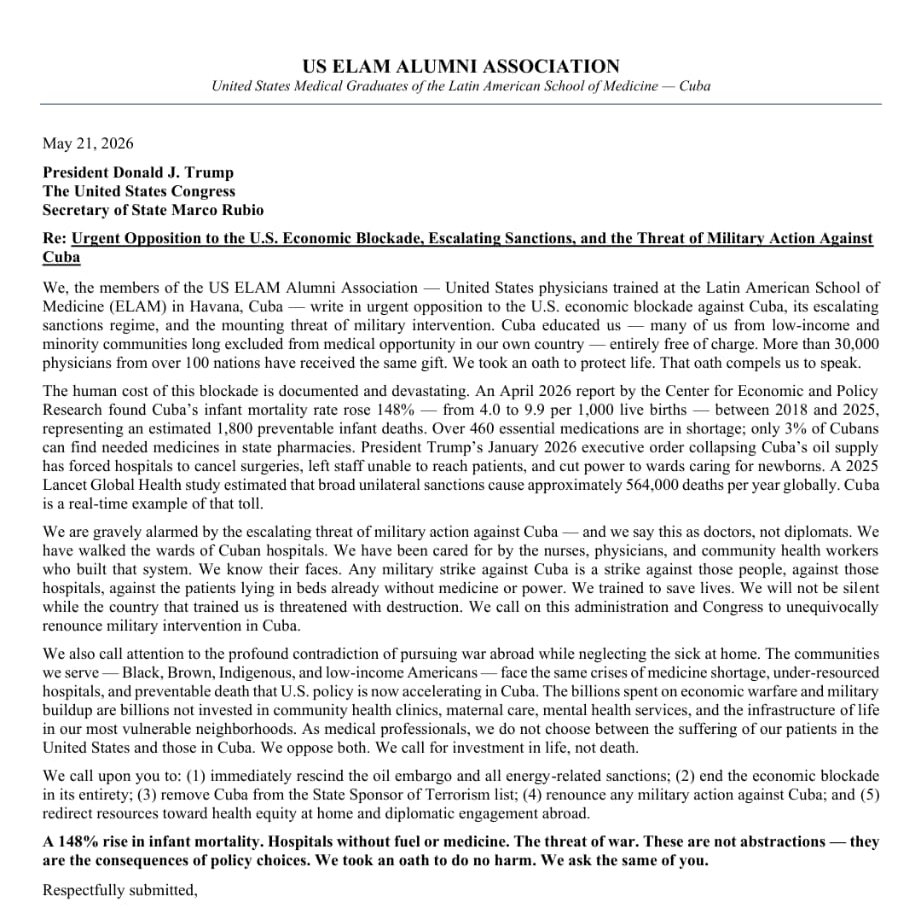
Letter from the #US@elam_oficial Alumni Association
"We are gravely alarmed by the escalating threat of military action against Cuba — and we say this as doctors, not diplomats.
We have walked the wards of Cuban hospitals. We have been cared for by the nurses, physicians, and community health workers who built that system. We know their faces.
Any military strike against Cuba is a strike against those people, against those hospitals, against the patients lying in beds already without medicine or power.
We trained to save lives. We will not be silent while the country that trained us is threatened with destruction.
We call on this administration and Congress to unequivocally renounce military intervention in Cuba."
At the Parliamentary Public Hearing #CubaQuierePaz, convened by the National Assembly of People’s Power #ANPP, we, the Cuban female deputies address the female members of Congress and the women of the United States.
Open Letter to the Women Members of Congress of the United States of America
Honorable Members of Congress, women of the United States of America:
We write to you from Cuba, in our capacity as female deputies of the National Assembly of People’s Power. We are women, mothers, grandmothers, daughters, and citizens deeply committed to the defense of human rights, equality, and the dignity of all people.
We are addressing you because we firmly believe in women’s capacity for dialogue, for understanding human suffering when it affects entire families, and for raising our voices when justice and humanity demand it, beyond political differences.
Since late January of this year, President Donald Trump has issued two executive orders that intensify the economic, commercial, and financial sanctions the Cuban people have endured for more than six decades, stating that Cuba poses an extraordinary and unusual threat to U.S. national security. A total oil embargo has been imposed, and pressure has been ramped up on countries or companies that dare to trade, invest, or facilitate financial transactions with Cuba. This serves the interests of a tiny anti-Cuban minority who care nothing for the severe consequences for the population.
Our noble country poses no danger to any nation, and these measures are creating a humanitarian catastrophe; they are suffocating our people, causing anguish and deep suffering among those of us who live the daily reality in our communities.
The consequences of these policies do not fall onto abstract structures; they fall on specific people, on the human beings who inhabit this nation. Those of us who work for women’s rights know that crises are never neutral. Women are always the first to bear their most severe impact. They are the ones who sustain daily life, develop survival strategies, and provide care when there is a shortage of electricity, food, drinking water, transportation, fuel, medicine, sanitation services, and more.
It is devastating that a power shortage brings neonatal and intensive care units to a standstill; it is heartbreaking that we are deprived of the possibility of purchasing essential parts and supplies for treatments or the operation of medical equipment, or buying the medications needed to cure or prolong the lives of patients with serious illnesses. All of this causes unnecessary suffering and can even become an inevitable cause of death.
We are talking about lives: there are 96,387 patients awaiting surgery, of whom more than 11,000 are children; 16,000 patients undergoing radiation therapy; 2,888 who depend on hemodialysis treatments; and 32,000 pregnant women who require ultrasounds—services that demand energy stability currently very difficult to guarantee; the infant mortality rate has risen from 4.0 to 9.2 per thousand live births, and life expectancy for children with cancer has dropped from 85% to 65%; to name just a few examples.
That is why we are writing to you today. As legislators, you understand the value of democratic institutions and of solutions built through dialogue rather than confrontation. You also know that conflicts, sanctions, and economic pressure tactics primarily affect those least able to protect themselves from their consequences.
We ask you to examine, with human sensitivity, the real impact that the maximum pressure measures imposed by your government are having on the daily lives of millions of Cubans, measures which are disproportionately affecting their right to access health, food, education, development, and a dignified life—measures whith the sole purpose of using the humanitarian crisis they cause as a pretext for military aggression.
We ask you to use the moral, political, and legislative authority you possess to promote paths of dialogue, understanding, and cooperation; that you reject this escalation, which could lead to greater tensions and a military confrontation that will only bring suffering to our peoples. You have the capacity to promote legal actions both to lift the sanctions that are suffocating us and to prevent war.
Cuba is a country of peace, but it has the right to defend itself if attacked. We do not want Cubans or Americans to die, but behind every political decision, human lives are at risk.
We, women, are not merely those who bear the consequences of wars and crises: we are also peacemakers, mediators, leaders, and decision-makers. May history remember that, when the danger of confrontation seemed to prevail, the female legislators of the United States had the courage to defend dialogue, cooperation, humanism, and peace.
With respect, hope, and confidence in the transformative power of women’s leadership, we send you this heartfelt appeal.
Female deputies of the National Assembly of People’s Power
Republic of Cuba.
#CubaPorLaPaz
#NoALaGuerra
#LaPatriaSeDefiende
#AbajoElBloqueoGenocida
#DerechoInternacional
"Our country doesn't drop bombs on other people, we don't have biological or nuclear bombs. But we train our doctors to help other nations."
- Fidel Castro
‘Besides her extensive personal experience dealing with far-right antisemitism — including being doxxed in neo-Nazi chat groups — Silverstein emphasised in her evidence that “the majority of the antisemitism [she has] experienced has come from Jewish Zionists”.
“While I have a PhD in Jewish history, it has repeatedly been made clear to me that I will never be employed in a Jewish Studies department in Australia because I and my work are anti-Zionist,” Silverstein’s evidence stated. “I have also been targeted on social media by Jewish people who discuss me as being a ‘traitor to Jews’, as ‘self-hating’, and so on.”
Examples of such targeting featured in Silverstein’s report include a Melbourne rabbi accusing her of “adopting a narrative of those who hate us”; a prominent Melbourne lawyer describing her on social media as “a token self-hating Jew”; a pro-Zionist Instagram account depicting her and other anti-Zionist Jews as rats and comparing them to Nazi collaborators; and abusive emails labelling her “kapo shit” and wondering why her family did not die in the Holocaust.
While many of the witnesses before the Commission have routinely conflated antisemitism with support for Palestinians and opposition to Israel’s genocide in Gaza, Silverstein noted in her report that, “I have never experienced antisemitism from proponents of the [pro-Palestine] movement throughout the course of my extensive, decades-long, professional and personal involvement in the Palestine solidarity movement and in researching histories of Palestinians in Australia”.’
https://t.co/6szpHrlePs