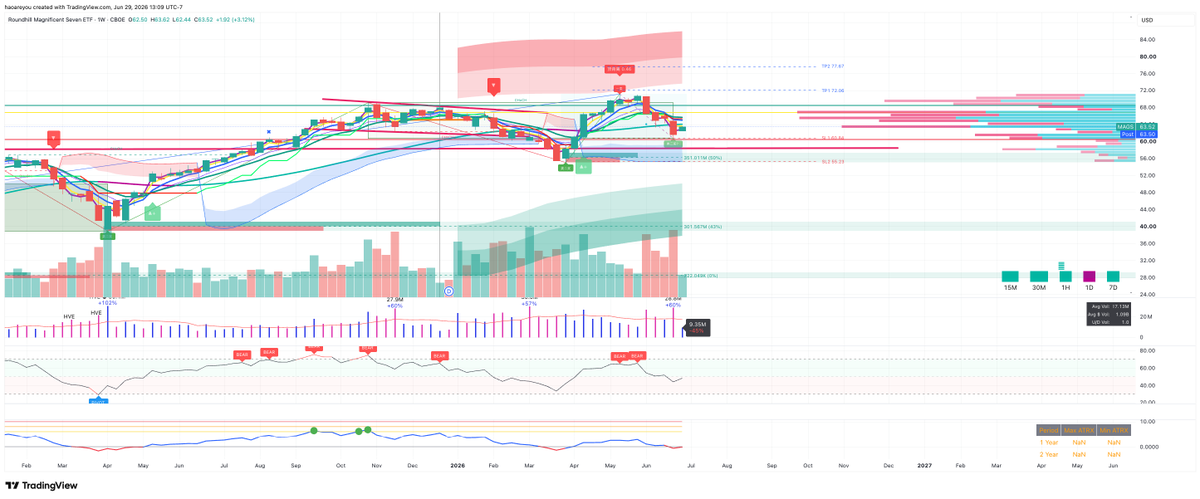
if you look at the weekly chart, you would notice that $MAGS had a top bearish divergence in the 2nd week of May then with a 15% selloff.
This is a typical case of "price moves before the news". Market has been worrying about MAG7's compressed margin and nagtive FCF due to rising memory and semi price for a long time already.
But when you read lots of these negative narrative on X or other media, it often times means the bottom is near and that's the last FUD in the near term to shake out the retail investors.
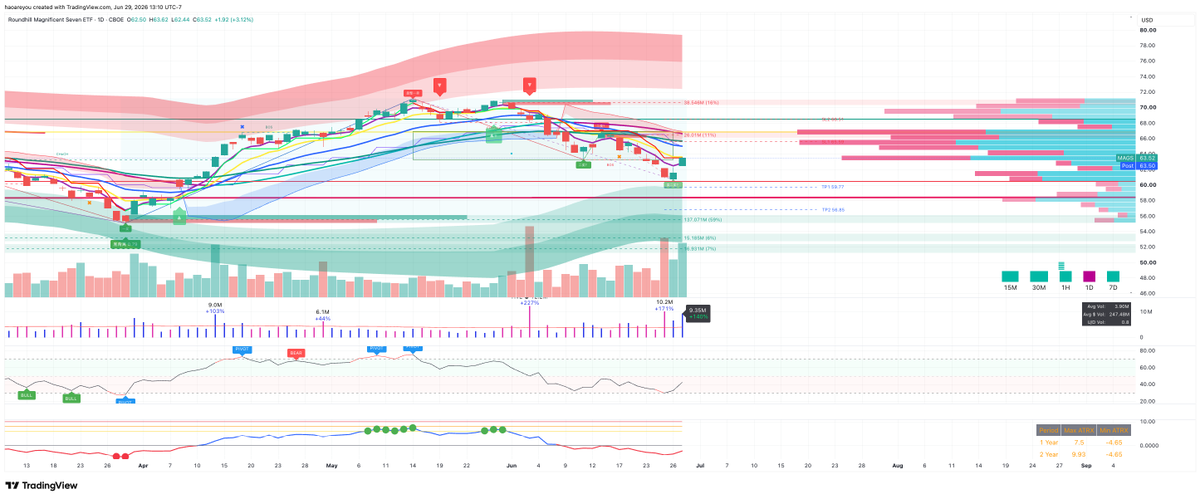
$MAGS had a capitulation candle on last Thursday and stopped at $59-$60 area then rebounce from there.
Don't let the FUD or FOMO information affect you, focus on the chart as these information is very likely to be priced in already.
Room is printing money
If you haven't registered and want access to VOLBOT 2.5 you can register for a FREE month HERE:
https://t.co/3IGsMCvccG
using the code: greenisgood
We are also live trading for minimum 1H+ a day.
Room confirm pls.
Bought the low on NQ today 😇
Andrej Karpathy spent 4 minutes in an interview explaining a single idea
about how most people haven’t even started learning how to use AI
and everyone paying $20/month for a subscription.. that's not really using Claude at all
his point is that the real skill gap is the ability to build with AI
he identified 4 behaviors that break Claude Code and put them all into one file
a developer expanded it into 21 rules and published it - 82,000 stars and #1 on GitHub Trending
coding accuracy jumped from 65% to 94%
here's what these 21 rules actually are and why most developers using Claude every day have never configured them
the full breakdown is covered in the article below 👇
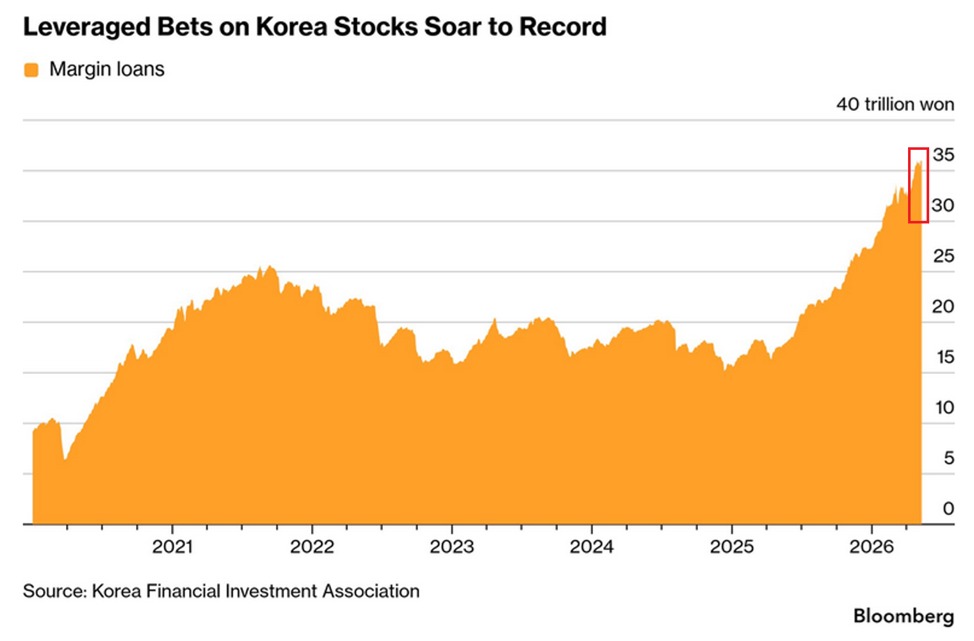
Risk appetite in South Korea is exploding:
Margin loans outstanding on Korean stocks are up to a record $24.3 billion.
Since the start of 2025, margin debt has surged +140% and is up +32% since the beginning of this year alone.
To put this into perspective, the value of leveraged bets on Korean stocks was ~$5.0 billion in 2020.
This also likely understates the real scale, given that many loans taken out to buy stocks are labeled under other categories.
Meanwhile, domestic investors have poured ~$25.3 billion into South Korean shares year-to-date.
Retail investors in South Korea are aggressively rushing into stocks.
Welcome to the most asymmetric trade in modern financial history.
The thread below lays out why. The opportunity exists because capital has chased the AI trade while ignoring the physical assets AI requires to run — assets that have quietly become the best-performing asset class of the decade. Since October 2020 when we first called for the commodity super cycle: QCI Total Return +217%, GSCI Total Return +205%, Gold +140%. NASDAQ trails at +130%. S&P 500 at +85%. The top three are all commodities. Yet oil cannot get out of its own way while copper and the broader atom complex prints fresh highs . That is the dislocation. That is the trade.
Get long. Buckle in. Hang on for the ride.
Forgive the longer posts in this thread — attempting to mimic my old 10-bullet commodity takes. On to it.
Last week, the United States refused to participate in the UN’s review of the Global Compact on Migration.
The United States objects to the Global Compact on Migration and UN efforts to facilitate replacement migration to the United States and our Western allies.
🚨BREAKING: Brown University student Alex Shieh previously EVISCERATED the school's administrators for having a $46 million deficit, despite surging costs for students.
They pay $90K+ PER YEAR.
Alex Shieh: "What about the kids who weren't born on third base?! [...] Brown is on track to run a $46 million DEFICIT this year. WHERE is all the money going?"
"I'll tell you where it's going. It's going into an empire of administrative bloat and bureaucracy! Brown employs 3,805 full time non-instructional staff for just 7,229 undergrads. That's one administrator for every two students."
"This isn't education. This is bloat paid for on the backs of students and families who are mortgaging their futures for a shot at a better life!"
Do you firmly support Alex Shieh on this?
A. Huge Yes
B. No
IF Yes, Give me a THUMBS-UP👍!!
MAKE THIS GO VIRAL ON 𝕏. LET’S GO 👏
The reason Costco spots recessions before economists is buried in who shops there.
The median Costco household earns above $125K. The US median is around $80K. The typical member is college-educated, owns a home, and has stock-based comp or 401(k) exposure that moves with the market. When THIS household trades beef for canned tuna, the upper-middle class is admitting their balance sheet just changed. These are the families whose discretionary spending IS the economy.
That signal is invisible to economists for structural reasons. BLS releases CPI on a 2-week lag. Jobs data hits the third Friday of the next month. PCE, the Fed's preferred inflation gauge, runs monthly. NBER does not formally declare a recession until 6 to 21 months after it started. The 2008 recession was officially dated in December 2008. It began in December 2007. The committee was a full year behind the actual economy.
A Costco category buyer sees the protein mix shift in POS data within 48 hours.
The protein hierarchy itself is a precise instrument. Beef costs the most per gram, has the shortest shelf life, and demands the most planning. Chicken is half the price, longer shelf life, more flexible. Canned tuna is one-tenth the cost, indefinite shelf life, zero prep. When a household walks down that ladder, they are pricing in a future income shock that has not yet shown up on a pay stub. The ribeye-to-tuna shift is a hedge against bad news the official data will confirm six months later.
Walmart sees the bottom 40% trade down first. Costco sees the next 40% trade down second. By the time Whole Foods sees it, NBER is two quarters away from making the recession official.
Costco hits the signal first because their members are the most exposed to wealth effects in the entire economy. Stock-based comp. Home equity sentiment. Executive bonus uncertainty. When the comp letter feels shaky, the chicken goes in the cart instead of the ribeye.
Galanti spent 40 years as CFO running the highest-resolution recession sensor in America. The Fed runs models. Costco runs registers.
🚨Inside Communist-Controlled Cuba:
As Cuba faces its largest humanitarian crisis in years amid growing tensions with the US, I went to see what 60+ years of communism has done to a country.
Within 24 hours I was planning my escape out of the country after being followed by their intelligence agents, and a 2 star general waited to interrogate me outside my hotel room at 4 AM. Right now Cuba has no oil or gas, 7/10 people are going hungry, there is no medicine and some haven't even had eggs in a year.
In communism there is no freedom of speech or press, and I was almost taken hostage for asking about communism. This is a look into Cuba like never before, no one truly knows how bad it is until now.
Like and share this video like wildfire!
The South Korean government is launching a growth fund where they cover up to 20% of potential losses to protect investors.
• Government absorbs up to 20% of losses.
• Up to 40% deduction and a low 9% tax on dividends.
• Available from May 22 to June 11, 2026.
what the actual fuck
So Lina Khan blocked the merger with Jet Blue because she said the loss of an airline would hurt consumers.
The end result: not only the loss of an airline but mass unemployment.
A socialism story.