Thanks to the inherent "BANIYA" inside me, I always question a lot when I look to buy obscene valuations.
Be a Baniya and always find what value you are getting for the price you pay!!
#investing#StockMarket
This was one of the best results season in last couple of Quarters.
We sat down and filtered the results of 100 Fast growing companies (there were many more) & compiled them in a PDF for you.
This PDF made using @stockscans. This covers
1. 100 Fastest growing businesses from different sectors.
2. Key Growth Triggers
3. Guidance given by them
Here is the link to get the access below 👇
https://t.co/MGYkeTxztz
Q1FY27 have been showing very decent results till now with median PAT growth at 27.3% and median revenue growth at 18.6%
Here are some of the Q1 results that we found interesting👇
What Jyothy Labs, Page Industries and Varun Beverages tell us about the moats we don't actually own?
On 9 May 2026, the board of Jyothy Labs met and concluded there was no further reasonable certainty that Henkel would renew the Pril and Fa brand licences beyond 31 May.
On 21 May 2026, Varun Beverages signed a revised exclusive bottling and trademark licence with PepsiCo, pushing the term from April 2039 out to April 2049 and deleting the clause that had confined VBL to acting as a special purpose vehicle for PepsiCo's business
Twelve days. Same market. Same underlying legal structure a foreign brand owner, an Indian operating partner, a fixed-term licence with defined exit provisions.
This tells one thing about the risk that one should continously think through while reading this businesses?
Will the outcome be something like what happened with Jyothy Labs or VBL. Let's understand this case studies and then the framework to think around such businesses..
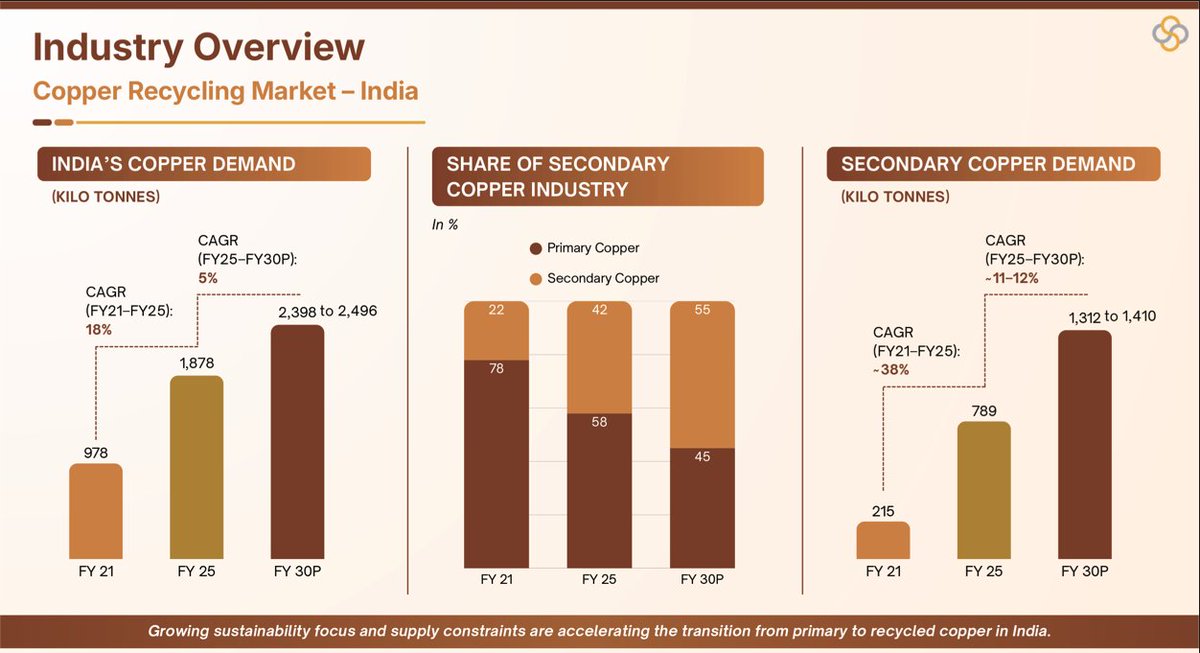
Demand for secondary copper has been growing at a faster pace, with expectations that the share of secondary copper will reach close to 55% by FY30.
Across the metal recycling space, interest in entering the copper recycling business has been on the rise, with players like Gravita and Pondy whose dominant share of revenue comes from lead recycling are looking to diversify their revenue streams into this part of the recycling business.
Copper is the pulse of the new-age infra capex boom and secondary copper has to ramp up to support this capex boom.
Disclaimer - not a recommendation to buy or sell
Snippet from Bhagyanagar investor presentation (Q1Fy27)
We initiated Sansera for our subscribers around 16th December 2025.
But the more important thing is how we filtered on this idea.
> First key factor we observed was the product mix change, where the company's intent was to gradually move from its ICE component business to Aero/Defence/Semicon (ADS) business.
> This product mix shift was visible from the fact that margins had been improving over the last 2 quarters, and growth was starting to pick up. That's how it came under our filters.
> Going a little deeper, we understood that the kind of things it was doing in the ADS business were quite moated. It had a single-source monopoly on Airbus A350/A320 thrust-reversal gimbals with zero defects over 12 years; hogging (machining from solid billet vs. forging) is a much harder-to-replicate capability for aerospace tolerances.
> Also, in its semiconductor business, it was working with Lam Research, where this year their business is expected to go from $10M to $30M .
> Also, as per our channel checks, they had orders/interest from Rolls-Royce for aero-engine feelers, the MMRFIC JV (navy fuses, radars), and a Tesla ESS order.
> All these things were a confirmation of our thesis that management has the capabilities, and that the product mix is changing for good.
> They have also given strong guidance of ₹8,000 Cr in revenue, with ADS at 20–25% of overall business and blended EBITDA margins moving above the 20% mark.
On top of this, we also visited their facility, where we got to understand the manufacturing complexity involved in the components they make for their ADS business, and their capabilities in precision engineering.
The framework was simple: through scanning, found a business where earnings were breaking out and margins were improving > went through their earnings calls and found the story of the product mix change > mapped out the value chain and tried to understand Sansera's moat in the new business they were focusing on > visited their facility to verify our thesis on the company.
Disclaimer: This is not a recommendation to buy or sell. We continue to hold it in our recommendation portfolio and may change our view at any point in time.
There's a severe localisation gap across parts of the EV value chain
We unpacked this in detail, along with the opportunities it opens up, in one of our latest detailed webinars on EV value chain
An elevator pitch on how the industrial gases industry works!
You separate air into gases, or you buy rare gases and repackage them. You sell either from a plant you own (merchant) or from a plant you build inside a customer's factory (on-site).
On-site is a 15-20 year annuity at thin margins. A merchant is a spot market where the same molecule earns very different money depending on the gas, the distance, and who else is selling nearby.
The whole game is capital, location, and the ability to squeeze extra high-margin gas (argon, liquid) out of a plant you've already built.
But let’s get into interesting details about that -
What does the industry actually sell?
Strip away the chemistry and this is an air-separation business. A cryogenic plant is an Air Separation Unit, or ASU that chills atmospheric air until its components liquefy at their different boiling points, and pipes off oxygen, nitrogen and argon at high purity. Everyone in the industry runs broadly the same technology, so purity differences are marginal (roughly plus-or-minus 5%). The molecule is a commodity. Almost everything interesting happens around the molecule in how it's contracted, delivered, and priced.
The demand base has historically been the heavy stuff: steel and metals, autos, pharma, healthcare, and a thin slice of chemicals and F&B. What's changing the growth story is the sunrise demand from solar and semiconductors, which pull large volumes of nitrogen and, in semis, demand purity that cheaper suppliers struggle to hit. That single shift is why every player in the country is pouring capital into new capacity at the same time.
The top four global MNCs Linde, INOX Air Products, Air Water India and Air Liquide India control roughly 80% of the market.
Below them sit regional, owner-driven players (Ellenbarrie, Vayu, Shree Ram Oxygas and similar) who have been around 10–15 years and whose space widened after COVID, when oxygen subsidies pulled local capital in.
Now let’s understand the 2 engines in this industry separately > on-site vs merchant
Everything downstream flows from one fork in the road: do you build the plant inside the customer's factory, or near a cluster of customers and truck the gas out? These are two genuinely different businesses with different economics, different customers, and different personalities.
> On-site - An anchor customer, usually a large steel plant, issues an RFQ saying, in effect, we need ~1,100–1,800 tonnes of gas a day flowing into our furnace. A supplier builds and operates an ASU on their premises under a Build-Own-Operate (BOO) contract running 15–20 years. The revenue is fixed and stable, so it's underwritten on a modest return — players will accept an operating margin of roughly 10–12%, sometimes pricing the whole thing to a ~10–15% IRR. It is deliberately boring money.
Why fight so hard for boring money? Because it's stable, long-dated and defensive with a 15–20 year foothold that also keeps a rival out of that customer. Contracts signed before roughly 2016–18 carried fatter margins and some still run (a few end around 2035), but the new-build market is now openly competitive on price.
> Merchant business - Here you own the plant, liquefy the output, and sell it as liquid, bulk or cylinders to whoever's within reach. Margins are structurally better but volatile: liquid/bulk runs a ~20–25% bottom line, while cylinder and specialty can reach ~40%. The catch is geography. Oxygen and nitrogen are cheap and heavy, so you can't economically truck them much beyond ~200–300 km before distribution cost (typically 10–12% of revenue) eats you alive. You plant an ASU, draw a 200–300 km radius, and fight for that circle.
The reason branded MNCs earn ~40–45% at the top while a strong regional player earns ~35% isn't a secret formula rather it's scale and mix. A Linde or INOX moves 4,000–5,000 TPD daily; a regional player moves 250–300 TPD. At a small scale, tender-driven medical demand keeps margins decent. But to scale from 300 TPD to 3,000–4,000 TPD you must chase the lower-margin sectors that make up the bulk of the market and that's exactly where pricing and margin pressure begin.
The value chain, end to end
Follow a molecule of oxygen from the atmosphere to the customer and you can see where value is captured and where it leaks.
Stage 1 - Build the plant (the capital gate)
This is a capital-intensive, power-intensive industry, and the entry cost is the first moat. A modest 200–250 TPD on-site plant needs at least INR 300–400 crore of initial capex. Core components are compressors, cold boxes that have to be imported; India makes none of them. Only fabrication and storage tanks (INOX, Cryolor, VRV) are domestic. Build time runs 16–24 months per ASU
Stage 2 - Choose your engineering partner (the quiet moat)
Who actually builds the plant is becoming the real differentiator. The MNCs carry in-house EPC muscle - Linde has Linde Engineering, INOX leans on Air Products' US technology which lets them build large, reliable ASUs and win the technically demanding jobs.
Regional players without that engineering wing increasingly tie up with Chinese OEMs on a sale-of-equipment basis: the Chinese firm builds and exits, and the local player does the O&M. It's cheaper (a 200 TPD plant runs ~INR 100–120 crore via a Chinese vendor vs ~INR 150–200 crore via an MNC), but blue-chip steelmakers (Tata, JSW, SAIL, AM/NS) often won't allow a Chinese machine where they're underwriting 15–20 years of reliability, power efficiency and capital backup, and they pay up for it.
The cost-vs-capability gap
> MNC plant, 200 TPD: ~INR 150–200 crore — technology, reliability, blue-chip acceptance.
> Chinese plant, 200 TPD: ~INR 100–120 crore — cost-optimised, favoured by smaller / secondary steel and rolling mills.
> No Indian regulation restricts Chinese ASUs, so the split is driven purely by which customer is buying.
Stage 3 - Extract the by-products (where margin hides)
A basic ASU makes oxygen and nitrogen. To pull argon you must bolt on a separate argon-recovery column and here's the quirk: that column costs roughly the same whether the plant is small or large, but a small 200 TPD ASU yields only ~5–6 TPD of argon while a big ASU yields 50–60 TPD. The capital-to-recovery maths favours scale heavily, yet argon's economics are so attractive that even smaller players are now installing the column anyway.
Stage 4 - Distribute (the tyranny of distance)
Oxygen and nitrogen are regional products which are heavy, cheap, and uneconomic beyond ~300 km. Argon is a national product valuable enough to ship across the country, though distribution then runs ~17–18% of revenue rather than 10–12%. This distinction quietly shapes the entire competitive map: oxygen/nitrogen competition is local and radius-bound, while argon competition is national and cyclical.
How to judge any player in this industry?
Pulling the mechanics together, a handful of questions separate a structurally strong operator from a fragile one regardless of the name on the door.
> Capacity trajectory: Can they actually double liquid capacity? You can't sell a molecule if you can't make expansion of 200 TPD takes 1.5 - 2 years, not six months.
> Mix quality: How much on-site annuity vs volatile merchant? How much argon and by-product upside are they extracting per plant?
> Engineering independence: In-house EPC, or dependent on Chinese OEMs who build and exit? This gates which customers they can win.
> Geographic competition: Are their plants in pockets with few rivals inside the 300 km radius, or in contested western/central India?
> Blue-chip acceptance: Can they clear the reliability/purity bar for Tata, JSW, AM/NS, and semiconductors or are they confined to secondary, cost-driven demand?
> Cycle timing: Are they adding capacity into the current glut, and can their balance sheet and geography absorb 2–3 years of merchant price erosion before demand catches up?
Dislaimer - not a recommendation to buy/sell
For decades India Defence story have been a manufacturing story where licence production, import substitution, domestic assembly have been the primary talk of the town
But now the talks are incrementally moving towards new chapter i.e. who owns the IP and not just the factory.
This changes the economics you work upon where manufacturer competes on cost and capacity whereas for IP owner has to compete on R&D depth and gets paid for something that no one else can replicate easily.
New TAMs that are opening up across this theme in India are :-
Modern conflict is increasingly a contest of sensor-to-shooter loop speed and how fast you can detect, decide, and neutralize. Drones, AI-enabled autonomy, and electronic warfare compress that loop. Legacy platforms don't.
This is creating genuinely new addressable markets rather than just growing old ones:
> Tactical drones: procurement moving from ~INR30-35bn in the last cycle to INR120-140bn now
> Strategic drones: a separate ~INR300bn opportunity emerging alongside
> Counter-drone / anti-drone systems: multiple speakers independently flagged this as potentially as large as or larger than the offensive drone market itself
> Directed energy (high-power lasers, EMP): still nascent, but multiple players are already fielding real contracts (₹2bn-scale laser air-defense deals)
Nobody disputes that electronics is the value core of modern defense - C4ISR, software-defined radios, missile electronics, command-and-control. What's new is where the frontier of electronics is moving:
> AI-enabled mission software and autonomous decision systems
> Quantum computing - described as a national-level opportunity that could exceed 10bn in ecosystem investment
> Cybersecurity as its own dedicated vertical, not a bolt-on
> Space electronics as a genuinely new business line, not an adjacency
Semiconductors remain the biggest import dependency, accounting for the overwhelming majority of imported content even in otherwise highly indigenized electronics products.
Also now shipbuilding story is moving from defence to commercial shipbuilding. India pays ~US$85-100bn annually in freight costs, and roughly 85% of that goes to foreign shipping companies. Logistics costs sit at 13-14% of GDP. That's the actual policy driver and not military ambition, but plugging a massive structural outflow.
India wants to build the industrial base that captures value across the entire maritime chain >>> shipping, shipbuilding, finance, arbitration and not just build hulls.
And then there is this space economy that is emerging currently in India. India's space sector opened to private participation in 2020, the number of private space companies has gone from ~7 to over 300.
The military angle compounds it where the government's plan is for 51 military satellites represents less than 20% of India's estimated long-term requirement. Satellite constellations need a minimum of ~7 satellites for continuous coverage
On the commercial launch side, the economics are the story and reusability is the thing to watch. Current break-even launch costs sit around US$10,000/kg; recovery-enabled reusable systems are targeting below US$4,000/kg. That's the same cost curve logic that made reusability transformative in global launch markets, now playing out domestically, with genuinely indigenous technology (single-piece 3D-printed engines manufactured in one print cycle, for instance) rather than licensed tech.
Space is also quietly merging into defense electronics companies building satellite/space-grade electronics are the same companies building EW and radar systems. It's becoming one continuous capability stack rather than two separate industries.
Here's a detailed deep dive on Shilpa Medicare, which we covered for our subscribers under SOIC Research a while back.
Every Sunday, we discuss one business like this from our watchlist both Indian and global.
Here is the link: https://t.co/IH9NedgP8o
Disclaimer - Nothing is a buy or sell recommendation and this is only for educational purposes
Today we are going to discuss a very unique 2W OEM that has been able to built a product that is built to last in 10+ years. For context - They had no legacy nothing and have built the business ground up from nothing (product first distribution later)
Ather invested in the things that compound and are hard to copy i.e. design IP, software, brand, charging network and rented the things that don't (cell manufacturing). That is why it spends less than Ola yet has better unit economics, and why the moat is earned rather than bought.
And this is the fruits of investing in building technology and a superior product for years before just thinking about scaling distribution. At the end of the day we can see the result that the product won that did not catch fire :)
But here today we will get into details of how they created this MOAT and how it is now able to win a superior market share and show such a strong growth at the same time when competition did not decrease in fact it has gone up!
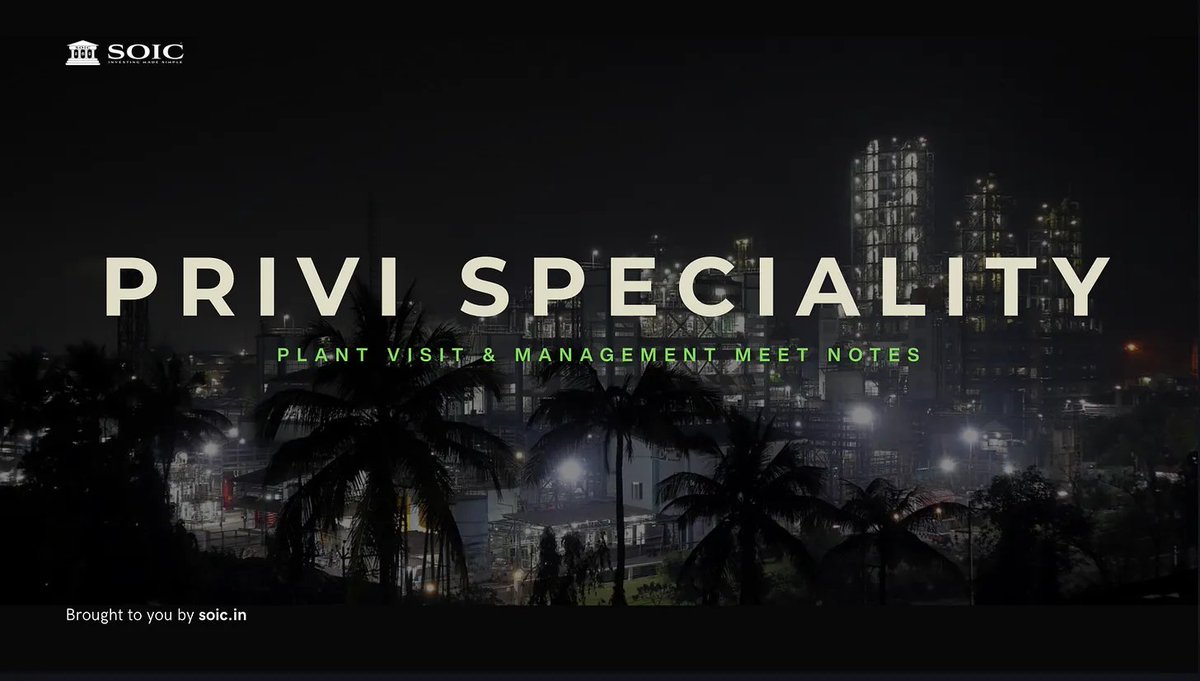
We recently visited Privi Speciality's manufacturing facility in Mahad
All the insights from that visit is compiled in this blog
Link - https://t.co/OqMjSYcZA7
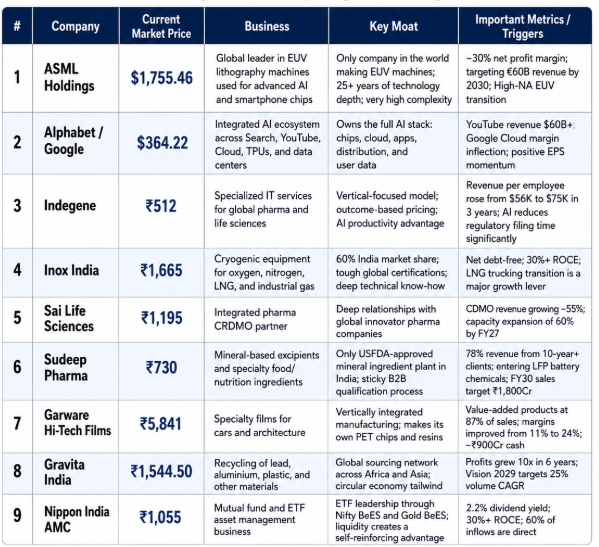
In recent times, I have added some great businesses to my watchlist through @soicfinance channel as part of their recent initiative. Thanks to @ishmohit1 for your wonderful in-depth details. Here is a glimpse of it - worth watching the actual videos - https://t.co/lcNvCgqmr9