I've got an agent in a loop optimizing a renderer with the goal to minimize frame times (and tests to measure). It got times down from 88ms to 2ms and allocations down from ~150K to 500. Sounds good, right? Wrong. This is exactly why agent psychosis is a big fucking problem.
As an experiment, I rewrote the Ghostty core render state in Go, with access to identically laid out data structures as Ghostty and the exact same validation tests. I made a purposely naive renderer (simple, correct, but slow). 88ms per frame with 150,000 allocations (horrendous, lol)!
I then kickstarted a Ralph loop to bring the frame times down. I told it it can't modify input data structures or the public API or tests (they're correct), but it can do anything else it wants. It got to work.
It has worked for about 4 hours. I've spent around $350 on this experiment so far. The results?
88ms => 1.5ms
150K allocs => ~500 allocs
Incredible right? Nope.
My hand-written renderer I ported has frame times (same benchmark) of ~20us (0.020ms) and 0 allocations in the update path.
This is the problem with psychosis and lacking systems understanding. If you don't understand the system, you're going to accept that this is an incredible result. If you understand the system, you'll see better solutions immediately and can do roughly 75x better on throughput.
The people who blindly trust agent output are in the former camp. They're sheeple, overdrinking from a fountain of mediocrity.
Standard disclaimer: I use AI all the time. I like AI. The point I'm making is to not blindly accept results. Think. Analyze. Learn.
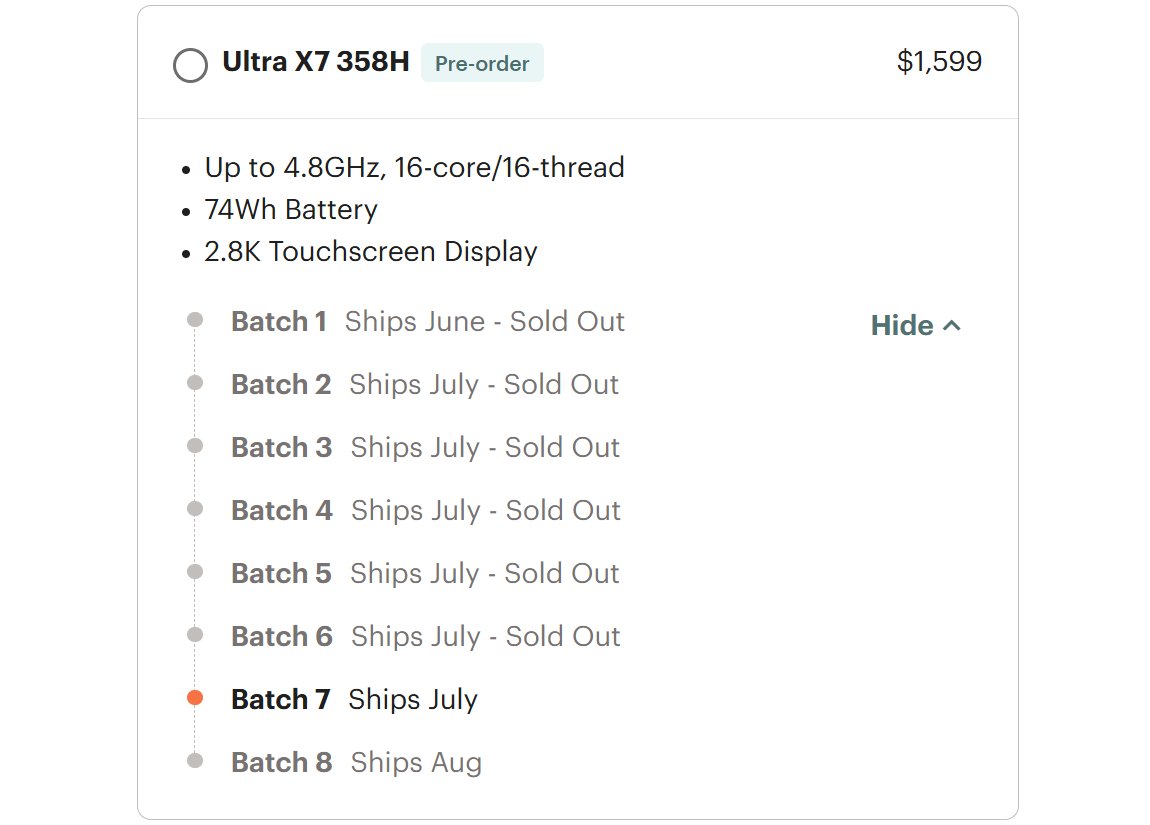
Framework Laptop 13 Pro is selling far above our forecast, and we've sold out of the first six batches already. Also nice validation of our approach, the Ubuntu configurations are outselling the Windows ones!
Three minutes of me driving around the GTs, passing P2s, spinning @George_Kurtz, and going three wide at ~300 km/h in turn 1 at the Daytona Rolex 24 with the Shopify #11 LMP2. Pure flow at the edge of adhesion!
We are a Small Research Lab based out of india
and we just dropped a one of a kind SoTA multimodal multilingual document retrieval model.
can embed and query documents across 22 langauges :
English, Spanish, French, German, Italian, Hindi, Marathi, Sanskrit, Kannada, Telugu, Tamil, Malayalam, Chinese, Japanese, Korean, Arabic, Bengali, Gujarati, Odia, Punjabi, Russian, and Thai.
It achieves state of the art performance across cross lingual and cross modal tasks.
You can now query a corpus of Japanese documents in Hindi or any of the other language.
check it out 👇
that feeling of dread and despair when the AI is clearly unable to grasp what you're asking, and you realize you'll need to code manually as did the old Mayans
I interned at an IIT and built the entire codebase for a research project. Just saw the paper published in a journal, with zero mention of me as an author or contributor.
I did the work. They took the credit. This is beyond unfair.
:D
We just saw an AI design a millimeter-wave power amplifier from scratch.
Not optimize it—design it.
→ It chose the architecture.
→ Sized the transistors.
→ Generated the matching networks.
The result?
A working PA that looks nothing like human design.
The matching networks resemble QR codes more than spirals.
This was presented at ISSCC 2025 by Princeton
→ Ten days of training on 400 CPU cores.
→ Minutes to get a ready-to-fab circuit.
The hardware design paradigm is slowly evolving:
→ From design tools to design agents.
→ From writing netlists to giving design intent.
→ From tuning circuits to describing goals.
This is what “vibe design” could look like in hardware.
A new workflow where the engineer sets the direction.
And the machine does the rest.