Physics teacher who is forever a student at heart. I use ISLE cycles to teach and learn. You can learn about ISLE (developed by Etkina) in the website below.
Use this link if you need a regular YouTube Format instead of the "YouTube Shorts" format.
https://t.co/c9XmN5PgB7
Note: I just replaced "/shorts/" in the url with "/watch?v="
This video from @gfletchy makes me realize that I never REALLY understood division as a kid. I was just a good robot.
https://t.co/ioiMNupYYR #iteachmath
@MsMagaryPhysics I also do motion diagrams with relative vectors combined with RH rule for determining the frame of reference. Then have students just remind themselves that the torques are only causing changes to rotational velocity so they can visualize diff quantities
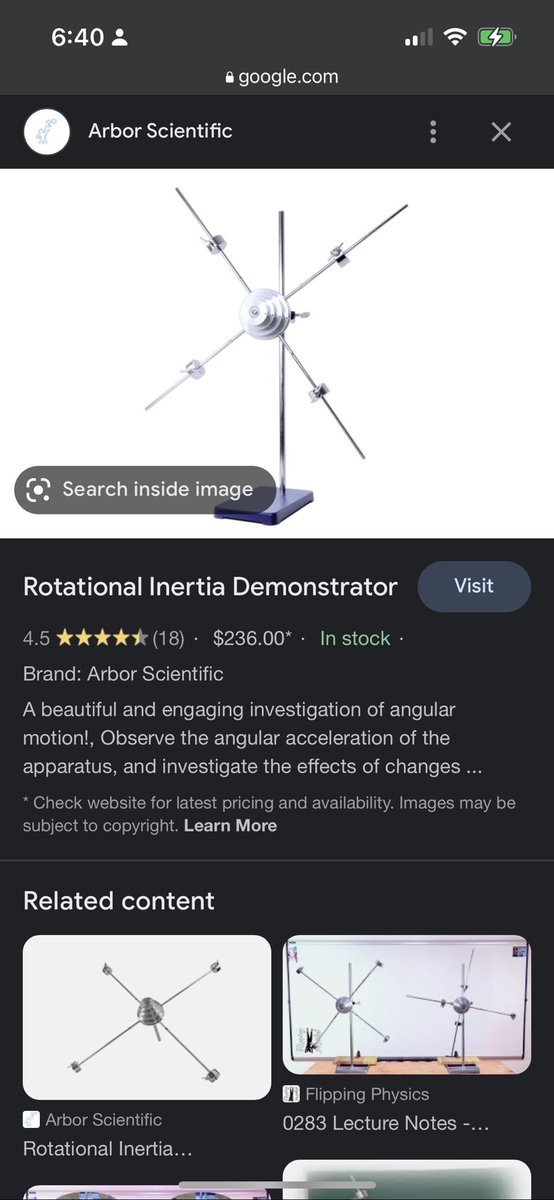
@MsMagaryPhysics Low friction fly wheels (or just building a high moment of inertia rotating platform with well oiled ball bearings). I think pasco sells a moment of inertia demo that does this. Make sure to have the wheel spinning with initial rotational v before having them exert torques.
@MsMagaryPhysics I use this but the main tricks I noticed was letting the kids observe negligible frictional effects by having large enough of a moment of inertia and making sure the velocity is not zero when I ask them to make observations. Hope this might help.
🚨New Lenz's Law demo🚨 Cheap, simple demo using toy rattle magnets and aluminium blocks from the density practical #repurposedphysics
https://t.co/UschnBI3DL
I decided to take Joe Cossette’s idea for directing the Van de Graaff discharge using graphite on paper, but I added an LED light bulb. Hard to hold that bulb still when you are getting shocked, but it looks cool.
The hoop doesn’t gain as much rotational kinetic energy as the disk, but it has more translational kinetic energy. It’s interesting to see both moving right but rotating counterclockwise.
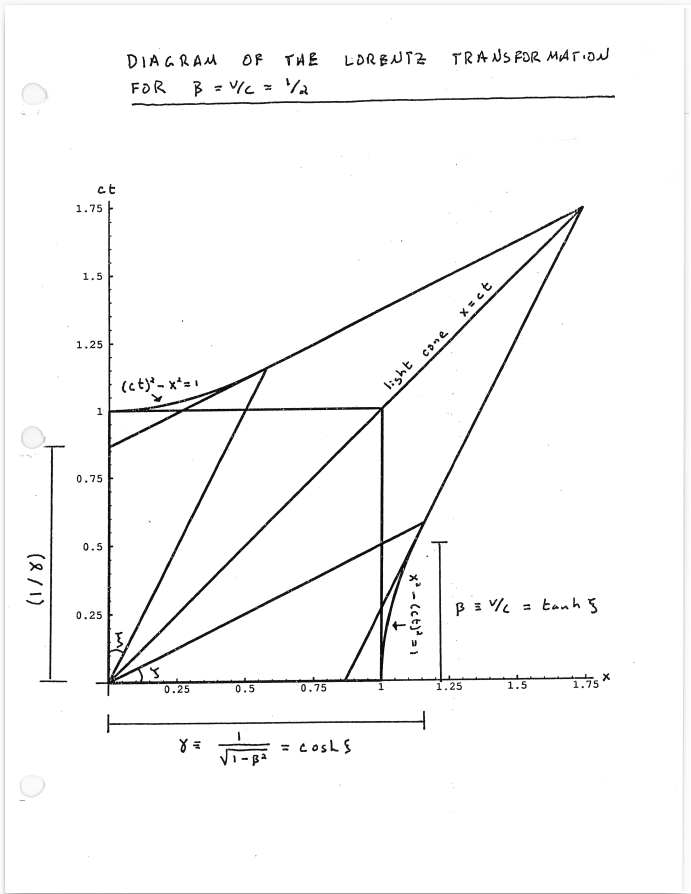
Talking to @SeamusBlackley about "aha" moments when studying relativity. Here's one such, when I was a grad student and I suddenly completely comprehended how Special Relativity is a geometric theory, and all those problems with rods and clocks and barn doors opening and closing were just trigonometry problems, and I drew this diagram as a key.
Did my first “fake paper as investigation prompt” lab today! Students have to design their own experiment to support or refute the paper. Here’s the prompt I used, modified from @eeps’s original. You can get this fake paper and more here: https://t.co/pb1yqP8k25 #iteachphysics
@fnoschese@Phet Wow, this is the best collection of physics teacher twitters who all love experiments. Thank you everyone here who uses their Twitter to share awesome things you all do to help our kids. (Also, RIP diffraction, still a winner in my heart for helping me make sense of quantum mech)
Here's a bracket I think the #iteachphysics community can get behind: @Phet Sim Showdown! Which is your favorite simulation? Round 1 polls are below! I'll do each round in separate thread for convenience. And I'll use #PhETSimShowdown so can find (or mute) as needed.
HUGE NEW SIM ALERT!
We just published our #HTML5 version of Vector Addition that has been completely redesigned with numerous new features, including exploring vector equations!
#Physics teachers commence rejoicing 🎉🎉🎉
#iteachphysics#edtech#STEM
https://t.co/kj01D9tdUu