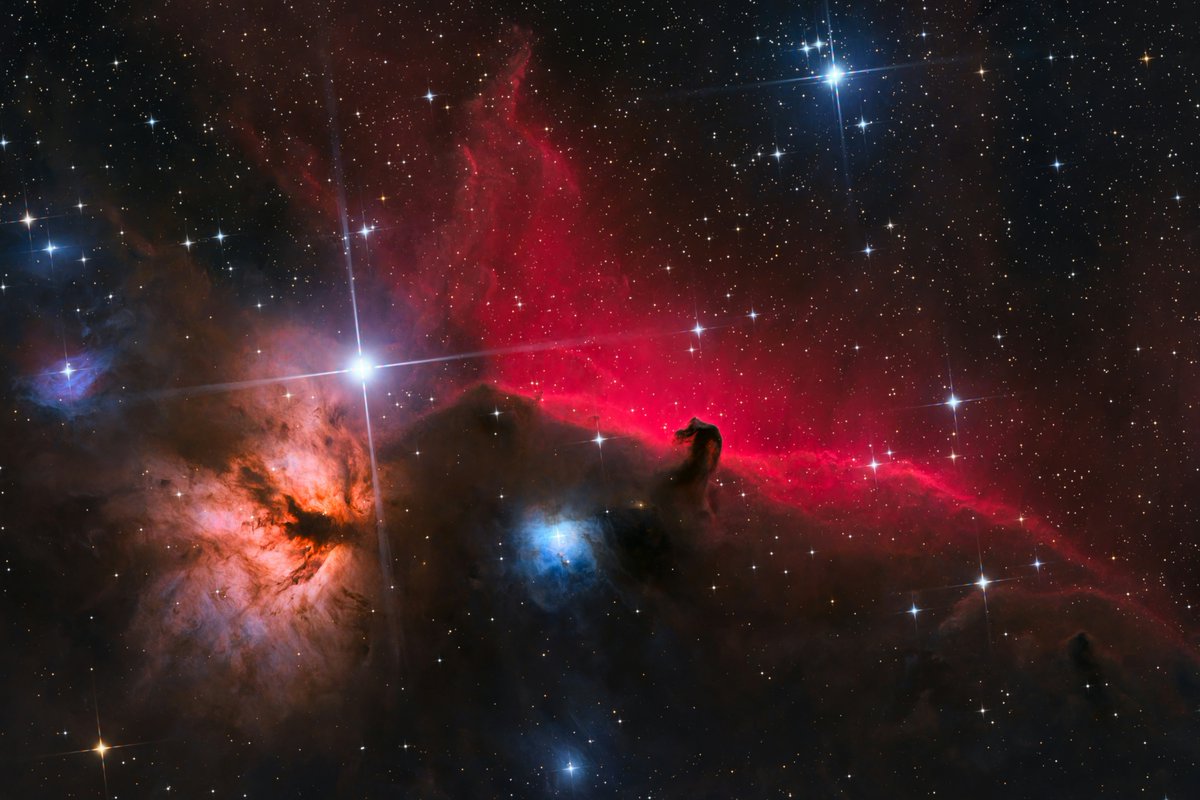
Barnard 59, op 600 tot 700 lichtjaar in de Slangendrager. Deze wolk zit zo vol stof dat hij het licht van de sterren erachter tegenhoudt. E.E. Barnard catalogiseerde 370 donkere nevels.
📸 ESO
#Astrofotografie#Sterrenkunde
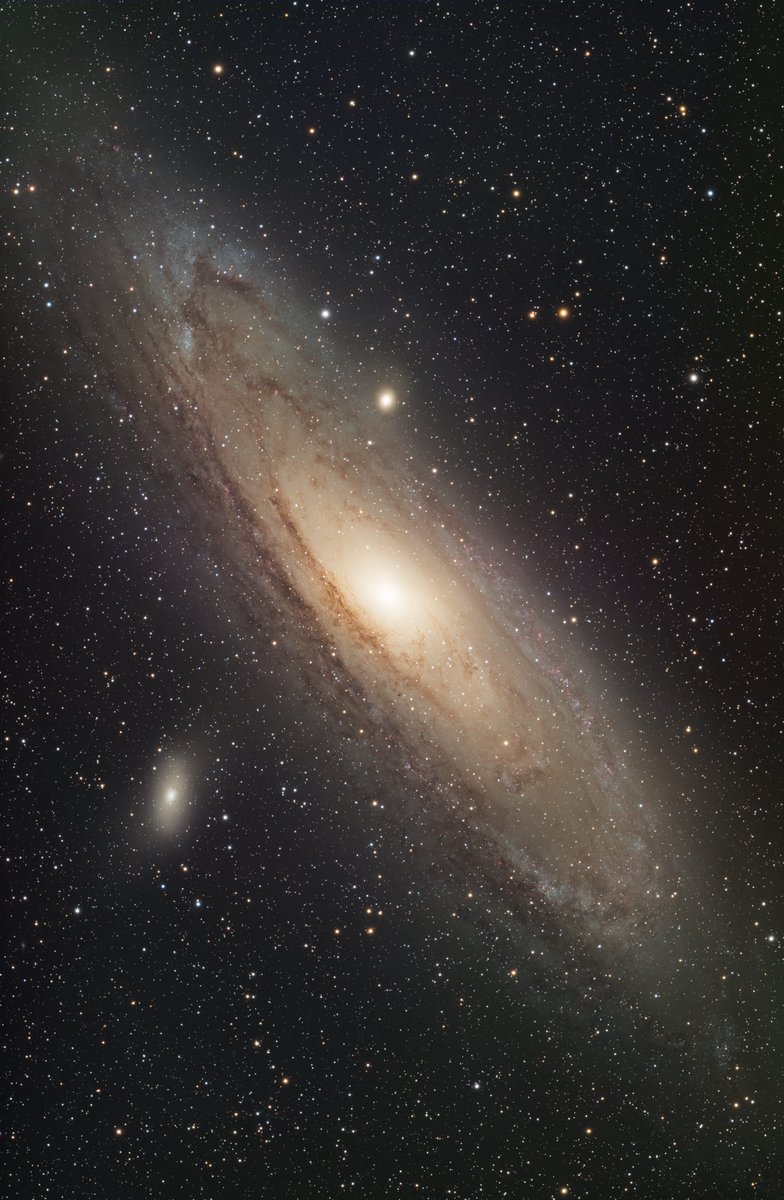
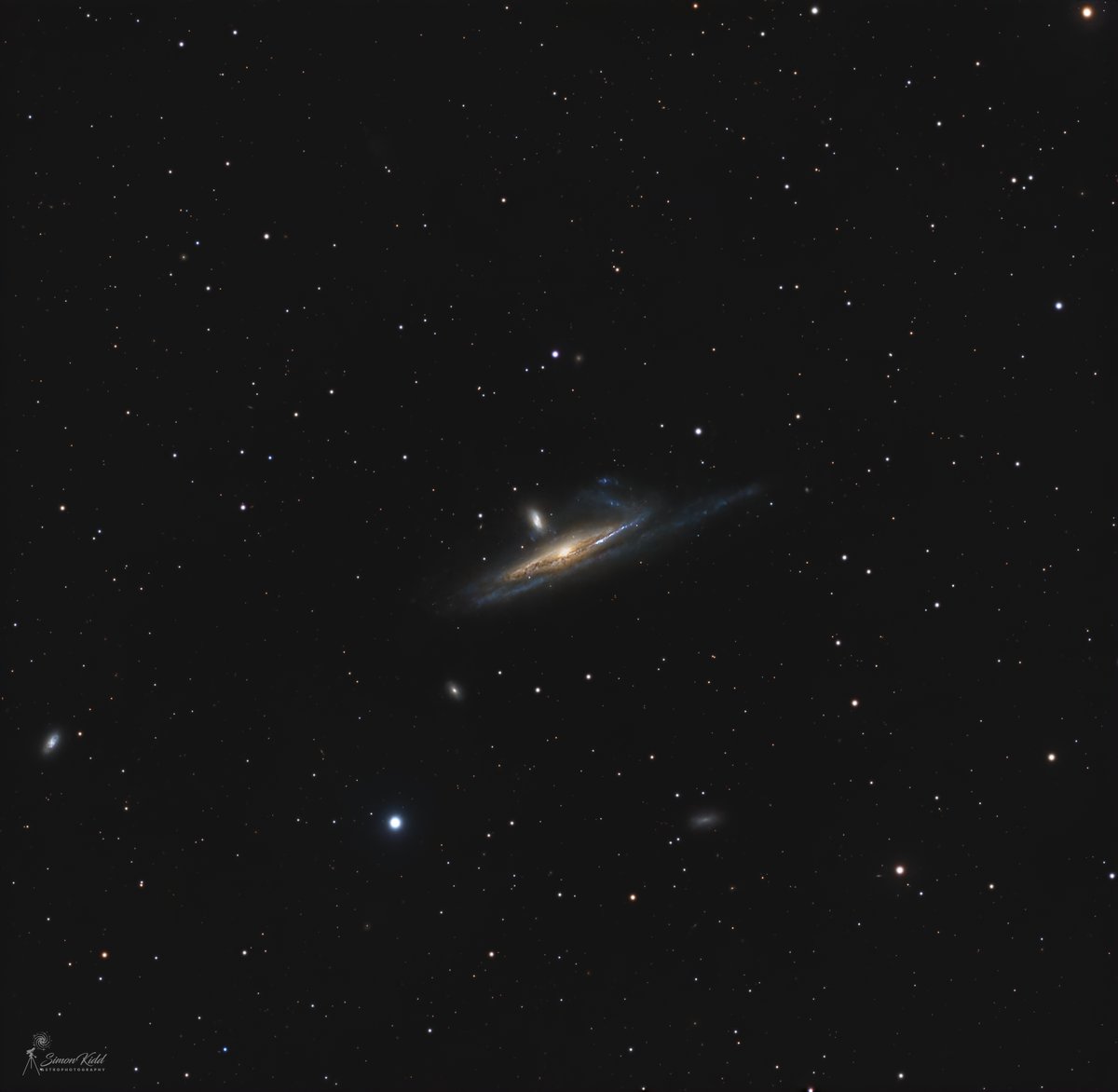
NGC 1532 aka Haley's Coronet is an edge on spiral galaxy ~58 million light years away in the constellation Eridanus. Smaller dwarf galaxy NGC 1531 can be seen interacting with NGC 1532 in this image taken from my backyard
#astro#astrophotographer#astrophotography#astronomy
🐠🔭👀 Follow the W of Cassiopeia eastward on an October night, toward the quiet border with Camelopardalis, and you reach a stretch of Milky Way that looks empty to the eye yet slowly turns deep red on any camera willing to wait. A fish seems to swim there, mouth open, a dark lane of dust tucked under its jaw. IC 1795, the Fishhead Nebula, its brightest knot catalogued as NGC 896.#nebulae
🔥 Inside the fish
The light comes from BD+61 411, a blue O-type star close to 40,000 °C, whose ultraviolet strips hydrogen bare until the atoms recapture their electrons and glow in Hα red. Around it lives a cluster only 3 to 5 million years old, many of its stars still wrapped in dusty disks where planets may yet form. Its wind carved a bubble, and that shell pushed into W3 Main and W3(OH), where massive newborns still hide behind dust. No black hole here. Nothing has lived long enough to die. Its neighbour, the Heart Nebula IC 1805, grows from the same molecular cloud and is several times larger.
✈️ Scale
An airliner at 900 km/h would need about 66 million years to fly from snout to tail, roughly the time since the last dinosaurs vanished. Light, crossing the Earth to Moon gap in 1.3 seconds, needs 55 years.
📷 When and how
October to January is the season. From my place 49° north the fish never sets, and in late October it stands near 77° altitude around 1 a.m., well above haze and town glow. Visually it stays a faint grey ghost even under dark skies. My smart telescope #Vespera, screwed to my roof tiles, gathered two hours of short subs while I slept; its 50 mm aperture and 2.5° field frame the head with room for the surrounding dust, and a dual-band filter helps the hydrogen cut through suburban light.
🏺 When the light left
These photons set out about 7,000 years ago. In Thessaly, Sesklo farmers painted red patterns on pale pottery in villages on low hills. At Vaihingen an der Enz, Germany, Linear Pottery families raised timber longhouses beside the river, and in southern Mesopotamia the first shrines rose at Eridu.
🤫🌍 Despite thousands of years of what we call progress, we humans have settled exactly one planet so far, the one beneath our feet. Instead of pouring our spirit and resources into science, education and peace, we spend them on foolish wars, profitable fear and endless noise, and for more than fifty years no human has set foot on the Moon again. Some nights I honestly wonder what we are trying to achieve here. #DeepTime
📡🧐 Then I look up and the questions only grow. Why do we hear no signals out there, and why does the sky look so silent? Did others poison their worlds to the very end, or blow themselves up one ordinary day? Maybe they choose to stay hidden and quiet. Or maybe we really are alone. Facing a depth like the one where the Fishhead Nebula drifts, seven thousand years back in time, I find more questions than answers, and somehow that feels right. #FermiParadox
🌍 Our Earth back then
Our planet deep in the Holocene back then, was in a warm, moist phase that turned the Sahara into grassland with lakes, hippos and giraffes, while herders painted cattle on rock walls that are desert today. The North Sea had already swallowed Doggerland, and coastlines looked much as they do now.
🦬 Aurochs and wild horses moved through oak, lime and elm forests across Germany. On remote Wrangel Island the last woolly mammoths still grazed, some three thousand years from their end. By the planet's clock, seven millennia is a single breath.
✨ Sit outside long enough and the dark stops feeling empty. While the town sleeps, a small #smarttelescope on my roof tiles keeps watch, and light that left a nursery of stars seven thousand years ago lands quietly on a sensor smaller than a fingernail. The universe is patient. It only asks us to look up and stay. And think.
Thanks for reading and Clear Skies /@xipteras #astrophotography