PSA: Technological nihilism is the belief that there's no point now due to AI. But do not feed into it. Often the deeper issue is the identity loss that is affecting everyone one way or another. You will evolve and re-tool to work on harder problems even if you cannot see it.
New: Anthropic API Compatibility. Use Claude Code with your Poe account to save up to 15% and have a single bill for all AI spend across providers.
You can learn more at: https://t.co/h0O0qhZXgO.
Introducing group chat on Poe: a new way to collaborate with any AI and anyone you know, all in a single conversation.
Now available to all users worldwide, groups can interact with any of the 200+ text, image, video, or audio models on Poe, plus any creator-made bots. (1/8)
Quora's new mission is to grow the world's collective intelligence. This company-wide mission encompasses both the Quora product and Poe. More below on what this means to us:
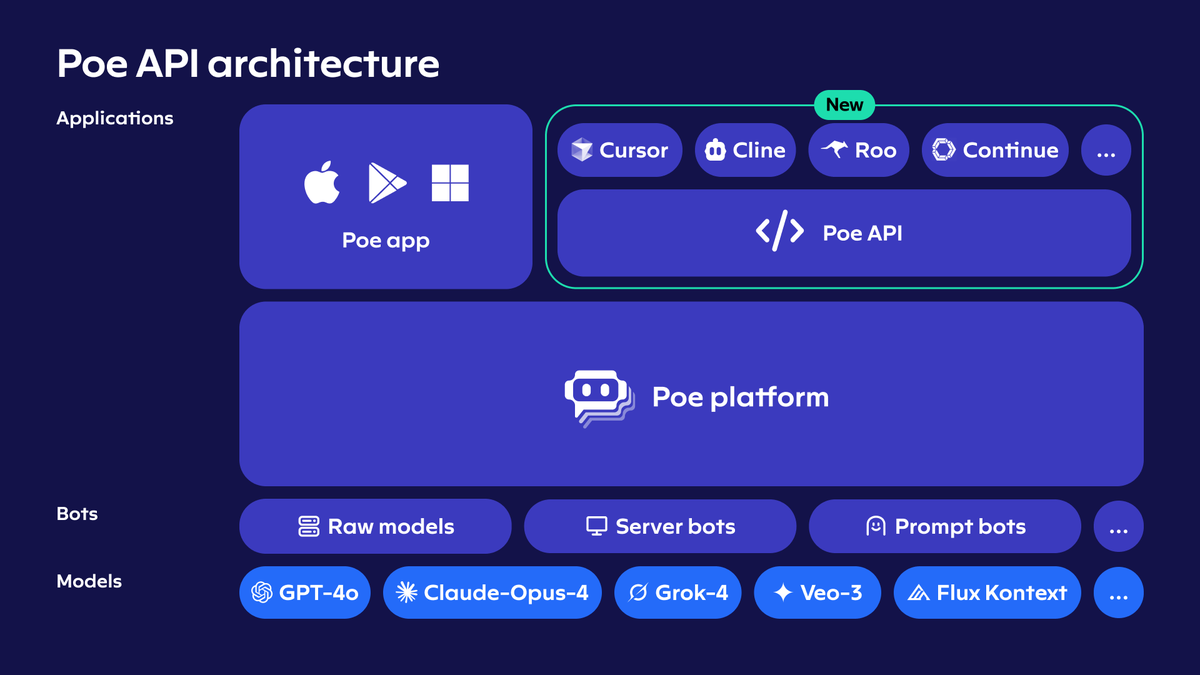
Introducing the Poe API for developers, with three important features:
1) Access to all models and bots on Poe across all modalities
2) A standard OpenAI-compatible chat completions interface
3) The ability to purchase points beyond subscription limits 🧵
@vogelito@solve_63 Hint’s do not penalize you! Though, if you have to wait until hints unlock others might find the password before you do, moving you lower in the leaderboard.
Your place indicates how many people have solved the challenge before you.
Introducing Poe Apps: a new, easy way to create and use visual interfaces into any combination of the 100+ text, image, video, and audio models on Poe. (1/5)
We are excited to announce that Quora has raised $75M from Andreessen Horowitz. This funding will be used to accelerate the growth of Poe, and we expect the majority of it to be used to pay bot creators through our recently-launched creator monetization program. (thread)
What is the world's most underrated building?
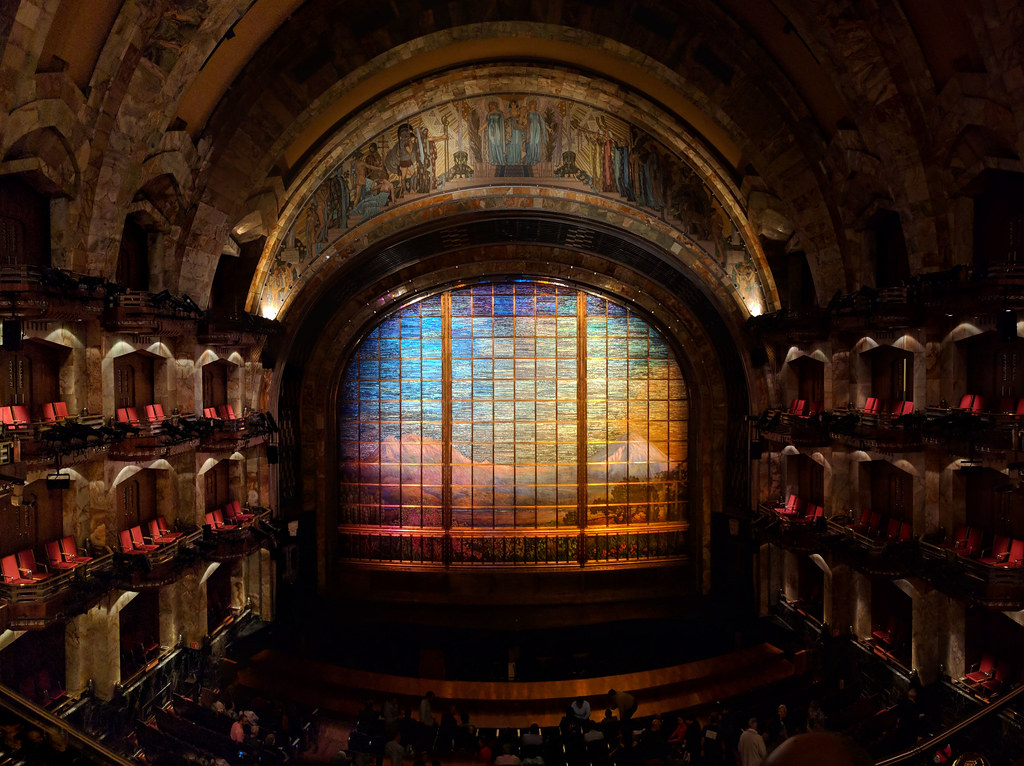
One answer might be the Palacio de Bellas Artes in Mexico City.
Why? It's quite possibly the only place on earth where Beaux-Arts, Art Nouveau, and Art Deco architecture were all somehow combined into a single, spectacular building.
The Palacio de Bellas Artes was commissioned in 1900, with the intention of completing it by 1910 to mark the centenary of the Mexican War of Independence.
An Italian architect called Adamo Boari, who worked in a mixture of Neoclassical and Art Nouveau styles, was appointed to design it. But construction was delayed and then came the Mexican Revolution, which lasted from 1910 to 1920.
The Palacio was left unfinished for two decades until construction restarted in 1932, this time according to Art Deco design principles under the leadership of the Mexican architect Federico Mariscal.
The Palacio de Bellas Artes was finally completed and inaugurated in 1934, and has hosted art exhibitions and theatrical productions, including ballet and opera, ever since. It is also home to two museums dedicated to Mexican architecture and art, along with the Ballet Folklórico de México and the National Symphony Orchestra.
From outside we are treated to a building thoroughly Neoclassical in shape and design, with particular influence from the Beaux-Arts style of 19th century France — this explains the almost Baroque flair and extravagance of the exterior.
But some of the sculptural details and the huge, colourful glass domes are more Art Nouveau, and they hint at the interior of the Palacio — a concert hall like no other, built from wood, marble, and stained glass, and decorated with mosaics and paintings.
Not to forget its crowning jewel: a huge, foldable glass "curtain" produced by Tiffany's of New York. This was one of the greatest achievements of the whole Art Nouveau movement: a sensuous, shimmering wall of light and colour.
And that's not all. The main lobby, despite what the Palacio's façade suggests, is a cathedralesque chasm filled with the sharp geometry, futuristic atmosphere, and industrial decadence of Art Deco.
Amid all this the Palacio de Bellas Artes is also decorated with colossal, visually arresting murals by several of Mexico's greatest painters — Diego Rivera, Jorge González Camarena, José Clemente Orozco, and David Alfaro Siqueiros — along with sculptures of Aztec and Maya gods.
Other artists from around the world were also commissioned to work on the Palacio, such as the Italian Symbolist sculptor Leonardo Bistolfi and the Hungarian craftsman Géza Maróti.
And so the Palacio de Bellas Artes is a kaleidoscope of architecture and design. Its complicated history has produced a wholly unique fusion of different and ostensibly conflicting styles. But, somehow, Beaux-Arts Neoclassicism, Art Nouveau, and Art Deco were all integrated into one glorious cornucopia of material, form, colour, and light.
Just like the great churches of the Italian Renaissance, which exhibited the very best work of the architects, painters, and sculptors of the day, the Palacio de Bellas Artes feels like a masterpiece of the many different artistic and architectural movements of the early 20th century all at once — subsumed and transformed into something miraculous by the unique characteristics of Mexican art and culture.
Today, we are opening up public access to a new AI product we have been building called Poe. Poe lets people ask questions, get instant answers, and have back-and-forth conversations with several AI-powered bots. (1/n)
@Aella_Girl - Taxi driver making an unexpected turn
- Seeing someone you don’t know in multiple unrelated places
- A group of people approaching you in the street at night
(i tried making them deliberatively ambiguous)
Today we are starting a beta test for a new product called Poe. Short for "Platform for Open Exploration", it lets people ask questions, get instant answers, and have back-and-forth dialogue with AI.