Had the chance to spend time with Jimmy Donaldson (@MrBeast) talking about something that's often invisible: the research behind every breakthrough for children with cancer.
Thank you @SU2C for being such an incredible collaborator on this campaign.
Watch the video: https://t.co/NzKK6fuIzw
#mycompany
What if the “Cry It Out” sleep training (aka extinction-based sleep training) has contributed to mental health issues in young people?
In some ways, it’s the most insane thing to do to a child (and is based on incredibly poor science). For centuries, families co-slept without issues, but in modern times, it has become increasingly taboo… why?
How can repeated emotional non-response to a baby be healthy? What does it do to their stress calibration, attachment expectations, and self-regulation? How does it play out in their long term relationships and social connections?
I’ve read the studies and they are poorly designed and weakly supported. Yet, we have an entire generation of parents that blindly follow this insane protocol without reviewing the data themselves.
To be fair, the data supporting co-sleeping is weak as well, but it has centuries of precedent so I feel much more comfortable supporting that than a new approach that was largely instituted since the 1920s.
For some context, in the 20th century, behaviorist John Watson (1928), interested in making psychology a hard science, took up the crusade against affection as president of the American Psychological Association. He applied the paradigm of behaviorism to childrearing, warning about the dangers of “too much mother love”. The 20th century was the time when “science" was assumed to know better than mothers, grandmothers, and families about how to raise a child. Too much kindness to a baby would result in a whiney, dependent, failed human being.
A government pamphlet from the time recommended that "mothering meant holding the baby quietly, in tranquility-inducing positions" and that "the mother should stop immediately if her arms feel tired" because "the baby is never to inconvenience the adult." A baby older than six months "should be taught to sit silently in the crib; otherwise, he might need to be constantly watched and entertained by the mother, a serious waste of time."
The truth is the opposite. We now know that ignoring a child raising cortisol levels and hurts trust and attachment. Yet, every young parent I know today has been brainwashed to let their child cry in silence. It’s truly wild.
Biotech Outlook 2026
Il 2026 segnerà l'inizio dell'era terapeutica di CRISPR.
Le società leader del gene-editing si preparano a generare miliardi di ricavi nei prossimi anni, mentre il pipeline si allarga rapidamente a malattie comuni come dislipidemie, Alzheimer's ed HIV.
Scarica qui l'outlook 2026:
https://t.co/4Dig4vobUf
Eli Lilly ($LLY) inaugurerà a Philadelphia uno dei
suoi Lilly Gateway Labs, una sorta di
incubatore per start up biotecnologiche.
La location si svilupperà su un'area di circa
4.000 metri quadrati, nel centro della città.
La struttura fornirà alle società
biotecnologiche spazi di laboratorio e
attrezzature pronti all’uso.
Lilly Gateway Labs è già presente in altre città americane famose per
l'innovazione nelle #biotecnologie: Boston, San Francisco e San Diego. Ci sono
inoltre sedi a Pechino e Shanghai.
La compagnia farmaceutica ha notato che dall'inaugurazione del loro primo
laboratorio, avvenuta nel dicembre 2019, , le imprese che vi operano hanno
ottenuto più di 2 miliardi di dollari in investimenti, con oltre 50 medicinali in fase
di sviluppo.
@EliLillyandCo inaugurerà a Philadelphia uno dei
suoi Lilly Gateway Labs, una sorta di
incubatore per start-up biotecnologiche.
La location si svilupperà su un'area di circa
4.000 metri quadrati, nel centro della città.
La struttura fornirà alle società
biotecnologiche spazi di laboratorio e
attrezzature pronti all’uso.
Lilly Gateway Labs è già presente in altre città americane famose per
l'innovazione nelle #biotecnologie: Boston, San Francisco e San Diego.
Ci sono inoltre sedi a Pechino e Shanghai.
La compagnia farmaceutica ha notato che dall'inaugurazione del loro primo
laboratorio, avvenuta nel dicembre 2019, , le imprese che vi operano hanno
ottenuto più di 2 miliardi di dollari in investimenti, con oltre 50 medicinali in fase
di sviluppo.
🇮🇹🇩🇪 OPINION: ITALY’S FACTORIES ARE BEATING GERMANY AND FRANCE, AND IT’S NOT ABOUT PRICE... IT’S ABOUT POWER
For years, we were told Germany’s engineering and France’s design were unbeatable.
Turns out, Italy’s been quietly lapping them in exports. Growing twice as fast as Germany and triple France in the last decade.
Not because it’s cheaper. Because it’s better.
High-quality goods. Smart production. Tight design. From fashion to food to pharmaceuticals, Italy’s manufacturing is winning where it counts: *global demand*.
And this isn’t some lucky streak.
Italy’s industry is now the second biggest in Europe, eighth in the world, and pulls in a €120 billion surplus that literally keeps the country’s energy running and books balanced.
Factories here invest more, carry less debt, and pay better salaries than both the public sector and services.
The tiny firms are shrinking, sure. But the big ones are getting sharper, faster, and richer. The industry’s scaling up, not tapping out.
And while Germany stalls and France fumbles, Italy’s holding its own despite sky-high energy costs, a tech transition, and an EU that still doesn’t quite get it.
Now Confindustria (Italy’s main industry association and manufacturing think tank) says the next leap is full digital: AI, automation, smart everything. The blueprint’s right there.
Italy just needs the political class to stop dragging its feet and back the winners.
Because here’s the quiet truth no one wants to admit:
Meloni's economy is outperforming Europe’s darlings and doing it with style.
Source: il messaggero
Una singola dose di un nuovo farmaco anticancro ha fatto quasi sparire un tumore al cervello in soli 5 giorni.
All’inizio del 2024, medici del Massachusetts General Hospital hanno trattato tre pazienti con glioblastoma ricorrente usando una nuova terapia CAR-T chiamata CARv3-TEAM-E.
Le cellule immunitarie del paziente vengono prelevate, geneticamente modificate in laboratorio per riconoscere due marcatori tipici del glioblastoma, e poi iniettate direttamente nel liquido cerebrospinale con una sola infusione.
I risultati sono stati straordinari e molto più rapidi del previsto:
•In un paziente, la risonanza magnetica a soli 5 giorni dall’infusione ha mostrato che il tumore era quasi completamente scomparso.
•Un secondo paziente ha avuto una riduzione di oltre il 60%, durata più di sei mesi.
•Anche il terzo ha mostrato una netta diminuzione del tumore in pochi giorni.
Queste risposte sono state molto più rapide e intense rispetto a qualsiasi precedente immunoterapia per questo tipo di tumore al cervello. I medici hanno definito le prime immagini “da rimanere a bocca aperta”.
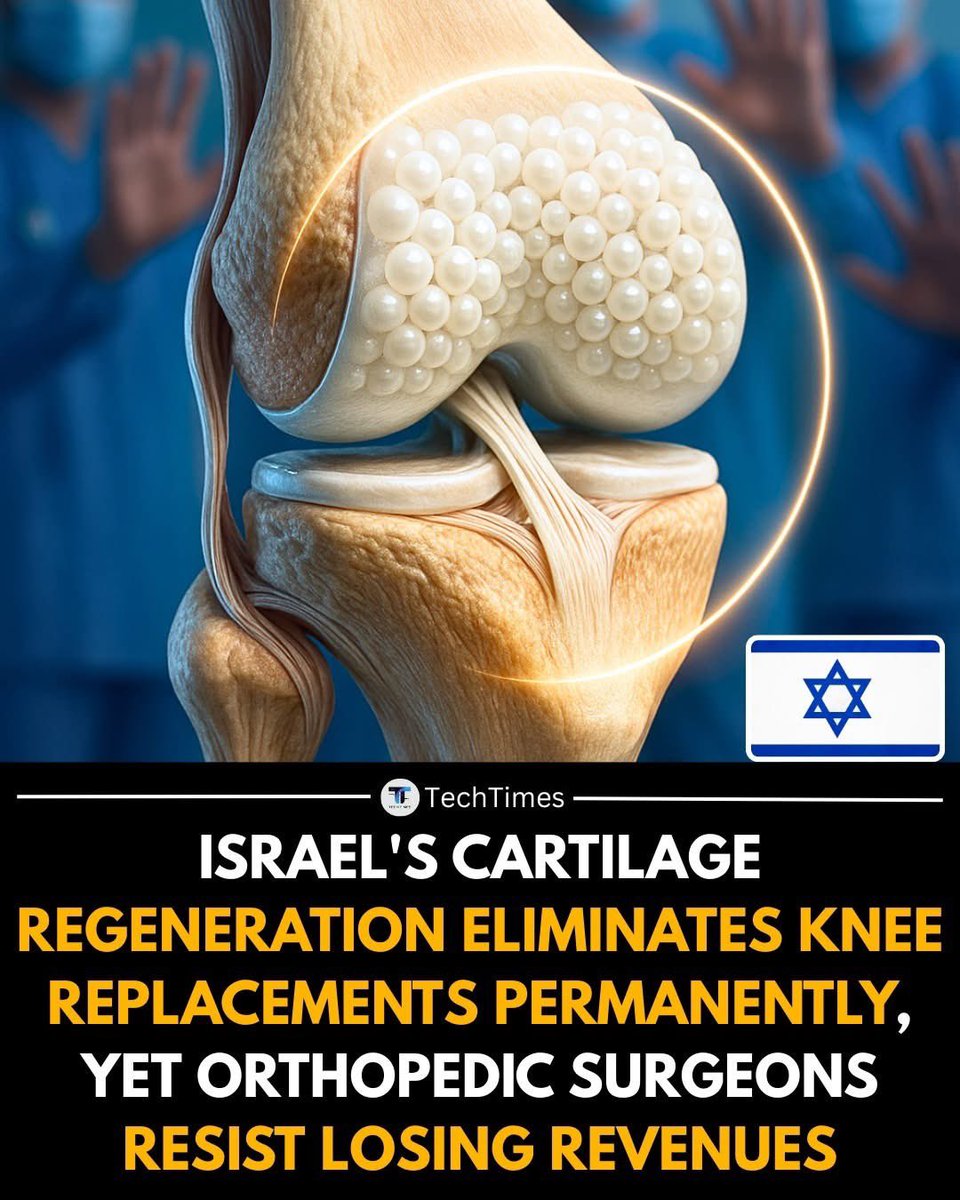
🇮🇱Israeli researchers have developed a breakthrough cartilage regeneration therapy that could eliminate the need for knee replacements altogether, offering millions of people a chance to restore joint function without major surgery.
The treatment uses advanced biomaterials and stem-cell engineering to regrow healthy cartilage inside the knee, repairing the damaged tissue that causes chronic pain, stiffness, and mobility loss. Early patients have shown remarkable recovery, with regenerated cartilage behaving just like natural, youthful tissue.
Scientists say the technology works by creating a supportive scaffold that encourages the body to rebuild cartilage from the inside out. Instead of replacing the joint with metal implants, the therapy restores what was lost — allowing patients to move freely again without long recovery times or invasive procedures. For many, it represents a future where worn-out joints can be healed rather than replaced.
But as the innovation gains attention, it’s facing resistance in some medical circles. Orthopedic surgeons who rely heavily on knee replacement procedures worry the therapy could disrupt a multibillion-dollar industry. Critics argue that financial incentives and established surgical practices may slow the adoption of regenerative treatments, even when they offer patients safer, less invasive options. Supporters push back, insisting that medicine must evolve toward long-term healing, not recurring operations.
The debate is growing louder, but one thing is clear: Israel’s cartilage regeneration breakthrough has the potential to redefine joint care worldwide. A future where knees can be fully restored — without implants, replacements, or lifelong limitations — is now within reach.
- TechTimes
Gli scienziati hanno appena usato CRISPR per eliminare completamente l’HIV dalle cellule umane — e le cellule sono rimaste immuni per sempre.
Un team di esperti della Temple University di Filadelfia ha compiuto un importante passo avanti nella lotta contro l’HIV utilizzando CRISPR/Cas9 — uno strumento preciso per il taglio del DNA — per cancellare direttamente il codice del virus incorporato nelle cellule immunitarie umane coltivate in laboratorio.
In un nuovo esperimento del 2024, i ricercatori hanno preso di mira le cellule T dormienti che ospitavano HIV-1 nascosto, rimuovendo così accuratamente l’intero genoma virale che le cellule non solo si sono liberate dall’infezione, ma hanno anche respinto successivi attacchi virali senza produrre alcuna progenie virale.
Questa cancellazione “senza cicatrici” rappresenta un contrasto netto con i farmaci standard, che tengono semplicemente il virus sotto controllo; qui l’obiettivo è la rimozione totale dai nascondigli difficili da raggiungere, aprendo la strada a quella che potrebbe diventare una soluzione definitiva e duratura con un solo trattamento. Sebbene si trovi ancora nelle prime fasi di sperimentazione, inclusi i test di sicurezza sull’uomo, questi successi di laboratorio hanno suscitato un reale ottimismo sul fatto che porre fine alla morsa dell’HIV possa presto passare dal sogno alla realtà per milioni di persone in tutto il mondo.
Scientists cut HIV out of immune cells using CRISPR.
And the cells stayed HIV-free even after re-exposure. A cure could finally be within reach.
In a groundbreaking advance, scientists at Temple University have successfully used CRISPR/Cas9 gene editing to eliminate HIV-1 DNA from the genomes of human immune cells.
Unlike existing treatments that suppress the virus, this method completely removes the genetic blueprint of HIV from infected T-cells.
Amgen ha comunicato recentemente che il
suo inibitore di PCSK9 Repatha ha raggiunto importanti obiettivi, comportando una notevole diminuzione del rischio di eventi cardiovascolari.