Nobody is ready for this number
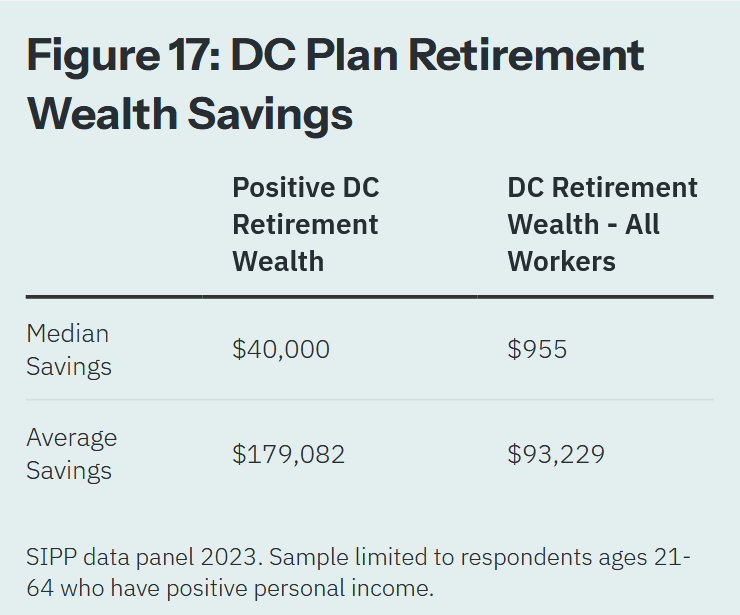
the median American worker has $955 saved for retirement
not 955k. 955 dollars…
When it comes to this conversation people tend to quote the average. But a handful of rich savers drag the average up and hide the fact that the guy in the middle has basically nothing.
and here's what drives me mad... everyone calls this a discipline problem. "should've saved more"
But you cannot save your way out of this
The whole plan was: earn a wage, buy assets and hold for 40 years. It worked when wages kept up with assets. they don't anymore. wages have lost HALF their purchasing power vs the S&P since 2008
So you're told to buy the one thing that runs away from your paycheck faster every year
Even people who did everything right are still screwed. It's not them. it's the plan.
I wrote out my thoughts on this in full today I’ll link the piece below.
If your father or mother is above 67, please pause and read this slowly.
At that age, life begins to feel different for them. The world moves faster, but their bodies move slower. The things they once did effortlessly now require effort. Their strength is not what it used to be, and even if they don’t say it, they feel it.
What they need now is not pressure. Not stress. Not arguments about money or past mistakes. They need stability. They need reassurance. They need to feel safe.
If they have savings, protect it. This is not the stage for risky investments or “let’s try this opportunity.” It is the stage for preservation. Capital safety matters more than high returns. Peace of mind matters more than profit.
If they depend on you financially, don’t see it as a burden. See it as a privilege. The same hands that once carried you are now weaker. The same voices that defended you now speak softer. Support them with dignity, not pity.
And beyond money, give them something deeper.
Call them without being in a hurry.
Sit with them without checking your phone every two minutes.
Let them repeat stories you’ve heard before. One day, you will wish to hear those stories again.
At 67 and above, what they truly fear is not death. It is loneliness. It is feeling forgotten.
Take care of their health. Help them organize their documents. Make sure they are not being financially manipulated. Protect them from stress. But most importantly, protect their heart.
Because one day, the chair they sit on will be empty.
And no amount of money will buy back one more conversation.
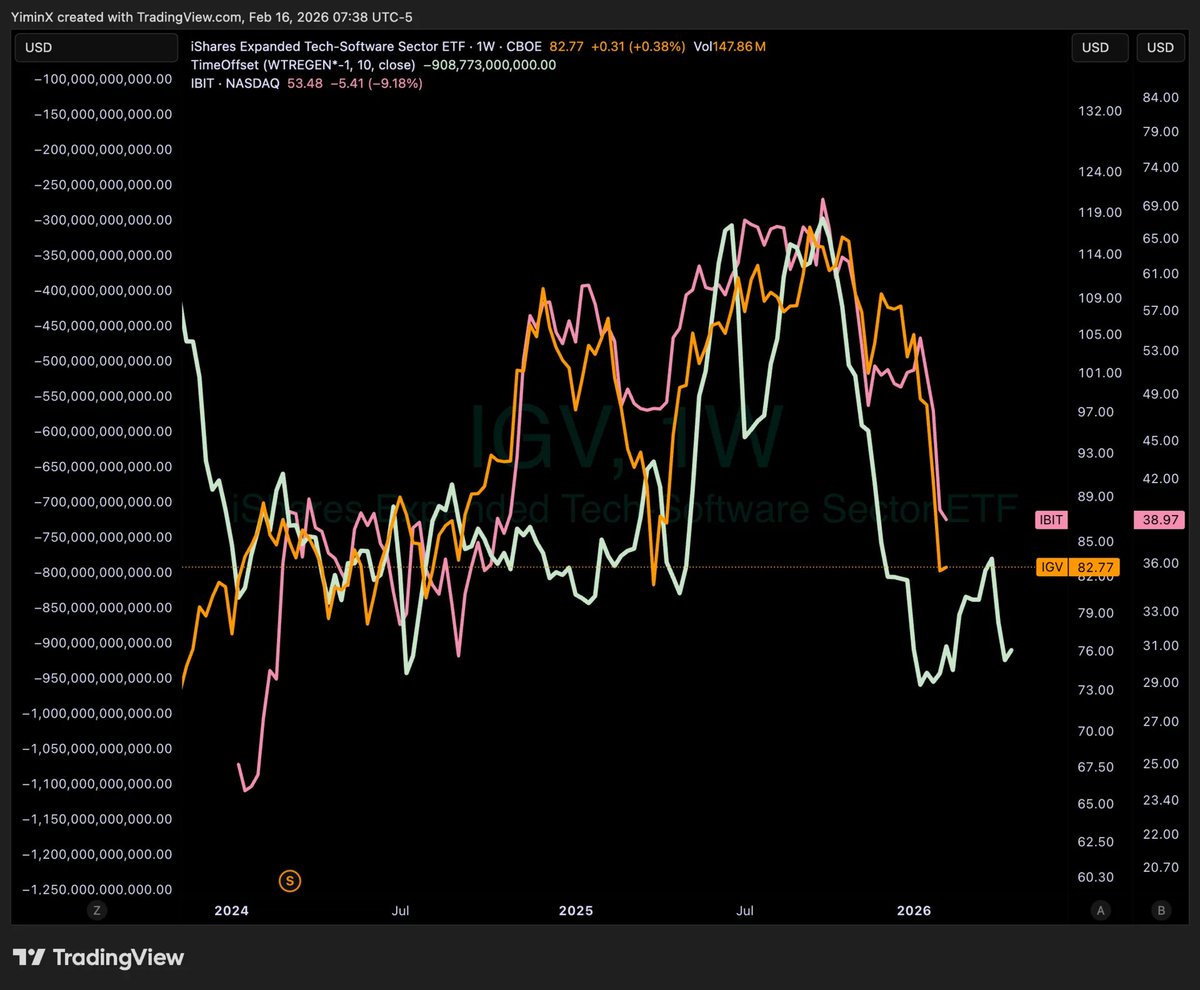
Why are Bitcoin $BTC and software $IGV trading almost tick-for-tick? (MUST READ)
It’s not a coincidence. It’s about DURATION.
Both asset classes are long-duration expressions of liquidity.
Software equities derive most of their value from terminal cash flows discounted far into the future. When long-end yields rise, their net present value falls.
Bitcoin, with no cash flows, is even more sensitive to long-end rates and liquidity.
Since October:
⚠️ 30Y yield: 4.5% → 4.9%
‼️ TGA: $800bn → $1tn
That combination drained system liquidity and pushed discount rates higher.
The chart below shows something more subtle:
There is a roughly 10-week lead time between the inverse TGA and $IGV & $BTC.
🔴 Liquidity tightens → software & crypto weaken 10 weeks later.
🟢 Liquidity eases → risk assets respond with a lag.
That framework explains the move far better than “AI killed software” or “the crypto 4-year cycle”.
If a story explains Bitcoin but not IGV — or IGV but not Bitcoin — it’s probably incomplete.
In the near term, the setup allows for a reflexive bounce in both.
But for that bounce to evolve into a sustained uptrend, TGA must continue to decline, and liquidity conditions must genuinely improve.
The good news is that the 30-year yield is already trending down from 4.92% to 4.37% in the past two weeks.
This isn’t about hype cycles or AI narratives.
It’s about liquidity dynamics that almost EVERYONE has overlooked.
I posted this earlier in the week on @RealVision, but thought it was worth sharing here as well, just to give everyone something to think about.
If you step back and look at the data, something interesting is happening in markets right now…
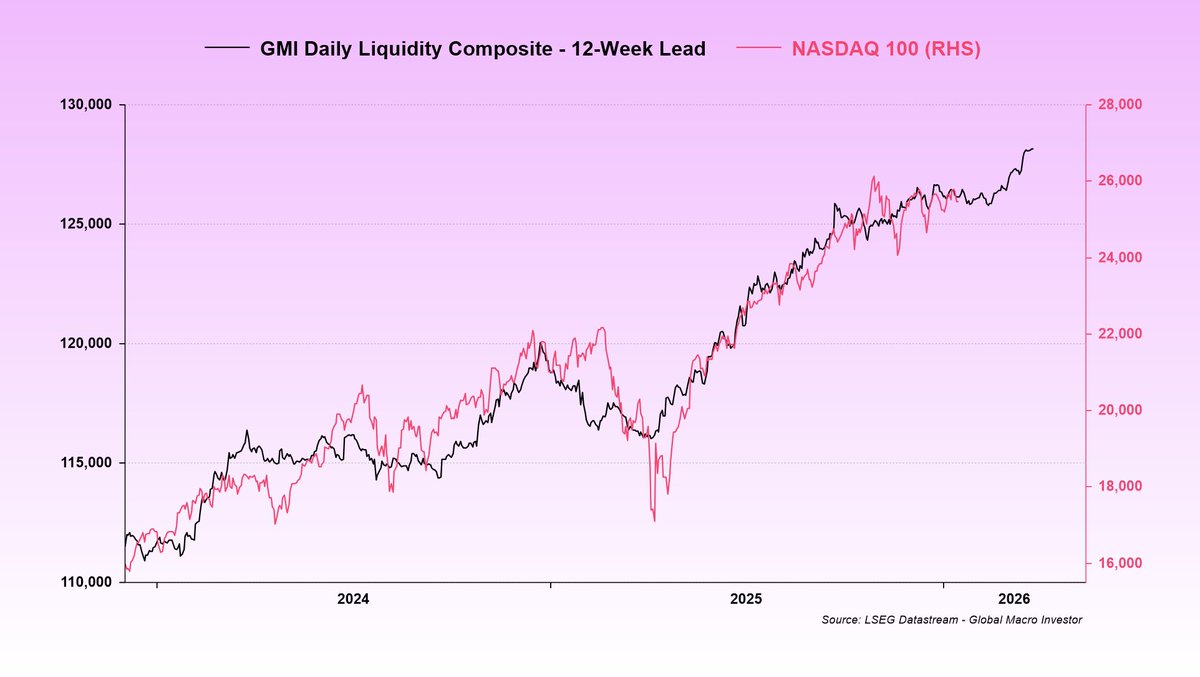
When you line up liquidity with equities, you get this (chart 1).
And then compare that with the same liquidity measure versus Bitcoin (chart 2), a simple truth emerges:
Both cannot be right...
Either equities are fundamentally mispricing liquidity despite trading near record highs, or Bitcoin is correctly signaling that the liquidity cycle has already peaked and that risk assets are about to roll over. Only one of these outcomes can ultimately be correct.
Now let’s separate data from opinion for a moment...
The data is clear:
Global liquidity has not yet peaked.
Now to my subjective view…
I think Bitcoin remains the outlier here, and that the events around 10/10 temporarily distorted price discovery, for reasons I’ve discussed at length previously.
Equities, credit, and broader risk assets are behaving exactly as you would expect in a rising liquidity regime. They’re hovering near all-time highs...
Bitcoin, by contrast, is pricing a liquidity peak that the data simply does not support at this stage.
At some point you have to step back and ask:
Is it more likely that one asset is right, or that every other BTC-correlated risk asset is wrong (chart 3)?
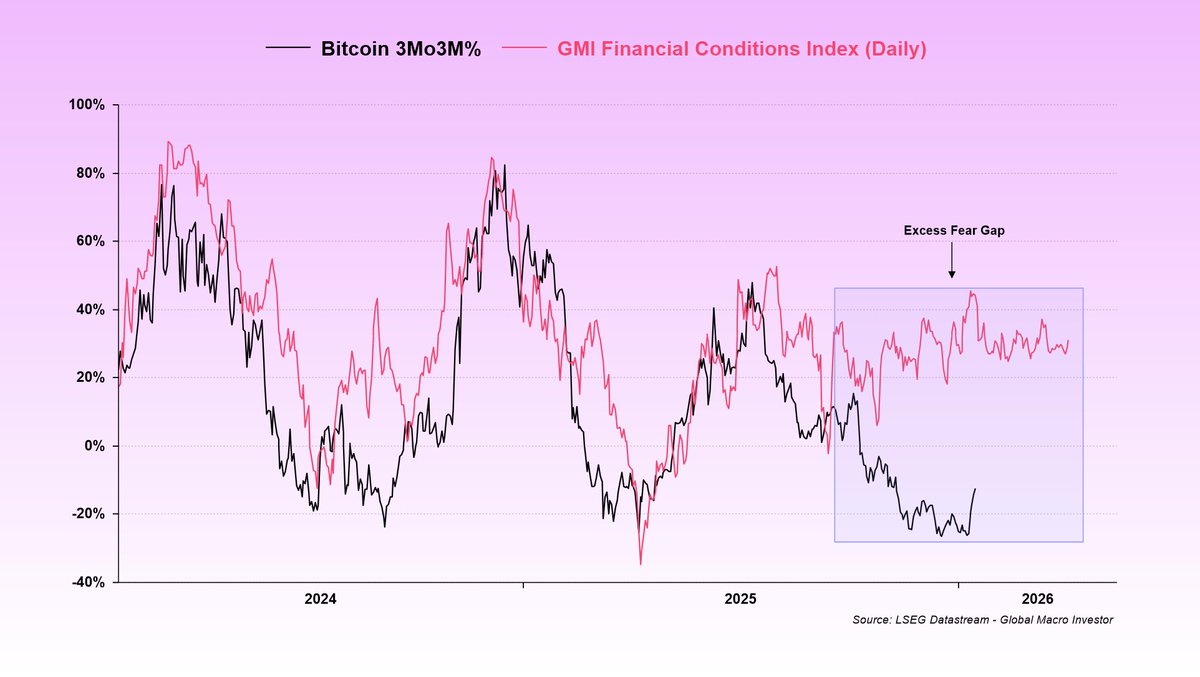
If you then layer in broader financial conditions, it stops being about opinion and becomes more about probabilities (chart 4).
What really stands out to me is the sheer magnitude of the “Excess Fear Gaps” that have opened up relative to the macro and liquidity fundamentals.
Right now, the weight of the evidence suggests liquidity is still rising and, in our view, will continue to rise, and that is what risk assets are reflecting.
That means Bitcoin is the anomaly.
What I’ve done here is present the data objectively and my view subjectively.
This is the battlefield for 2026.
The bull versus bear debate comes down to one thing and one thing only:
The direction of global liquidity...
When I distill down October 10th, I get to this...
Binance broke ( the worlds largest exchange). The API's shut down for market makers. Everyone got liquidated. Most market makers were not able to backstop liquidity. It spread across exchanges.
Those exchanges that have their own market makers or the ability to backstop prices probably absorbed a huge amount of liquidation in small caps and majors. Someone had to step in.
The equity Flash Crash in 2010 was similar.
That inventory, much like on a large market making desk, or program trading desk in equitie has to be unwound to reduce the extra risk they took on.
There has been 10's of billions of backstop liquidity to unwind. Some at huge losses, some at amazing profits.
It is not market manipulation.
If there was any, it was in the backstopping of prices when market makers couldn't due to technical issues...
This is what we are seeing today, in my mind. Those that backstopped the liquidity need to de-risk. In program trading we would see the same... every day liquidations to average out over time and reduce impact as much as possible.
Things are not liquidity right now so it has a large impact.
Year end audits and market liquidity constraints around year end mean that a lot needs to get finished now.
This too shall pass.
OMG - We aRe AlL GoInG to DIE!!!!
I HaD One chanCE tO UnfuCk My FUtuRe!
IT's OveR!
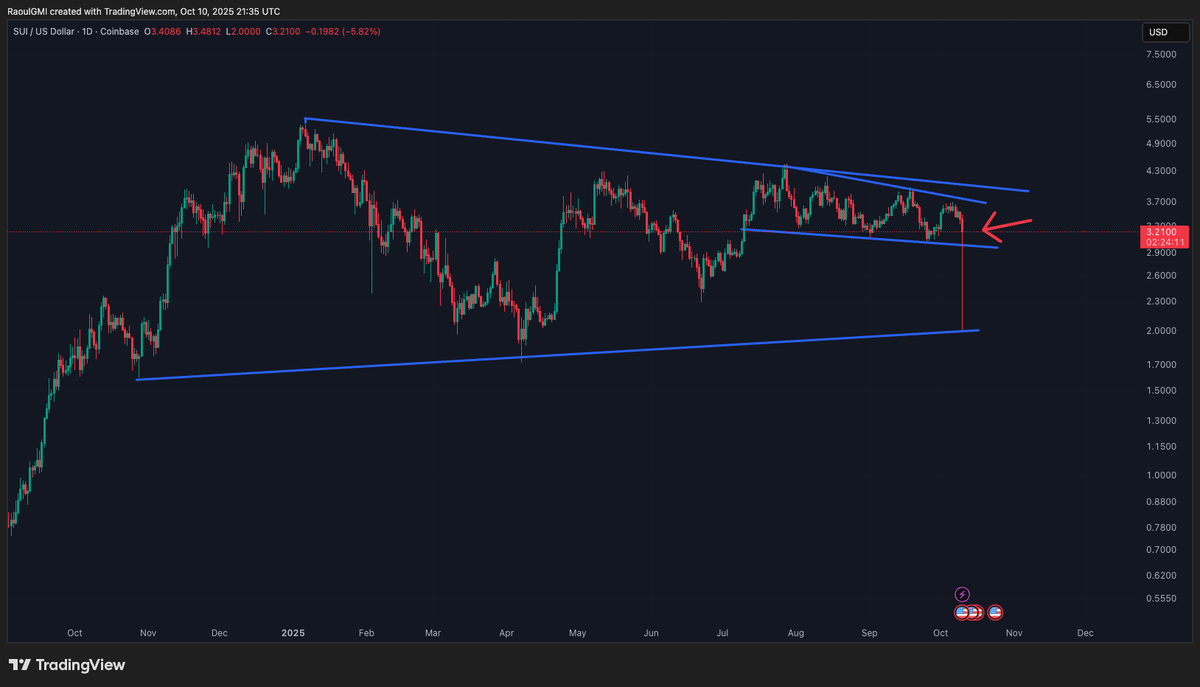
Meanwhile... Sui. Textbook wedge.
(Yes I use "wedge" for all flags, pennants, triangles and all that jazz, dear troll) 1/
🚨GIVEAWAY
5 winners, $1000 each
Steps:
1. Join our waitlist (link below)
2. Drop a screenshot of the email confirmation
3. Like & RT this post
If we double the waitlist total by Sunday, .@RaoulGMI will add $5k more to one extra winner!
Winners announced on Monday, Oct 27
Well that was a gift for anyone who had stables... haha. Perfect test of bottom of wedge in SUI and back into the small flag pattern we were in before...
If the federal government wanted to make America healthy again, they could put a 100% tax on any item sold in a grocery store that rates as ultra-processed on the NOVA scale and have that money go directly to local family-owned farms.
We don’t need more drugs, no matter what they cost. We need people to stop eating food-like products and start eating actual food.
@PeterSweden7 Most likely, the reality is that the majority of western social benefits are underfunded (meaning government sponsored programs are completely insolvent)