Big Banks like #JPMorgan wiping out regional banks = cruel
Regional banks = heart and soul of America
#Amazon cutting 18k jobs due to WTFed's credit issues
Ripple effect bringing down the USA, small banks and businesses
Stay aware.
#supportsmallbusiness#saveregionalbanks
Hi SG users 🇸🇬
Nemo now supports Grab Food!
Craving milktea or nasi lemak? Ask your AI agent to order on web or via telegram.
Nemo won’t spend a single cent without your permission. You set the spending limit. You approve the purchase with passkey.
Double the security, triple the fun.
AI agents for nasi lemak! 🍛
Imagine having 3 bots running tasks for you on Telegram.
-One scans 35 crypto groups for alpha.
-One triages your emails & Substacks.
-One lets you know when NVDA drops to $200.
In this private preview, Nemo lets Telegram users create multiple AI bots, each with its own job and its own memory.
They can work with you 1-on-1 in DMs, or live inside different Telegram groups you add them to.
Search @ HeyNemo_bot on Telegram and build yours.
I ran a test comparing a top-tier model with Kimi K3
The game was created in one shot using /design from Command Code.
I must say, the rumors aren’t just rumors anymore. It took only $0.038 to get an actually playable game.
It's insane how Kimi K3 surpassed the top-tier model
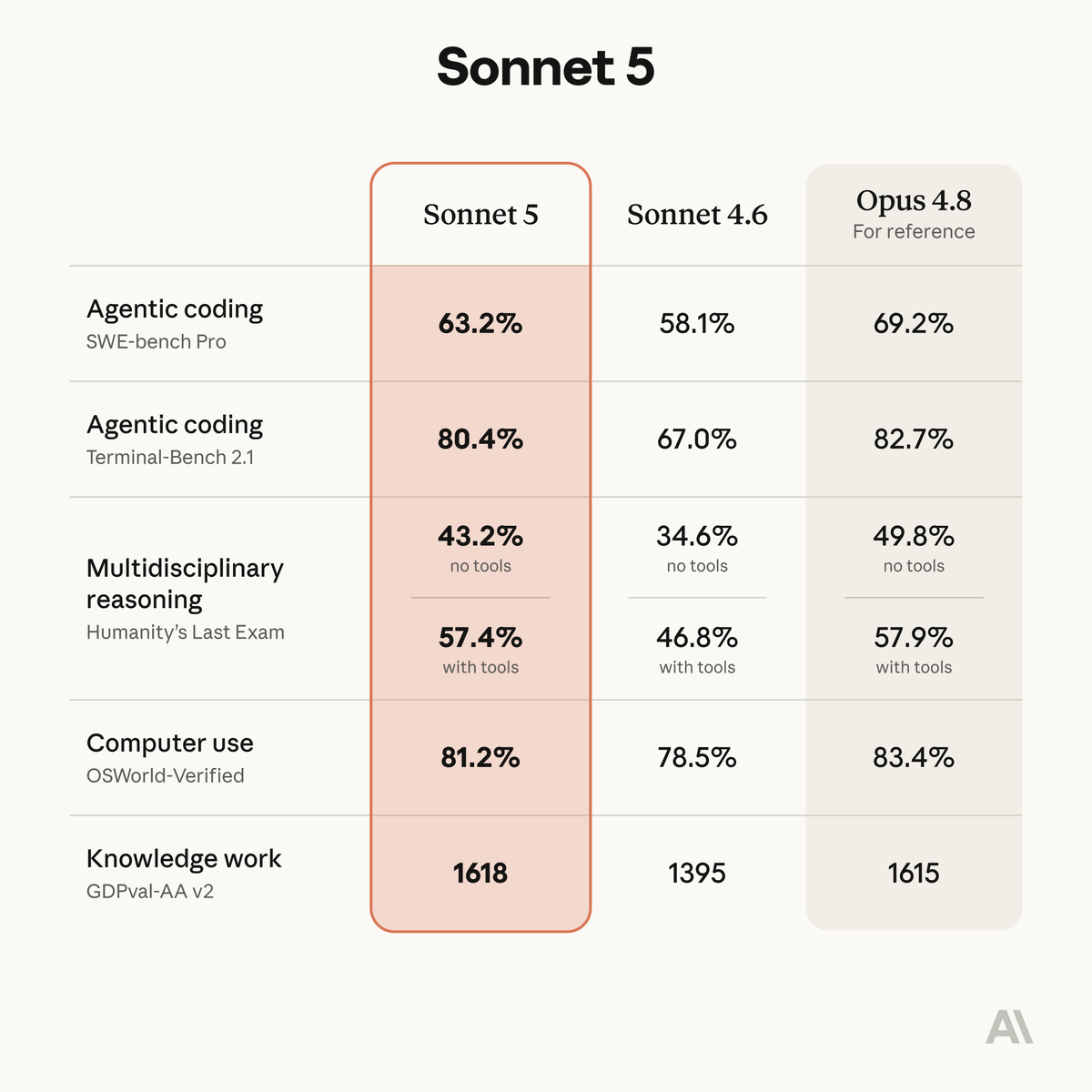
Sonnet 5 is a substantial improvement over Sonnet 4.6 on reasoning, tool use, coding, and knowledge work.
Its performance is close to Opus 4.8, at lower prices.
🇯🇵 A broccoli farmer in Japan used ChatGPT and Codex to build his own farm tools.
With no engineering background, he created software to monitor crops, manage his greenhouse, and help run the farm.
That's a pretty solid use of AI.
How I think about "security":
The goal is to minimize the divergence between the user's intent, and the actual behavior of the system.
"User experience" can also be defined in this way. Thus, "user experience" and "security" are thus not separate fields. However, "security" focuses on tail risk situations (where downside of divergence is large), and specifically tail risk situations that come about as a result of adversarial behavior.
One thing that becomes immediately obvious from the above definition, is that "perfect security" is impossible. Not because machines are "flawed", or even because humans designing the machines are "flawed", but because "the user's intent" is fundamentally an extremely complex object that the user themselves does not have easy access to.
Suppose the user's intent is "I want to send 1 ETH to Bob". But "Bob" is itself a complicated meatspace entity that cannot be easily mathematically defined. You could "represent" Bob with some public key or hash, but then the possibility that the public key or hash is not actually Bob becomes part of the threat model. The possibility that there is a contentious hard fork, and so the question of which chain represents "ETH" is subjective. In reality, the user has a well-formed picture about these topics, which gets summarized by the umbrella term "common sense", but these things are not easily mathematically defined.
Once you get into more complicated user goals - take, for example, the goal of "preserving the user's privacy" - it becomes even more complicated. Many people intuitively think that encrypting messages is enough, but the reality is that the metadata pattern of who talks to whom, and the timing pattern between messages, etc, can leak a huge amount of information. What is a "trivial" privacy loss, versus a "catastrophic" loss?
If you're familiar with early Yudkowskian thinking about AI safety, and how simply specifying goals robustly is one of the hardest parts of the problem, you will recognize that this is the same problem.
Now, what do "good security solutions" look like?
This applies for:
* Ethereum wallets
* Operating systems
* Formal verification of smart contracts or clients or any computer programs
* Hardware
* ...
The fundamental constraint is: anything that the user can input into the system is fundamentally far too low-complexity to fully encode their intent. I would argue that the common trait of a good solution is: the user is specifying their intention in multiple, overlapping ways, and the system only acts when these specifications are aligned with each other.
Examples:
* Type systems in programming: the programmer first specifies *what the program does* (the code itself), but then also specifies *what "shape" each data structure has at every step of the computation*. If the two diverge, the program fails to compile.
* Formal verification: the programmer specifies what the program does (the code itself), and then also specifies mathematical properties that the program satisfies
* Transaction simulations: the user specifies first what action they want to take, and then clicks "OK" or "Cancel" after seeing a simulation of the onchain consequences of that action
* Post-assertions in transactions: the transaction specifies both the action and its expected effects, and both have to match for the transaction to take effect
* Multisig / social recovery: the user specifies multiple keys that represent their authority
* Spending limits, new-address confirmations, etc: the user specifies first what action they want to take, and then, if that action is "unusual" or "high-risk" in some sense, the user has to re-specify "yes, I know I am doing something unusual / high-risk"
In all cases, the pattern is the same: there is no perfection, there is only risk reduction through redundancy. And you want the different redundant specifications to "approach the user's intent" from different "angles": eg. action, and expected consequences, expected level of significance, economic bound on downside, etc
This way of thinking also hints at the right way to use LLMs. LLMs done right are themselves a simulation of intent. A generic LLM is (among other things) like a "shadow" of the concept of human common sense. A user-fine-tuned LLM is like a "shadow" of that user themselves, and can identify in a more fine-grained way what is normal vs unusual.
LLMs should under no circumstances be relied on as a sole determiner of intent. But they are one "angle" from which a user's intent can be approximated. It's an angle very different from traditional, explicit, ways of encoding intent, and that difference itself maximizes the likelihood that the redundancy will prove useful.
One other corollary is that "security" does NOT mean "make the user do more clicks for everything". Rather, security should mean: it should be easy (if not automated) to do low-risk things, and hard to do dangerous things. Getting this balance right is the challenge.
1/ Verifiable computation: Exploring Ethereum’s role as a base layer for trust in autonomous systems.
Wednesday, Feb 11:
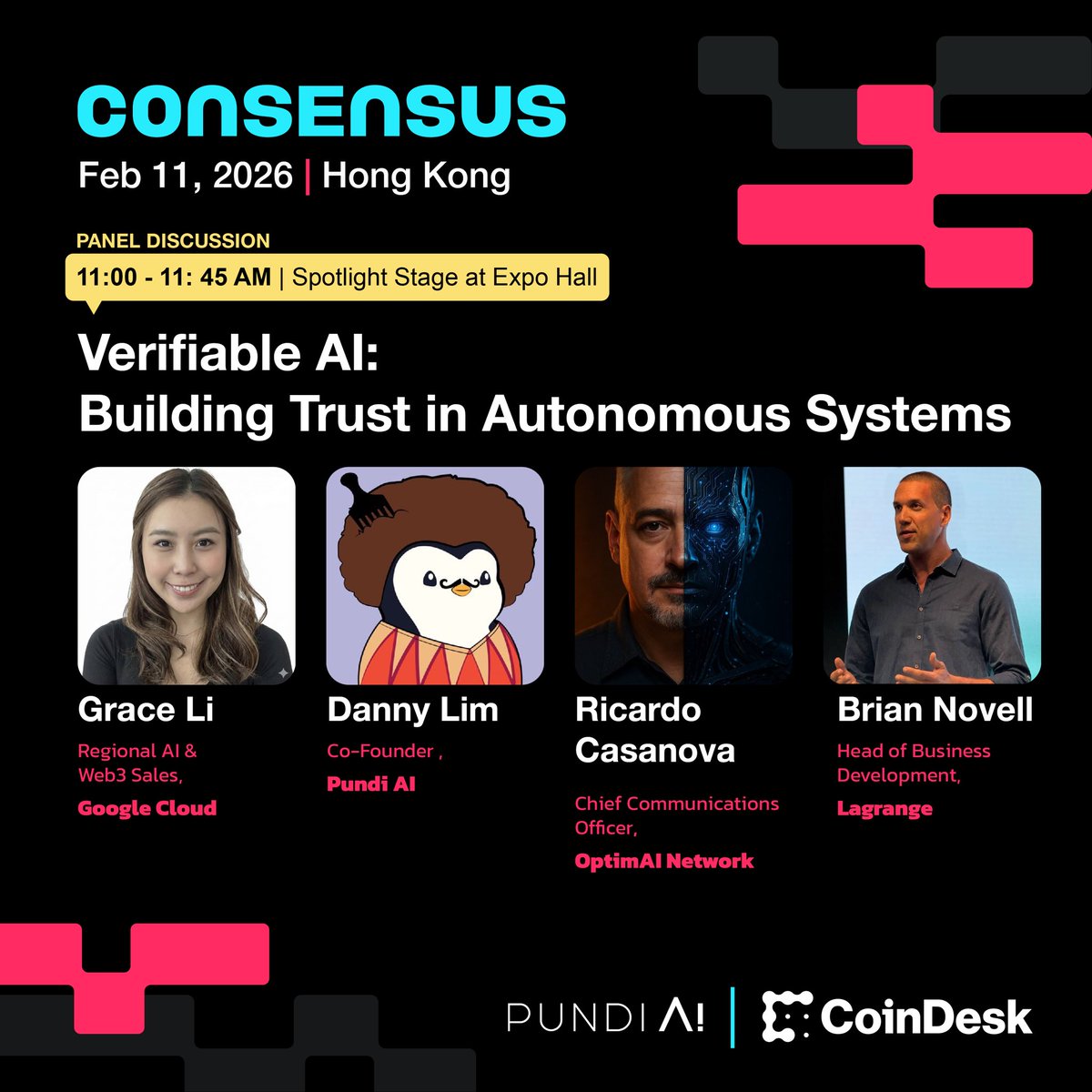
- 11:00 HKT: Verifiable AI: Building Trust in Autonomous Systems with @lagrangedev, @OptimaiNetwork & @PundiAI
- 15:00 HKT: Why Robot GDP Will Surpass Human GDP with @virtuals_io
Thursday, Feb 12:
- 10:50 HKT: Beyond Bolt-On AI: The Rise of AI-Native Web3 with Ant Digital Technologies, builders of @JovayNetwork
Pundi AI is ready for #ConsensusHK2026🇭🇰
Our co-founder @agintender will be speaking on the Spotlight stage tomorrow together with @googlecloud, @lagrangedev, and @OptimaiNetwork.
We will be talking about how to make AI agents actually verifiable, not just “trust me bro”.