Landing Pad: launch a meme coin whose floor is paid for in advance.
Every coin sold fills a reserve no one can withdraw. Sell back at the floor, any time.
Free public test: https://t.co/6WmkMAMXlW
$LPAD (https://t.co/A8bDm61TUP, no floor):
GaWqCRMjHVZD6JNG9yDt9c9eLN1nZnQRJmR4w2zEpump
@votesa Creator fees over creator bags is the right direction. A dev paid from volume wants the coin alive for months. A dev holding 10% of supply only needs one good top.
@big_maven1 One check I'd add to any rug guide: what do you get back if everyone sells at once? If the honest answer is "whatever the next buyer pays", size your bet like it can go to zero.
@AlgodTrading Memecoins won't die, people will always want to bet on culture. What should die is the version where insiders get in cheaper and the only exit for everyone else is the next buyer.
@jords The part that gets me: none of the fee money stays with the coin. If even a slice of every trade went into the coin's own reserve, all that retail volume would at least raise the price holders can sell back at.
@barkmeta Hard to build a big cap when every early wallet can exit into later buyers at any time. Size needs holders who aren't scared of being the last one out, and right now nothing protects the last one out.
@TheCryptoKazi The drop is brutal because nothing sits under the price when the voices go quiet. Attention will always fade. The question is whether there's a floor someone actually paid for when it does.
@lmc_security Exactly. Trustless would mean the money backing a coin can't be moved by anyone, not a dev promising they won't. No creator bag, no withdraw function, no upgrade key. Anything less is trust.
@blazeycrypto Three checks before anything else: 1) does the dev or a cluster of fresh wallets hold a big bag from the first blocks, 2) can anyone pull the liquidity, 3) can the contract be changed (owner, upgrade or mint authority). Any yes = walk away.
@miguelrare Interesting. We tried the opposite: 0% to the team, one flat price for the first 80%, and the full sale value sits in a reserve with no withdraw, so holders can always sell back at a floor. How would you stop the other 80% from becoming everyone's exit liquidity once it unlocks?
$LPAD is live on https://t.co/MStik6NG4h.
It is the meme coin of Landing Pad. The launchpad itself is still in public test.
Mainnet launches at whichever comes first:
- 100 pieces of tester feedback
- $LPAD at a $1M market cap
CA: GaWqCRMjHVZD6JNG9yDt9c9eLN1nZnQRJmR4w2zEpump
5/ This is a test version. The contracts have not had an independent audit yet, and nothing here has real value.
Try to break it: launch a coin, buy, sell, run the stress test on the home page. Tell us what fails.
https://t.co/tu3Dh5ktIW
4/ Nobody holds a key to the reserve.
The reserve is locked by the code. The platform controls one wallet only: its own fee wallet. Fees go out automatically with every trade.
One wallet can hold at most 2.5% of a coin.
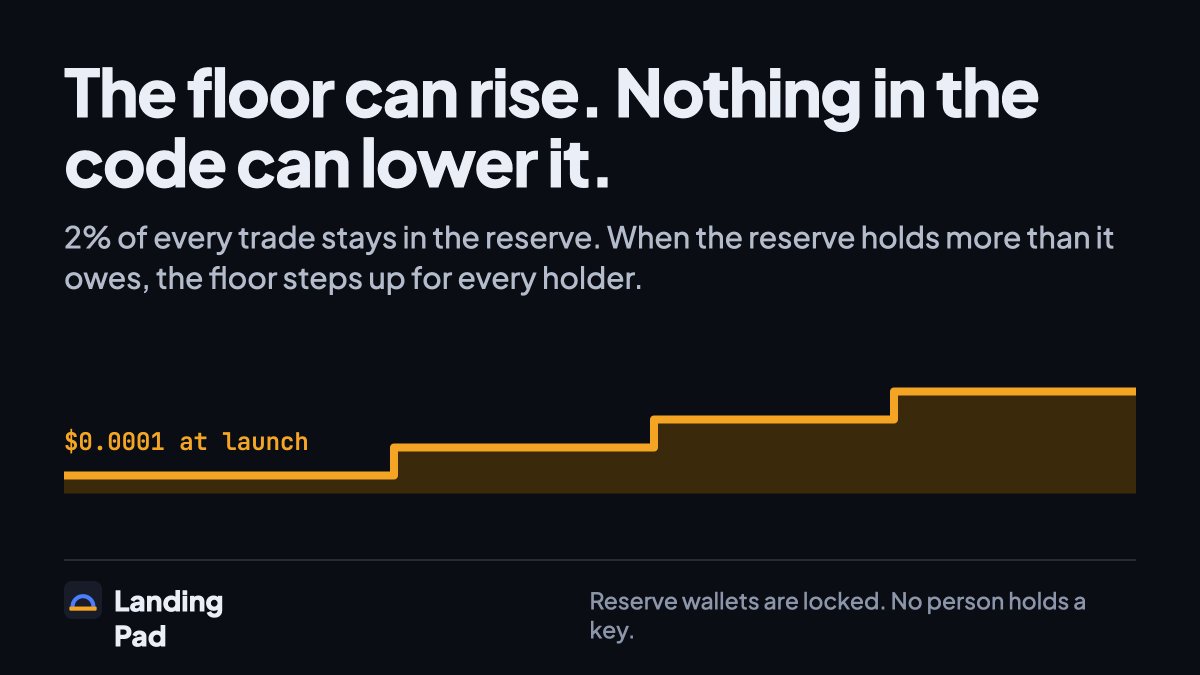
3/ The floor can rise. Nothing in the code can lower it.
Every trade pays a 5% fee: 1% to the coin's creator, 2% to the platform, 2% stays in the reserve.
When the reserve holds more than it owes, the floor steps up for every holder.
2/ The floor is paid for in advance.
Money from the fixed-price sale goes into a reserve that covers every coin in circulation at the floor price.
Buy $1,000, change your mind, sell: at least $902.50 comes back. The 5% fee each way is the whole cost.
1/ One price for everyone.
The first 800 million coins of every launch sell at the same fixed price: $0.0001. No presale, no insider round, no early-buyer discount.
The price starts to climb only on the last 200 million.