Everyone's calling 2025 'the year of agents' - just like they did for 2024 🤔
A thread on what agents actually are, why they matter, and my spicy take on if they're just VC bait... 🌶️ 1/7
@housecor I guess the question is who is accountable for the code you deploy?
I feel responsible for anything I commit - and I’d say the team is responsible for anything we deploy.
Thus - it feels like human code reviews are a requirement
New in Claude Code: Artifacts.
Interactive pages built from your session, like a PR walkthrough or a living project dashboard, shared with your team at a private link.
Available in beta on Team and Enterprise plans.
This is a super exciting release - Claude Fable 5 is the same underlying model as Mythos but with added safeguards. The benchmarks are great and it's SOTA on everything by a margin but I'll add that *qualitatively* also, this is a major-version-bump-deserving step change forward (imo of the same order as Claude 4.5 was in November), peaking especially for long problem-solving sessions on very difficult problems. You can give it a lot more ambitious tasks than what you're used to, the model "gets it" and it will just go, and it's never felt this tempting to stop looking at the code at all (but don't do this in prod!). The model still has quirks that people will run into and the safeguards are configured to be a little too trigger happy for launch, which can hopefully be tuned over time.
I feel a lot of things changing as working software increasingly comes out on a tap. The Jevon's paradox kicks in and I feel my own demand for software growing substantially. You can ask for anything - explainers, visualizers, dashboards, bespoke single-use apps (e.g. a full wandb that is hyper-specific just for your project), you can 10X your test suite, auto-optimize code, run giant research projects with custom HTML for the results, anything! "Free your mind" (Matrix ref). Really looking forward to all the things people build!
@htmx_org I was just resharing grug with my team 😆 it’s such a gold mine in the age of AI. Sending my appreciation for your OG work on this
https://t.co/rHaiSGnEmJ
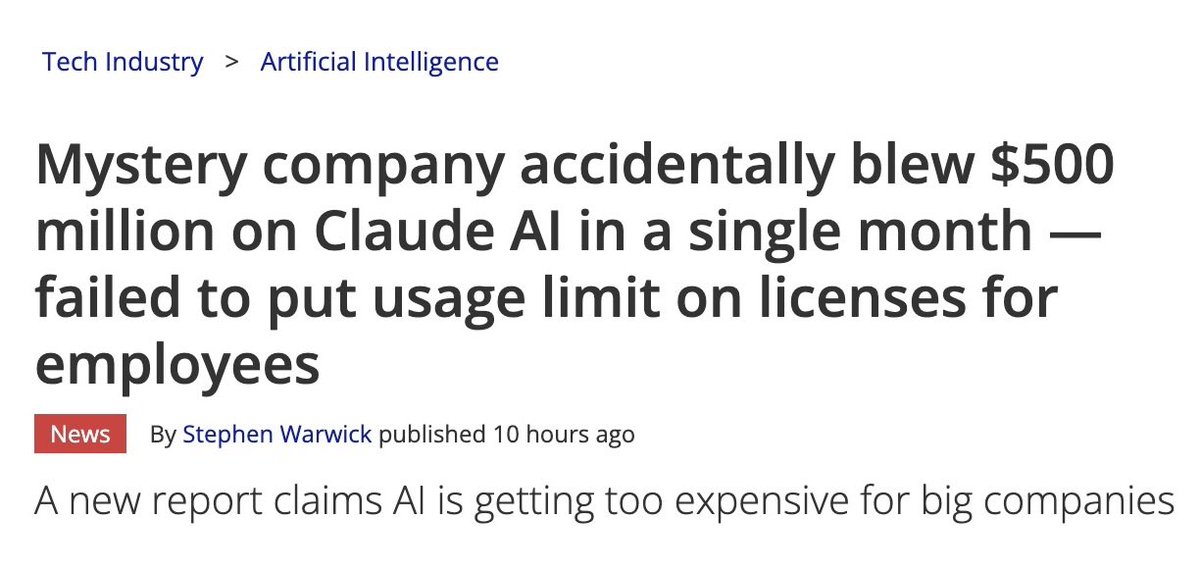
Can anyone explain to me why companies don’t just give employees $100 / month Claude Code or Codex plans instead of paying per token? There has to be an explanation, because this keeps happening and doesn’t make sense otherwise
The AI ponzi scheme goes like this:
Everyone is generating all these long ass docs and then passing them off for others to read
Then the person receiving is like, wtf this is way too long, and hands that into an AI to read and summarize
Then they are generating a long ass response back
and this cycle goes like that forever. and we call this work now 😅
The token lords watch this from their towers nodding and grinning.
I strongly believe there are entire companies right now under heavy AI psychosis and its impossible to have rational conversations about it with them. I can't name any specific people because they include personal friends I deeply respect, but I worry about how this plays out.
I lived through the great MTBF vs MTTR (mean-time-between-failure vs. mean-time-to-recovery) reckoning of infrastructure during the transition to cloud and cloud automation. All those arguments are rearing their ugly heads again but now its... the whole software development industry (maybe the whole world, really).
It's frightening, because the psychosis folks operate under an almost absolute "MTTR is all you need" mentality: "its fine to ship bugs because the agents will fix them so quickly and at a scale humans can't do!" We learned in infrastructure that MTTR is great but you can't yeet resilient systems entirely.
The main issue is I don't even know how to bring this up to people I know personally, because bringing this topic up leads to immediately dismissals like "no no, it has full test coverage" or "bug reports are going down" or something, which just don't paint the whole picture.
We already learned this lesson once in infrastructure: you can automate yourself into a very resilient catastrophe machine. Systems can appear healthy by local metrics while globally becoming incomprehensible. Bug reports can go down while latent risk explodes. Test coverage can rise while semantic understanding falls. Changes happens so fast that nobody notices the underlying architecture decaying.
I worry.
@GergelyOrosz@badlogicgames I’m also finding the LLM agreeable to each dev in situation based on how they prompt it - adding a confusing third party to the mix.
LLM psychosis scales with your distance from the code. As a result it tends especially to afflict non-coding managers, PMs, and execs. It’s also a self reinforcing loop. As the code becomes an object of disgust (unreadable pile of vibecoded shit) you are forced to distance yourself further from it and your only interactions with the code are mediated by model.
A few additional points:
1. I bought my codex subscription out of frustration in January. Way too much instability and crashes. I couldn’t rely on Claude anymore. forced/recommended move to single executable.
2. It seemed that a 20$ openai sub was similar to a 100$ anthropic sub.
3. banning of 3rd party harnesses and experimentation. Random blocking sessions for odd reasons.
Having been part of the industry for 50 years, I can confidently report that none of this is true.
Sure, writing code has a non-zero cost; this is true of any artifact.
But you know what costs even more, Jonathan?
Writing bad code; writing unnecessary code; writing more code than you really need simply because you think you might need it someday or you are too lazy or sloppy to clean up after yourself.
Anything that costs nothing is often worth nothing as well, and results in significant unintended consequences.
> As a dev, I feel mentally exhausted from all the ai speculation
Reduce your exposure to tech twitter. The algorithm optimizes for radical takes. You consume other people's anxieties and projections