1/ #EconTwitter
My first solo research paper is out!
"The Macroeconomic Effects of Global Supply Chain Shocks"
https://t.co/8ltv47p4zU
As inflation surged globally, researchers and policy makers asked:
What role do supply chain disruptions play in business cycle fluctuations?
@lapo_bini1 received the 2025-26 Walter Heller Memorial Prize Award for one of the best 3rd year papers! Learn more about his paper, “The Macroeconomic Effects of Global Supply Chain Shocks,” and his research in macroeconomics and applied econometrics: https://t.co/PL66ThP2v7
@lapo_bini1 received the 2025-26 Zhao Family Econometrics Summer Research Fellowship which supports our graduate students in the Econometrics field. Learn more about Lapo here: https://t.co/PL66ThP2v7
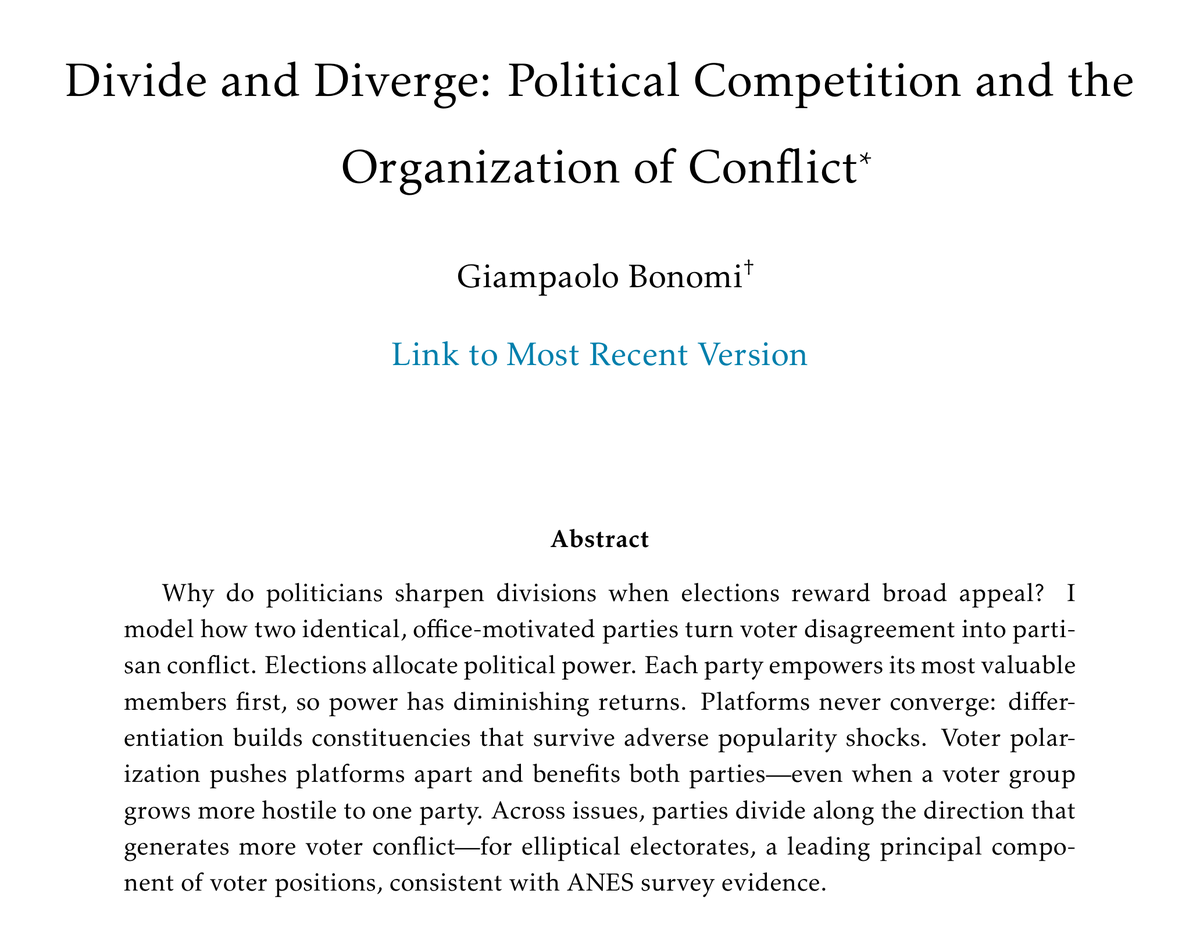
I'm on the #EconJobMarket! I’ll be sharing my papers here, starting with "Divide and Diverge."
I show that even identical parties that care only about power take opposing positions in equilibrium. Platform differentiation allows each party to build a voter coalition that stays loyal after negative popularity shocks. Sharper voter divisions create more room for differentiation: even radicalizing the other side's voters can pay off. In short, divisions stabilize political power.
The same logic explains which disagreements become partisan: parties organize competition around voters' deepest disagreements, locating on the first principal component of voter views. This provides an equilibrium foundation for a tool widely used by political analysts to identify the main axis of political conflict.
For more: https://t.co/3SJiNP8GLp
Highly relevant!
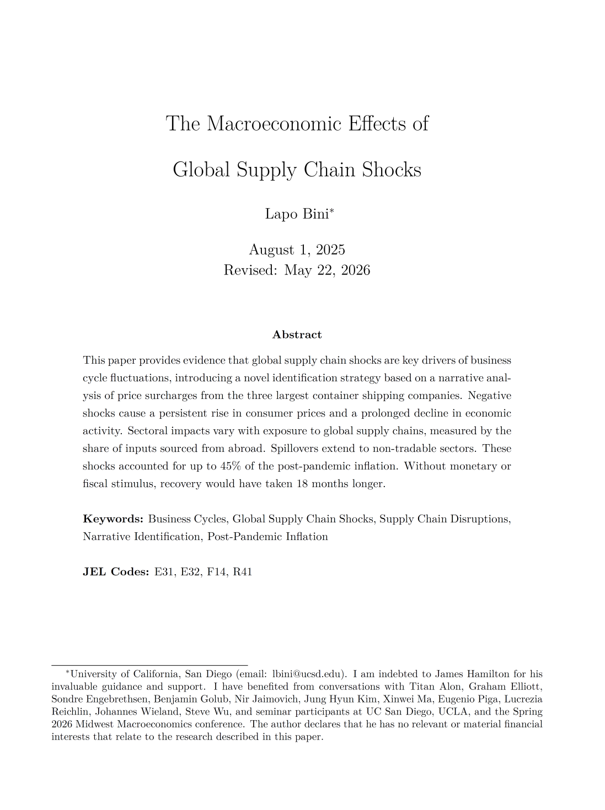
"The Macroeconomic Effects of Global Supply Chain Shocks" by Lapo Bini.
"This paper provides evidence that global supply chain shocks are key drivers of business cycle fluctuations, introducing a novel identification strategy based on a narrative analysis of price surcharges from the three largest container shipping companies. Negative shocks cause a persistent rise in consumer prices and a prolonged decline in economic activity. Sectoral impacts vary with exposure to global supply chains, measured by the share of inputs sourced from abroad. Spillovers extend to non-tradable sectors. These shocks accounted for up to 45% of the post-pandemic inflation. Without monetary or fiscal stimulus, recovery would have taken 18 months longer."
https://t.co/k27Eawg58t
The program for the 2026 Society for Economic Dynamics Annual Meeting in Athens is out!
It has been a dream to work with Jen-Jen La'O and our amazing committee to put together this year's program.
https://t.co/XwWDVvAirC
*Small logistical changes might still come.
Our updated measures of *supply chain uncertainty* to include the Iran war episode dwarf even the Covid period.
In recent work we show that high supply chain uncertainty makes the pass-through of energy-oil shocks to inflation much larger and persistent.👇
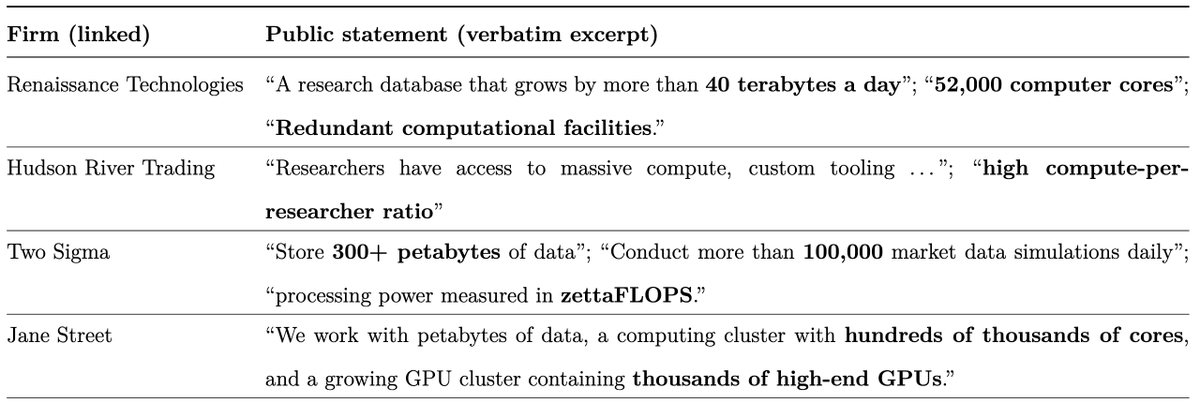
Did you know there is an arms race between quant hedge funds?
Ren Tec, HRT, Two Sigma, Citadel, and others are competing in how much data and compute they have.
But Why?
https://t.co/xT8Rd3Fq32
#econtwitter#Quant#ML#AI
@UCSDEcon Lapo Bini was awarded the 24-25 TA Excellence Award. Recipients of this award are recognized for their glowing effort and teaching evaluations from students! Learn more about his research in applied macroeconomics and time series econometrics: https://t.co/6BimXrq0c2
New paper: “Beyond the Taylor Rule” joint with Emi Nakamura and Venance Riblier. Emi presented this paper at the Jackson Hole Symposium. We investigate how descriptive and how prescriptive the Taylor rule is. 1/
https://t.co/ag3IAJGPQg
Super interesting!
"The Macroeconomic Effects of Global Supply Chain Shocks" by Lapo Bini.
"This paper examines the economic impacts of global supply chain disruptions. Using price surcharge announcements from the three largest containerized shipping companies, I construct a novel measure of global supply chain shocks. Negative shocks trigger a persistent rise in consumer prices and a decline in economic activity. ...Spillovers extend to non-tradable sectors. These shocks accounted for up to 51% of the post-pandemic inflation. Without monetary or fiscal stimulus, recovery would have been delayed by 18 months."
https://t.co/k27Eawg58t
@int_mon_econ Check this out: https://t.co/Yf0Xa9OIiE I study the macroeconomic effects of global supply chain disruptions on business cycle and post-pandemic inflation! @int_mon_econ
1/ #EconTwitter
My first solo research paper is out!
"The Macroeconomic Effects of Global Supply Chain Shocks"
https://t.co/8ltv47p4zU
As inflation surged globally, researchers and policy makers asked:
What role do supply chain disruptions play in business cycle fluctuations?
11/
For more details, results, and robustness checks, check out the full paper and online appendix:
https://t.co/8ltv47pCps
If you found this interesting, a retweet would help me share the work. Thank you!
1/ #EconTwitter
My first solo research paper is out!
"The Macroeconomic Effects of Global Supply Chain Shocks"
https://t.co/8ltv47p4zU
As inflation surged globally, researchers and policy makers asked:
What role do supply chain disruptions play in business cycle fluctuations?
10/
Global supply chain shocks are major drivers of business cycles.
They account for ~25% of the long-run variance in industrial production and ~35% in consumer prices, highlighting their central role in shaping macroeconomic fluctuations.