Rubric-based RL is everywhere — but the LLM-as-judge can be gamed, and the policy learns to hack it.
CHERRL injects a known bias into the judge, so you can reproduce reward hacking from a clean start, watch true vs proxy reward diverge, and pin the exact onset step. 🧵
you mean IDENTITY.md (name/creature/vibe/emoji/avatar)? I'm glad this is on your list, but I suppose neither IDENTITY nor MEMORY decides what deserves authority.
That's exactly how my CodexBar bug survived review: the knowledge existed, it just had no normative weight at review time.
I actually pitched an early version of this in clawsweeper#74 back in May: induce a draft repo profile from a few real accepted/rejected maintainer decisions. You (fairly) said to keep the bot core small and revisit "with concrete examples and outputs". Maybe https://t.co/atljBkNHxu is that concrete example: same invariant, learned twice by the repo, invisible at review time.
Agent identities fix what my #74 pitch lacked, a home outside the review pipeline. If I have the chance, would love to build this part with you. Prototype over the weekend, numbers included, same as #2228. Where should it land: core, plugin, or ClawSweeper first?
@steipete, I opened https://t.co/atljBkNHxu with a concrete fix and a review-system proposal: classify Codex rollout shape before accounting, then add a maintainer-approved architectural-memory loop to ClawSweeper.
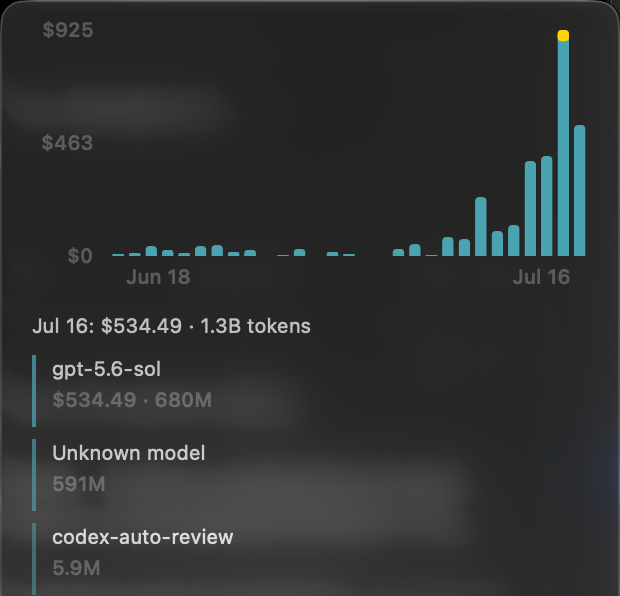
The currently installed CodexBar build on the affected machine displayed 1.3B tokens for one local day, including 591M under “Unknown model.” On a frozen 2,012-file corpus, current main reports 4.086B / 886M Unknown for Jul 16; the patch reports 231.5M / 0 Unknown for Jul 16, identically on cold, warm, and forced scans.
This proposal comes from sustained work in CodexBar: I have opened 27 PRs and 13 issues. Nineteen PRs merged directly, and #1042 was landed separately by the maintainer with co-author credit.
The process concern is repeated architectural learning: the repository had already documented these constraints and merged adjacent safeguards, but the next review did not carry them forward.
#2208 fixed a real reset-only subagent shape. But it encoded `source.subagent` as a universal counter-semantics rule. That is the wrong abstraction: the field describes lineage provenance. #2108 already documented copied-parent-prefix subagents, and #2118 protected parent-cache invalidation. The new rule bypassed that resolver entirely.
With that history in view, the failure mode follows directly. The fix in #2228 classifies rollout shape first, preserves genuinely restarted counters, removes proven copied prefixes at the local leaf boundary, and falls back to the inherited parent baseline when the boundary is unavailable. It also keeps #1042’s intended cache contract: parser changes rotate a generated producer hash; `codex-vN` is for incompatible schema/layout changes, not every parser fix.
This is also a useful ClawSweeper case study.
In a Jul 16 audit, a public ClawSweeper marker was present on 1,047 of 1,125 CodexBar PRs/issues opened since May 22, about 93.1%. A marker is not necessarily a substantive review. That scale is still impressive. But the #2208 state report retrieved only #2193, omitting #2037, #2108, and #2118. It reviewed head `0dbfc16f`; GitHub shows the final PR head as `59a18fcc`, with no later ClawSweeper state report or formal GitHub review recorded against that final head.
State report: https://t.co/Og3myoDND5
To be precise, GitHub records the final merge under @steipete, not ClawSweeper. I am criticizing the public review path’s missing architectural-memory gate, not inventing a bot merge actor.
The recorded review was internally consistent with the context it selected. The missing architectural-memory gate is the system bug.
ClawSweeper already has both halves of a better design:
1. Bottom-up repo state: per-item reports, root-cause clusters, decision packets, and review history.
2. A top-down prompt hook for `.agents/maintainer-notes/`, which is meant to preserve maintainer decisions and prevent well-intentioned reversions.
Review prompt: https://t.co/xru2sS5lsv
CodexBar currently has no maintainer-notes directory. The missing piece is a controlled promotion loop from high-quality history into versioned policy.
I am not proposing generic RAG over every comment. That would promote noise. The authority hierarchy should be explicit:
- current code, tests, and real runtime evidence establish observational truth;
- the repository contract and maintainer-approved notes establish normative policy;
- merged fixes, owner-authored reverts, and canonical issue decisions are candidates for promotion;
- bot reports and contributor comments remain evidence until a maintainer approves them.
After a merge, revert, or canonical owner decision, ClawSweeper could generate a small memory PR. Only a maintainer merge would activate it. Future reviews would load matching notes by path and concept, show which decisions were applied, and request an explicit maintainer acknowledgement when a diff conflicts with an active invariant. Notes need provenance, status, expiry, and supersession, not an immortal bag of text.
I would test this first on one subsystem: seed the Codex cost scanner’s hard-won invariants, replay the recent PR history without leaking future knowledge, and measure caught regressions, retrieval precision, and false warnings. Keep the pilot advisory until the evidence supports a stronger gate.
ClawSweeper does not need more raw context. It needs a memory hierarchy proportionate to its role in maintainer review and routing.
It seems clear that the Cursor team has said everything they intend to say on this topic.
In my opinion, that’s disappointing. For a company that started with so much goodwill and has grown into one of the biggest names in AI development tools, I expected better communication and more respect for the users who helped support it early on.
I don’t think most people in this thread were asking for the impossible. A clear, honest, and transparent explanation of what changed, why it changed, and how it affects legacy subscribers would have gone a long way. Even if many of us still disagreed with the decision, at least we would have understood it.
A good example is GitHub Copilot. When they changed their plans a month or so ago, everything was communicated clearly. Some users were unhappy, but they knew exactly what was changing, when it would happen, and what their options were. People could then decide whether to stay, upgrade, or move elsewhere.
Unfortunately, I don’t think Cursor handled this situation in the same way. Instead, many legacy users were left trying to piece together information from forum replies, previous announcements, and changing behavior in the product. That uncertainty has probably done more damage to trust than the actual pricing or model changes themselves.
That’s the part I find most disappointing. Legacy users weren’t just customers—we were early adopters who helped build Cursor’s reputation. I think we deserved clearer communication and a more transparent transition than what we received.
@jakevin7 I revisited two older twitter-cli PRs and cleared the review threads. #64 now uses twitter-text v3 weighting and scoped NoteTweet flags; #65 fails closed on unconfirmed Article publishing. Tests, Ruff, and mypy pass: https://t.co/uzYA8GjMYU
@wey_gu I cleared the remaining review feedback on a few con PRs. #247 is green and fixes clipboard-state collisions across duplicate code blocks. #245 and #248 now have fresh commits and CI runs: https://t.co/6836CN0ZJv
@sama I might be a data point in that 2.5x. Spun up an aggressive multi-agent dev loop and OOM'd a 32GB Macbook pro in record time. The bottleneck has officially shifted from intelligence to local unified memory.
I paid for Cursor Legacy Individual through Apr 25, 2027. In July, new frontier models moved behind token-billed Max Mode. Human support acknowledged the change, then denied a prorated remedy because I had used the plan and purchased it over 14 days earlier. @cursor_ai@mntruell
@cursor_ai@mntruell
as i quote from forum"
the amount of money cursor is charging for grok 4.5 is a scam bros, I ran something through grok 4.5 with open router and grok build and it costed me pennies, meanwhile I ran the exact same thing through cursor with “max mode” and it costed me dollars, the hell are you guys smoking? Max mode grok 4.5 is such a joke honestly, basically 50x the cost vs just using grok via open router or grok build"
Update: Support firmly refused a prorated refund.Cursor's logic:
Sell an annual subscription.
Put the best features behind a new paywall 3 months later.
Deny refunds because "you bought it over 14 days ago and used it before we changed the rules."It's like a gym selling an annual pass, removing all the weights in month 3, and refusing a refund because you "already used the treadmill." Absolute joke. @cursor_ai
thanks, this makes the direction much clearer. the gap i'm feeling is exactly in workflows that start in the browser: Atlas made page context feel ambient, while the extension makes me manage access and context. i'd love to see that low-friction loop survive, even if Atlas itself doesn't.
tried the new ChatGPT built-in browser today. honestly this feels like a browser for agents, not for me. no history search, no URL predictions, no Chrome extensions. even basic navigation feels clumsy. fine as a task canvas; i can't imagine using it all day.
1/3: A more robust in-app browser for you and your agent:
Now the in-app browser supports:
- multiple tabs
- password manager + autofill
- full authentication support including device passkeys, enterprise SSO
- downloads
- print, find in page, and other small features that you've known and love in browsers.
To try it, just tap Cmd + T on the Desktop app.
I love using the in-app browser to iterate with the agent on websites, documents on the cloud, and data dashboards.
Overall, it's pretty incredible to just have a built-in browser to view all the artifacts and citations from my agents without having to context switch and copy-paste URLs.
Legacy Individual users can access these new frontier models only through token-billed Max Mode. My annual plan runs through Apr 25, 2027; human support acknowledged the mid-term change but denied any prorated remedy.
Evidence: https://t.co/N8zAr2TY6H
I paid for Cursor Legacy Individual through Apr 25, 2027. In July, new frontier models moved behind token-billed Max Mode. Human support acknowledged the change, then denied a prorated remedy because I had used the plan and purchased it over 14 days earlier. @cursor_ai@mntruell
@cursor_ai@mntruell The impossible standard: I could only discover a July policy change after using the product, but that earlier usage is now being used to deny any remedy.
Full discussion:
https://t.co/tpCc1TK9Jf
that gap changes multi-tab Q&A: Atlas was "ask and keep browsing"; now i babysit access and context. the desktop app is Electron (app.asar + a 244MB Chromium framework), but the bigger problem is intentional. this is an agent workspace, not an everyday browser.
weirdly, the Chrome extension isn't short on permissions. its manifest has <all_urls>, debugger, history, tabs, scripting and nativeMessaging. what's missing is ambient context. Atlas owned the whole session; the extension has to attach and decide what it can read.