no independent test of the Hubble mirror's shape was planned.
two other instruments showed the error anyway. one showed it every time it was used. the other showed it in a May 1981 interferogram, about nine years before launch.
the one instrument trusted to check the shape of Hubble's mirror had been assembled incorrectly.
a lens in it sat about 1.3 mm out of position, against a tolerance of 0.01 mm. the mirror was polished to match it.
your CAD model knows exactly what the part looks like. It has no idea why.
everyone agrees the notes belong in the drawings, then writes them in email.
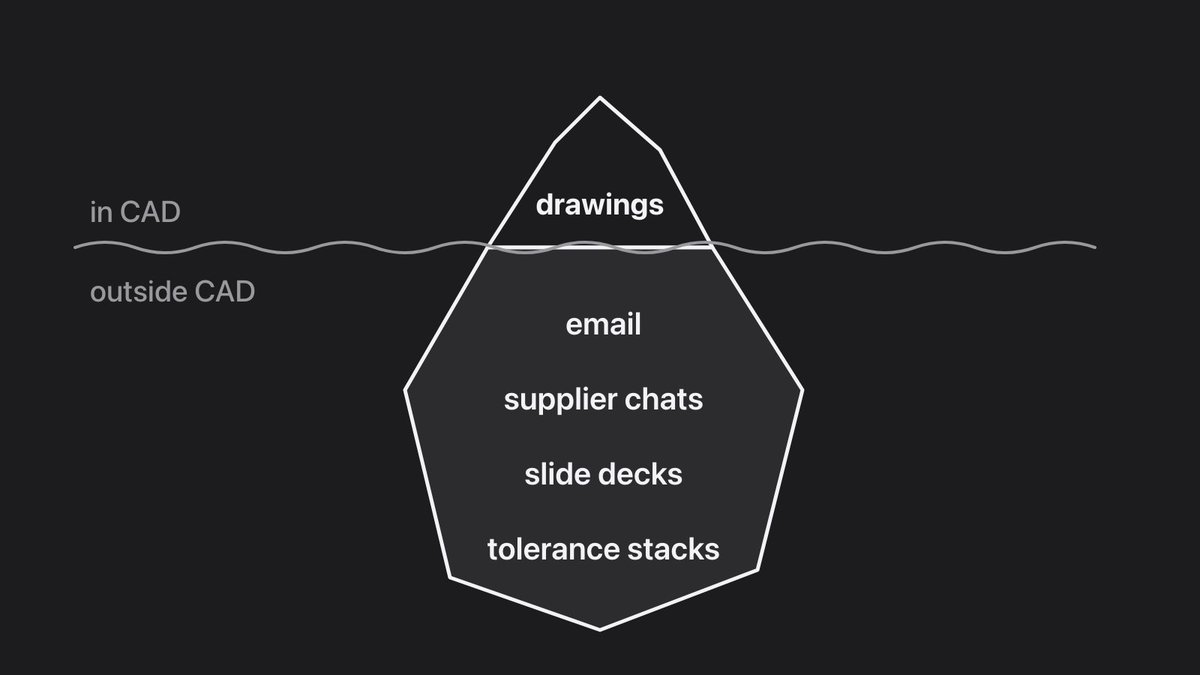
The rest gets scattered: - the tolerance stack in someone's spreadsheet - the material change agreed in a supplier chat - the "we tried that, it cracked" buried in a slide deck from two years ago - the deviation approved in a reply-all
None of it lives in the solids.
The drawing is the tip of the iceberg. The reasoning sits below the waterline, in tools that don't version with the part.
The geometry gets handed down. The intent gets lost.
If a decision changes the part, it should travel with the part.
more teams are starting and shipping hardware faster than ever.
5 months from idea to walking is the barrier coming down, the way it did for software. https://t.co/5jXPxXoqlr
Meet Roger, the humanoid purpose-built to protect human life in the most dangerous jobs across energy and public safety.
The experts stay safe and in control. Roger goes in.
No full autonomy needed.
Roger takes the risk. They get the job done.
Idea to walking in 5 months.
@paulg if the deepest change takes the form of code, whoever writes an org's internal tools ends up shaping it more than whoever picks its apps. does Replit win by turning ops people into those authors?
the change wasn't hidden. it was on the shop drawings the engineer's office reviewed and approved. it was even questioned in review. nobody ran the numbers.
on July 17, 1981, two walkways in the atrium of the Hyatt Regency in Kansas City fell to the lobby floor. 114 died. The reason?
the rods holding them up were not arranged the way the contract drawings showed.
July 17, 1981. at the Hyatt Regency in Kansas City, the fourth-floor walkway and the second-floor walkway suspended beneath it fell to the lobby floor.
a separate third-floor walkway did not collapse.
selling PLM to a small hardware team assumes they have 6 months to spare
one of our design partners told us the best case is "two months to set up."
So the why behind each change sits in email and Slack the whole time.