India is rushing to buy LNG to replace supply disrupted by the Middle East conflict 🇮🇳💰
The move is to meet demand from:
🌾 Fertilizer plants ahead of planting season
⚡ Power producers as hot weather boosts cooling needs
🏠 Houses switching from LPG
https://t.co/pco9idl1rl
Asian coal prices rise to the highest level in almost two years 🪨📈
What's going on?
🇮🇩 New Indonesia export rules are delaying shipments, tightening the market
🚢 Japan/Korea depending more on coal as Hormuz closure chokes LNG
🇨🇳 Summer heat is coming (higher Chinese demand)
Of note: The cost of urea fertilizer in the US GoM (New Orleans benchmark) is down to pre-war levels of ~$470 per metric ton (down ~33% from a peak of ~$710 in mid-April).
Urea prices also sharply lower (30-40% down) in Latam and Europe, although still above pre-war levels.
🇨🇳At the open, China’s most-active futures contracts were mixed: coking coal rose over 3%, coke and rapeseed oil gained more than 2%, asphalt and methanol were up about 1%. On the downside, #palladium fell over 3%; #platinum, SHFE #silver and SHFE #nickel declined more than 2% #gold down 0.5%; stainless steel (SS) and #lithium carbonate dropped nearly 2%
$XAUUSD $XAU $GLD $XAGUSD $XAG $SLV $XPD $XPDUSD $XPT $XPTUSD #OOTT (https://t.co/nJCFrCez0t)
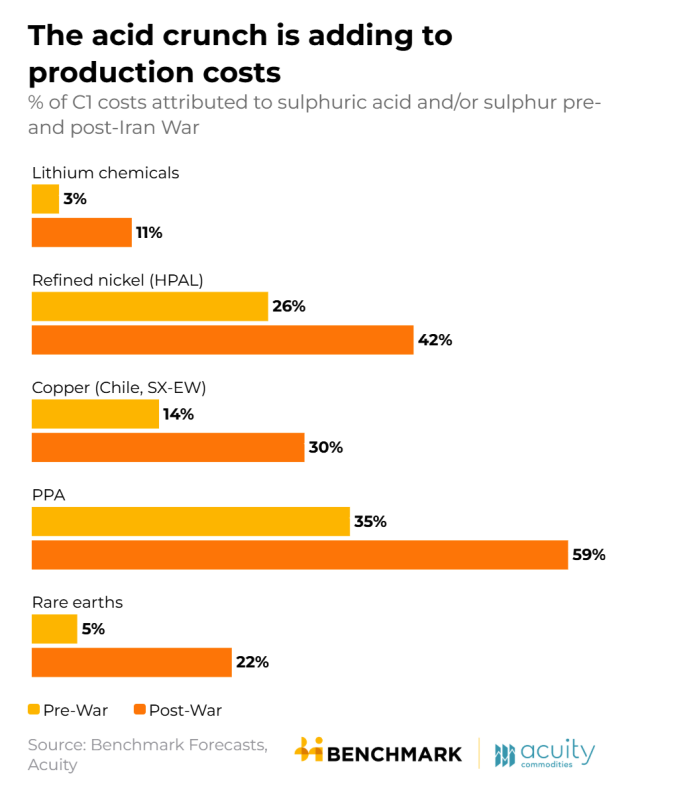
Sulphuric acid has overtaken energy as the single largest cost component in hard-rock lithium conversion.
Geopolitical conflict in the Middle East has sent sulphur prices climbing over 50%, causing regional sulphuric acid prices to more than double and forcing a severe supply crunch across critical minerals.
According to a Benchmark Mineral Intelligence study:
▪️ Lithium Squeeze: Sulphuric acid previously represented 3% of lithium production costs; it now accounts for 11% (and 22% of total conversion costs).
▪️ Nickel Exposure: Sulphur input costs for HPAL nickel have jumped from 26% to 42%.
▪️ Supply Risk: With half of the global seaborne sulphur trade passing through the Strait of Hormuz, over 50% of 2026 lithium, cobalt, and rare earth output faces direct disruption exposure.
Paul Flynn and Whitehaven's big bet 💥
M&A stories & ambitions. Thermal vs Met. Coal's new era. Royalties. India. Activists. All of it. And more.
YT → https://t.co/Ar0gzhW7rP
Spotify → https://t.co/nWCXaXk5bo
Focus → https://t.co/pfuuizmf8u
China’s LNG imports are recovering at a bad time for Europe 🇨🇳🚢
More Chinese purchases comes just as Europe needs to restock for winter. European LNG imports are already down ~13% year-over-year
Meanwhile, Hormuz remains shut -- choking a fifth of global LNG supply
The power revolution is next:
Annual thermal power plant additions surged +70% YoY in 2025, to ~92 gigawatts, the largest annual increase since data began in 2008.
This is also +28% above the prior peak of ~72 gigawatts set in 2015.
The pipeline of future plants is growing even faster, with Chinese firms submitting approval requests for 51 gigawatts of new coal capacity in Q1 2026 alone.
At this pace, 2026 is on track to surpass the record 162 gigawatts of new proposals filed across the full year of 2025.
This comes as China continues to promote coal as a reliable backup when wind and solar power are unavailable, while simultaneously pledging that coal use will peak before 2030.
Meanwhile, China is also aggressively expanding nuclear capacity, with 39 reactors currently under construction, nearly 5 times more than India, which is in 2nd place, at 8 reactors.
Energy is the next hot commodity.
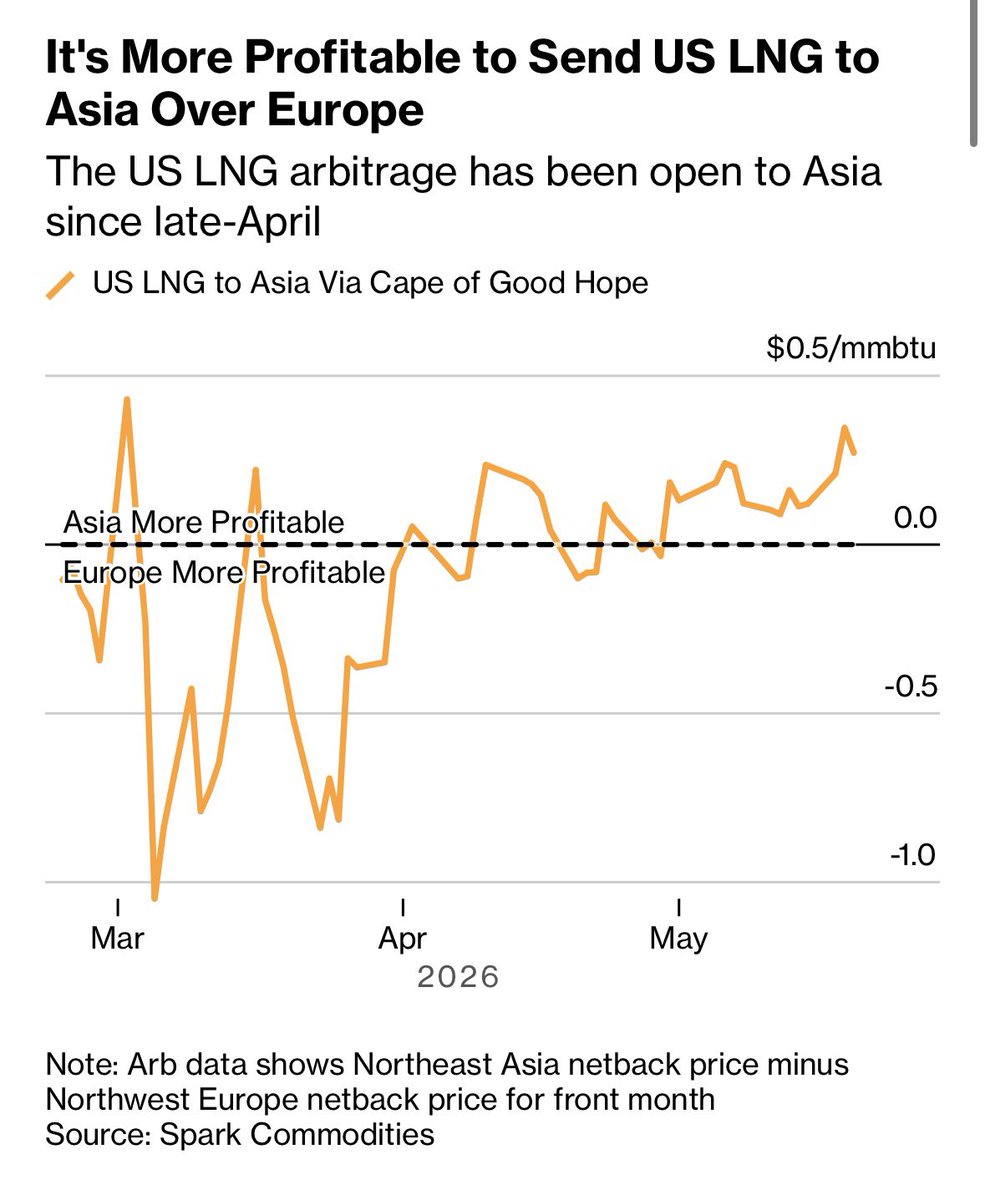
Asia is pulling LNG away from Europe
🚢 🚢 🚢
It has been more profitable to send LNG to Asia since late-April
That’s reducing LNG flows to Europe — imports into the region are down 16% compared to this time last year (on a 30-day moving basis)
https://t.co/IIErYazW7h
A deadly blast at a mine in China’s coal hub threatens to tighten supply of the power plant fuel 🇨🇳 🪨
Stricter safety checks in Shanxi province could curb near-term production and support prices just as summer begins
https://t.co/GE35gyp9hC
CHART OF THE DAY: Electric car sales grew by 20% globally to exceed 20 million in 2025, meaning 1/4 of all new cars sold were electric, according to @IEA new report. Note, however, that a growing share of those electric cars include a gasoline engine (PHEV and EREV).
David Friedberg: El Niño Could Trigger a Global Food Crisis
“This Science Corner is about the dreaded El Niño season that is coming up.
Ocean temperatures are going to exceed anything we have seen in recent history.
Why does this all matter? The reason is the oceans are the battery of weather.
And at this point, there is so much excess energy stored up in the oceans, it's about 11 million terawatt-hours. That's 500 years worth of human energy in this ocean. And over the next few months, that energy's going to be released into the atmosphere.
99% confidence that will make the upcoming year the hottest year on record by far that humans have ever experienced.
Southern Argentina, Chile, Brazil could see record-shattering heat waves, and this is where things start to get a little nasty, because when that happens, the crops start to fail. Hundreds of millions of people depend on the exports out of Brazil, Brazil is the world's largest ag exporter.
And the scariest one of all is if the monsoons fail, which is now a very high probability event in India. 150 million farmers in India, and 1.5 billion people that depend on that food.
If you think about the second and third order effects of this, over the next year you could see energy prices spiking, and electricity spiking, and the grid failing in parts of the Southwest. Commodity prices spiking all over the world. And then you would see places like India, the Philippines, Vietnam starting to face some sort of unrest if there isn't enough food supply that's coming into those markets.
And then the question in India is a really nasty one because there isn't a really good solution.”
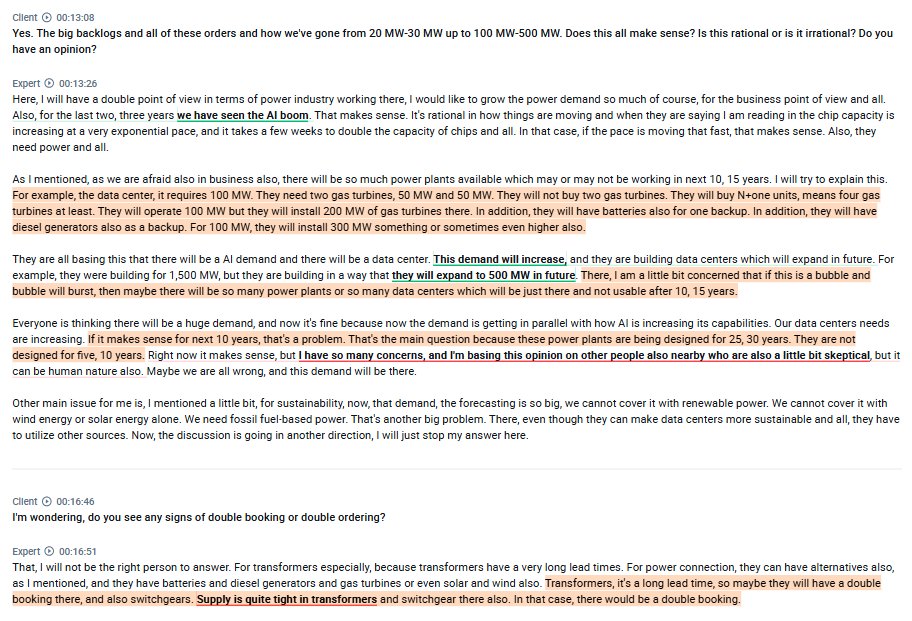
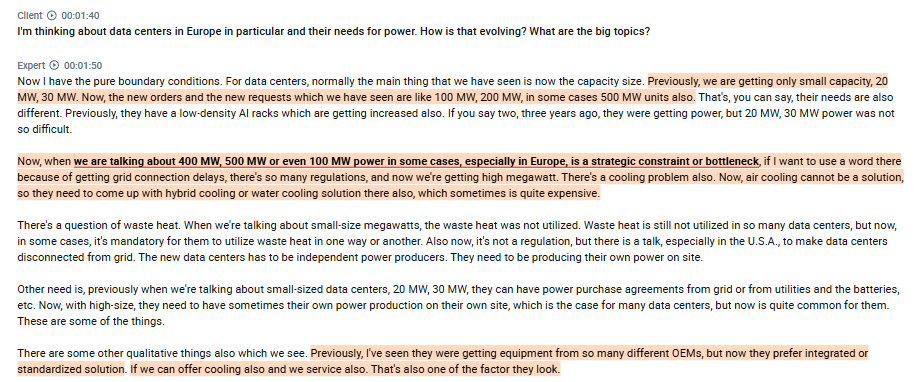
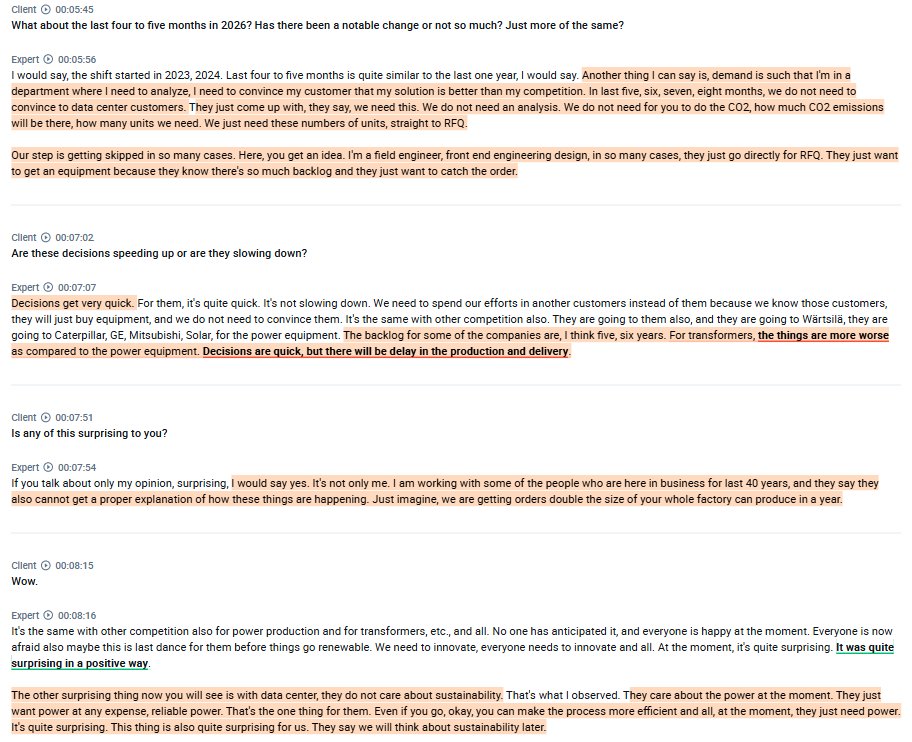
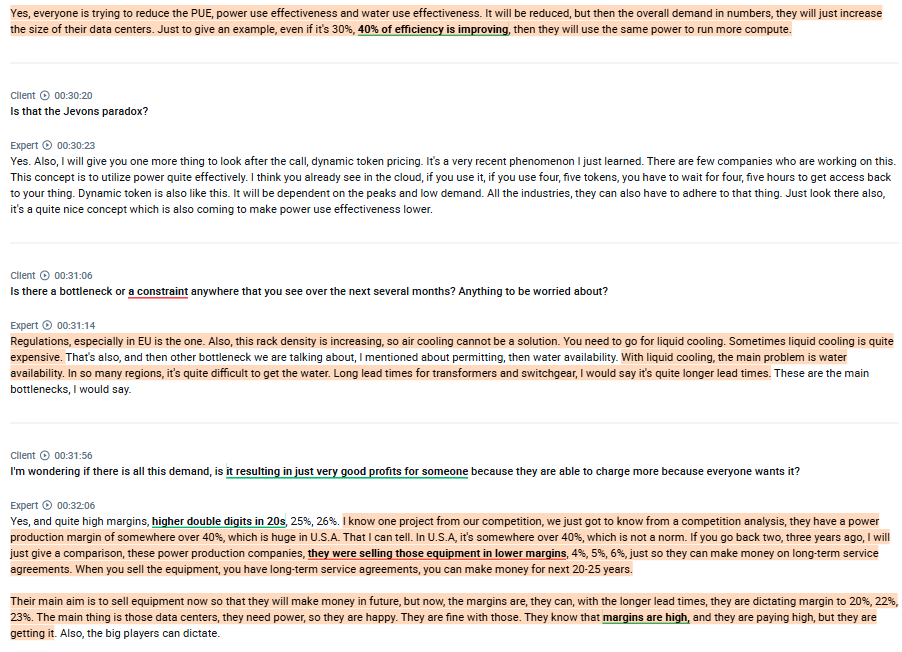
A MUST-read interview with a Siemens employee explaining just how high demand is for energy equipment right now because of AI:
1. The whole situation is shocking even for people who have been in the business for 40 years. They are getting orders that are double the size of what their entire factory can produce in a year.
2. Demand is so high in the last 5-8 months that they don't need to convince or send any analysis (such as CO2 emissions, etc.) to clients because they just want the equipment, because there's so much backlog that they just want to catch the order.
3. Decisions are being made very quickly by clients; the backlog for some of the energy equipment companies is 5-6 years. For transformers, the situation is even more difficult.
4. He mentions that right now, data center builders do not care about sustainability; they just want power at any expense, reliable power. They say they will think about sustainability later.
5. The orders have gone from previous 20-30 MW orders to now 200-500 MW units. Customers have previously wanted to get equipment from different OEMs, but now they prefer an integrated standardized solution.
6. An interesting dynamic is that even though the data center requires 100 MW, the builders are buying N+1 units of gas turbines (so more than just for 100 MW) as backups, as well as having more energy capacity, as they believe they will continue to grow that data center.
7. He does believe there is some double booking going on on transformers and switchgears because of extra-long lead times.
8. Everyone is trying to reduce PUE, and water use effectiveness, but even after improving, they just use the same power to run more compute.
9. The problem is also liquid cooling, as it is expensive, and water availability in many regions is a problem.
10. Margins on equipment in the sector have gone from 4-6%, where they were 2-3 years ago, to 20-23% and in some cases even 40%. The data center builders know the margins are high, but they are fine with it because they just want to get it.
found on @AlphaSenseInc
Environmental license issued for the Alacran copper project previously owned by $CDB.V
Together with the El Roble operating mine in the same forest area as $ANDC.V's Cobrasco, a bit of a good look for the company as well as other peers/seniors in Colombia