Most SNARKs encode computations into finite fields. Snarking integer arithmetic needed, for example, in ML and RSA, incurs a big overhead. Our new paper with the @lagrangedev research team builds SNARKs that work with integers natively---see our new paper https://t.co/cmWfEKTkNk!
❓Can just 1,000 physical qubits run practical quantum algorithms requiring 10+ billion logical operations without a single error?
Yes!
I am thrilled to share our new work introducing mitten codes: 20%-rate qLDPC processors with parallel fault-tolerant logic and real-time telescoping decoding, offering a practical path toward scalable, fault-tolerant quantum computation. ⚛️
Paper: https://t.co/5vuhGyKSyM
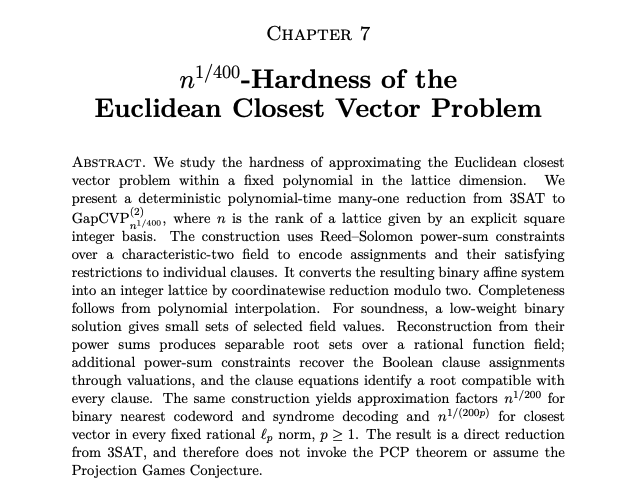
Just to clarify something for the post-quantum space, this isn't an attack on ML-DSA or ML-KEM, it's actually kind of the opposite. What was proved is a hardness result: approximating the CVP within n^(1/400) is NP-hard. So it is another evidence that a lattice problem is difficult (which we want :)).
So there is no algorithm anywhere in this work or a no deployed scheme getting weaker.
1/6 Frontier LLM models just helped us solve an open problem on quantum channel capacity (https://t.co/3VSAKX9F6V) I’d been stuck on since 2022, when @wangxinfelix first posed it to me. I honestly don’t think I would have completed this work without AI assistance.
Quantum chip fabrication requires a cleanroom that keeps out noise, dust, and contaminants to ensure proper development.
Because the Josephson junction, the superconducting device that controls electrons, is smaller than a grain of human hair!
Source: https://t.co/xSZnMVHhLK
My take on the AI situation in q information/applied math: it looks like we are on the brink of a revolution that's comparable to the invention of telescopes for astronomy (credit to @martinmbauer for the analogy). We will no longer see things with our naked eye, but... 1/
wow, so frontier models can also solve deep theory questions in quantum cryptography.
wondering more and more what next year @qip conference will look like
I'm happy to see the unclonable encryption problem solved; Prabhanjan Ananth and Amit Sahai report their findings, with the help of the UCLA harness (link below). This was a challenge for the quantum crypto community for the last 6 years.