nice, which prompts was the 125 tok/s measured on?
on our DGX Spark, Inkling 2 Mini's bundled draft model made one 32k-token prompt 3.4x faster and another only 1.8x in SGLang, while plain decode ran all five at about 31 tok/s.
so we now read any draft-model speedup as partly a statement about the prompts.
https://t.co/CL1yU4uS7G
@ho_bevan yes, our best stretches hit 7.2 tokens per pass of the possible 8!
on Qwen3.8-27B each wrong guess cost only 1.77 ms, so a longer draft is cheap to try per prompt type 👇 https://t.co/jXTaHmI67e
we gave our drafter 2 more guesses per pass and got zero extra accepted tokens.
so what did those wrong guesses cost us?
a small model, DFlash2, guesses the next few tokens and Qwen3.8-27B checks them all in one pass. at 7 guesses instead of 5, it still accepted the same 48 in the same 15 passes, and the reply came out 53 ms slower.
that's 1.77 ms per wrong guess. being wrong is cheap, so the number worth tuning is how many guesses the big model keeps.
we timed each setup 10 times, one request at a time. a second prompt cost 1.76 ms per wrong guess, almost the same, so the price held across prompts.
our draft model on Inkling 2 Mini made one 32k-token prompt 3.4x faster and another only 1.8x. the only thing that changed was the text 👇
with the draft model on, Inkling 2 Mini ran our five 32k-token prompts at anything from 57 to 107 tok/s. plain decode ran all five at about 31.
the draft model guesses 7 tokens ahead, and the big model keeps the guesses it agrees with in one pass, so speed most likely depends on how predictable the next stretch of text is.
at 32k, SGLang logged anywhere from 2.8 to 7.2 tokens per pass.
a second server matched every prompt's speed within 0.3 tok/s, so the spread comes from the text itself.
that makes a speculative decoding number partly a statement about the prompts.
our 32k median was 71 tok/s, yet our fastest prompt ran 1.9x our slowest.
which prompts do you use when you benchmark a draft model?
@laky_fx makes sense, cause a lifetime average hides exactly this! ours swung from 2.8 to 7.2 tokens per pass across our five 32k prompts at temperature 0.
do you see the rolling rate split by request type, like code vs chat?
it tracks how the prompt ends. the 107 one stops inside a table of unicode escapes like 0x10584:'\U00010584', and its last few thousand characters compress best of the five.
the 57 one stops in docstring prose. only 5 prompts though, and over the full 32k the ranking disappears.
hmm good call, we haven't tried with temperature 0.7 at temperature 1 on 1k prompts the draft model already fell from 83 to 53 and 65 tok/s on two servers, keeping 3.2 to 4 tokens per pass instead of 5.3, so the fast end most likely shrinks.
agreed on quoting the 57 for latency!
the loop is going to trip up local tooling at first.
when we ran Inkling 2 Mini on our DGX Spark, llama.cpp couldn't load its GGUF, because the metadata says 48 blocks while the file holds 24 physical ones, with the middle 12 run 3 times per token.
will the GLM-5.4 weights describe the loop in the config so loaders can follow it?
https://t.co/7wo3o48Jh6
if you run Inkling 2 Mini on a DGX Spark, a 2.3x speedup is already sitting inside the checkpoint you downloaded!
a small draft model ships inside it, guesses 7 tokens ahead, and the big model checks all 7 in one pass.
we ran it in SGLang with one request at a time, on 1k-token prompts of docs and Python code.
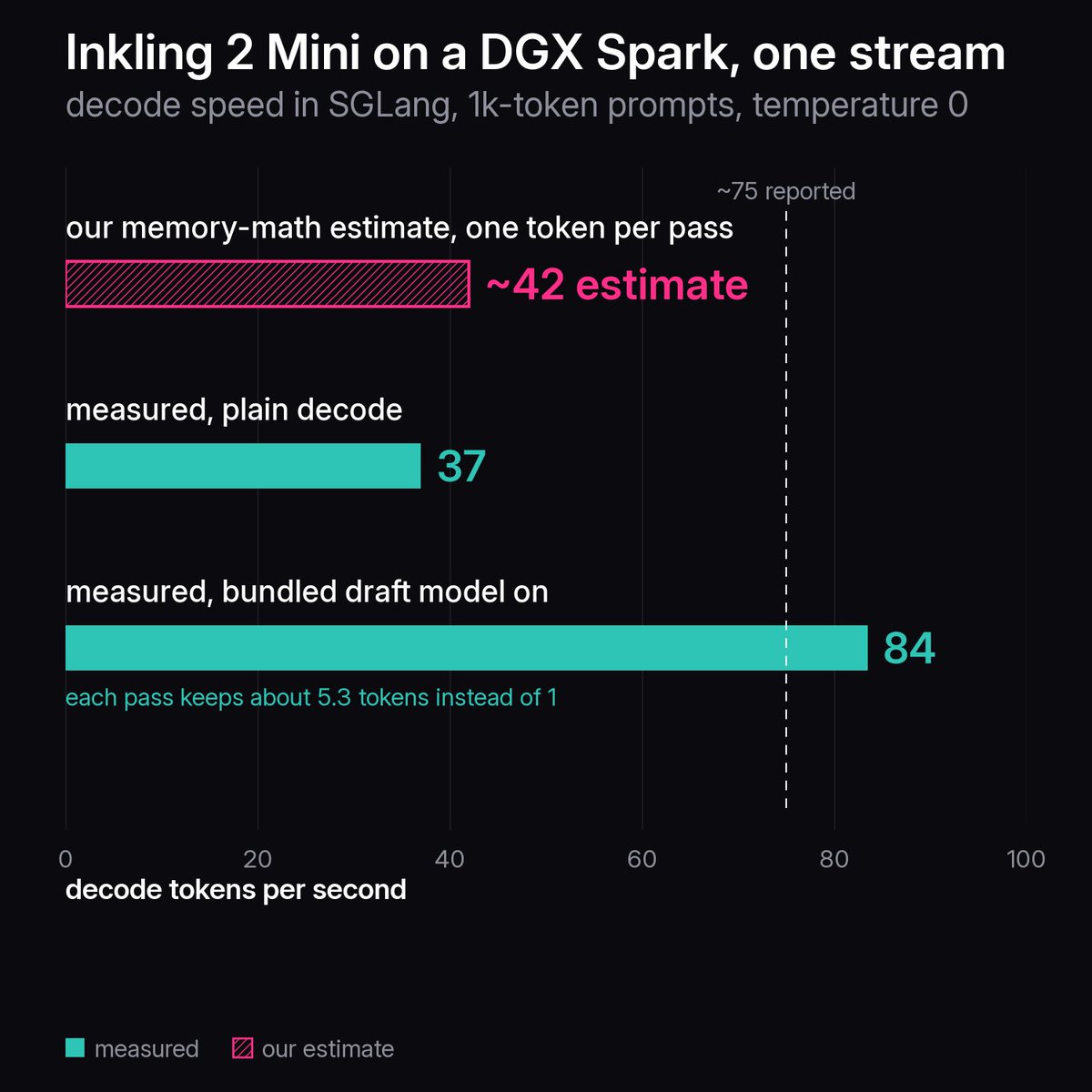
plain decode gave us 37 tok/s, 87% of the 42 our memory-speed math predicted this morning.
with the draft on we got 83, because each pass kept about 5.3 tokens instead of 1.
with a 32k-token prompt, the draft model still more than doubled decode speed, from 32 tok/s to 71.
at temperature 1, each pass kept about 3 tokens instead of 5.3, so the gain shrank to 1.5x, 53 tok/s.
so ~75 tok/s on this box is within reach with the draft on, at least on text this predictable.
thank you @thinkymachines@soumithchintala
if you're picking a drafter for speculative decoding, a simple ratio called all 4 our Qwen3.8-27B speedups to within 5% 👇
a pass that checks drafts costs a little more than a plain decode step, and it hands back more than one token. so the speedup per token is tokens per pass / how much more a pass costs.
we ran it with vLLM & with DFlash2 checking 7 drafts, we got 5.33 tokens per pass on our code prompt, and each pass cost 1.18x a plain step.
that predicts 4.52x, and we measured 4.33x.
the same division held for the other setups. MTP with 1 draft predicted 1.76x against 1.74x measured, MTP with 3 drafts 2.44x against 2.36x, and DFlash2 with 3 drafts 2.82x against 2.72x.
both sides leave out the fixed setup time of each request, which is why the whole-reply speedup in the DFlash2 case was lower, at 3.96x.
so tokens per pass does nearly all the work, since our passes cost only 1.10x to 1.27x a plain step while handing back 1.9 to 5.3 tokens.
when you compare drafters, measure tokens per pass on your own prompts first.
every time we started Inkling 2 Mini on our spark, SGLang spent about 2 minutes just loading the weights!
that's one 19.5 GB file in 120 to 136 s, about 0.15 GB/s, and on starts with warm compile caches it was over half the time until the server answered.
the 0.64 GB draft model file loaded at a similar rate, in 3.5 to 4.3 s.
has anyone traced where SGLang spends those 2 minutes?
we've been running it on one DGX Spark this week.
in SGLang, a single request gets about 36 tokens/s, and 32 requests at once lift the total about 6x to 225 tokens/s while each one slows to about 7.
so the same box can be a fast assistant for one person or a slow one for many.
https://t.co/QIgyVKEHcV
one DGX Spark running Inkling 2 Mini can serve one fast request or many slow ones at the same time, so we measured how that trade works out in SGLang.
with 1 request, it produced about 36 tokens/s. with 32 requests at once, the total rose about 6x to 225 tokens/s, while each request slowed to about 7 tokens/s.
2 at once lifted the total 1.5x and 8 lifted it 3x, and it was still climbing at 32, the most we tried. 61 of the 96 timed requests at 32 hit the prefix cache, which flatters that top number by an amount we didn't measure.
it grows far less than 32x most likely because Inkling is a mixture of experts. one request reads 8 of its 128 experts per layer, but we estimate 32 requests picking at random need about 112 between them, so each step reads far more weights.
@dair_ai the serving cost part shows up on the power meter too.
on our DGX Spark, a 27B model drew 45.4 W in plain decode and 37.4 to 39.2 W with an MTP or DFlash2 drafter on, so replies finished faster and on less power.
https://t.co/NaFi38zZAR
if you watch nvidia-smi while you decode, look at the power.
plain decode drew 45.4 W on our 27B. speculative decoding drew at most 39.2 W.
the setup doing more work per pass drew less.
every MTP and DFlash2 setup sat between 37.4 and 39.2 W.
plain decode sat at 45.4 W, and ran the hottest.
on our code prompt, a reply took about 666 J with speculation off and 145 J with DFlash2.
4.6x less energy, for a reply that came back 3.96x faster.
we don't know why yet. our best guess is that a plain step multiplies one row, and our timing showed the matmul path changes at two rows.
curious if anyone has seen batch-1 decode pull more power than wider passes on other gpus?
@filicroval that's in the range we saw once the draft model that ships inside the checkpoint was on.
in SGLang on our DGX Spark, one request ran 36.6 tok/s without it and 83.5 tok/s with it, so we're curious whether your 67 has it on.
https://t.co/26xwLlYY9l
if you run Inkling 2 Mini on a DGX Spark, a 2.3x speedup is already sitting inside the checkpoint you downloaded!
a small draft model ships inside it, guesses 7 tokens ahead, and the big model checks all 7 in one pass.
we ran it in SGLang with one request at a time, on 1k-token prompts of docs and Python code.
plain decode gave us 37 tok/s, 87% of the 42 our memory-speed math predicted this morning.
with the draft on we got 83, because each pass kept about 5.3 tokens instead of 1.
with a 32k-token prompt, the draft model still more than doubled decode speed, from 32 tok/s to 71.
at temperature 1, each pass kept about 3 tokens instead of 5.3, so the gain shrank to 1.5x, 53 tok/s.
so ~75 tok/s on this box is within reach with the draft on, at least on text this predictable.
thank you @thinkymachines@soumithchintala
one DGX Spark running Inkling 2 Mini can serve one fast request or many slow ones at the same time, so we measured how that trade works out in SGLang.
with 1 request, it produced about 36 tokens/s. with 32 requests at once, the total rose about 6x to 225 tokens/s, while each request slowed to about 7 tokens/s.
2 at once lifted the total 1.5x and 8 lifted it 3x, and it was still climbing at 32, the most we tried. 61 of the 96 timed requests at 32 hit the prefix cache, which flatters that top number by an amount we didn't measure.
it grows far less than 32x most likely because Inkling is a mixture of experts. one request reads 8 of its 128 experts per layer, but we estimate 32 requests picking at random need about 112 between them, so each step reads far more weights.
@soumithchintala@ericjang11 Wow might be worth giving it a shot! I’ve been mostly using gpt-6 Sol for cyber with different prompt combinations to bypass the warnings 💀
@m7jazin interesting, thanks! our 784 was with prefix caching off, so we haven't seen what block size vLLM picks with it on.
if each group could keep its own block size, would attention drop back near 16, or would the shared memory pool still tie it to the state size?
we watched 2 token slots in a finished request's attention cache on our DGX Spark. 1,760 of 1,760 later checks found them changed, yet no attention layer ever wrote to them!
so who did?
Qwen3.8-27B mixes 16 attention layers, which keep a key/value (KV) entry per token, with 48 linear-attention layers (Gated DeltaNet), which keep one running state per request.
vLLM stores both in one pool of memory pages, so it grows the attention block until an attention page is at least as big as a state page.
that made each block 784 tokens with speculation off and up to 832 with speculative decoding on, while Qwen3-0.6B, which has no linear-attention layers, keeps the usual 16.
two engine steps after our request finished, vLLM handed its page to the next request's linear-attention state, and our slots changed on every check from then on.
so the same page most likely held one request's keys and values, then the next request's running state.
curious about how big these blocks get on a hybrid model with prefix caching on?