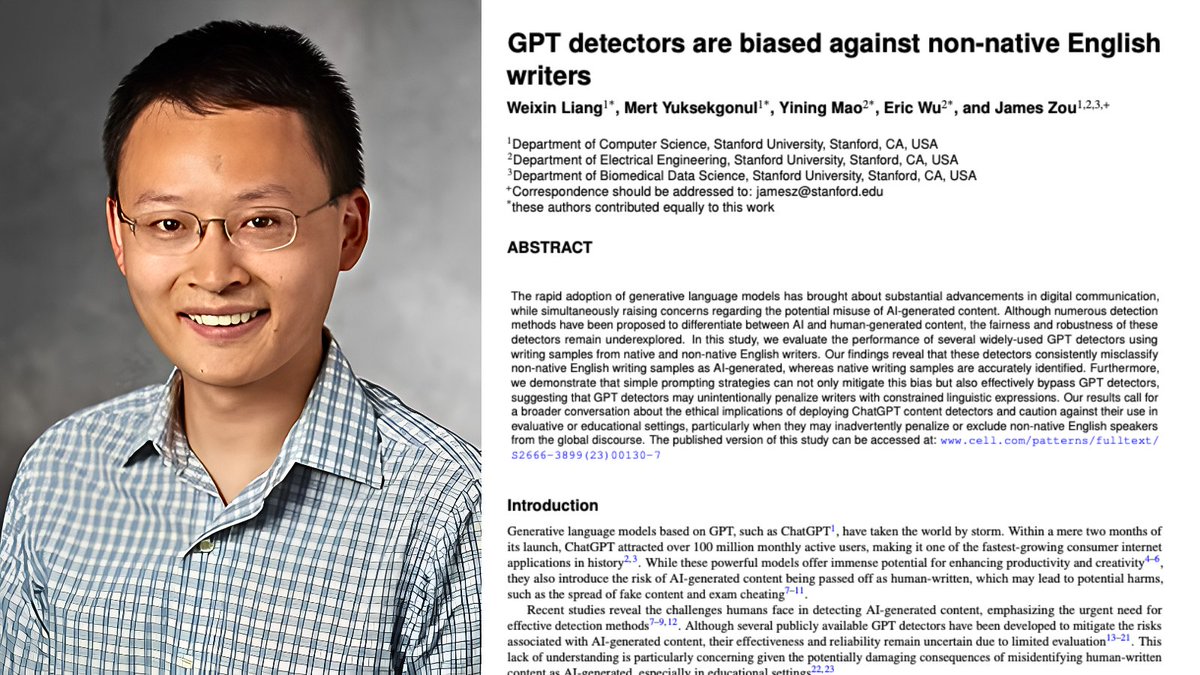
A Stanford team proved AI detectors call human writing fake more than 61% of the time, then found the fastest way to pass the test was to let ChatGPT rewrite the essay for you.
I had to reread the study, because it sounds like a joke and it's being used to punish people every day.
The team was led by James Zou. They took 91 essays written by real students preparing for an English exam for foreign speakers. They fed them to seven of the most popular AI detectors on the market.
On average, more than 61% came back flagged as machine-written. 89 of the 91 essays got flagged by at least one detector.
Then they ran essays by American eighth graders through the same seven detectors. Almost perfect scores. Human, human, human.
The reason is almost insulting once you see it.
Most detectors guess by measuring how predictable your words are. A chatbot picks the most likely next word, every time. So does someone writing in their second language, because they reach for the safe word they know instead of the fancy one they're unsure of. Plain English looks like a robot to these machines.
So the researchers asked ChatGPT to rewrite the flagged essays with bigger vocabulary. The flag rate crashed from 61% to about 12%.
The cure for looking like a machine was letting a machine rewrite you.
The company that built ChatGPT already knew this. In January 2023, OpenAI launched its own detector. It caught only 1 in 4 AI-written texts and wrongly accused real humans 1 time in 11. Six months later they switched it off. The note is still on their website. One line. Pulled for its low rate of accuracy.
The people who understand this technology best gave up on it. Everyone else kept going.
A copywriter once pasted the Declaration of Independence into a detector. It came back 98.51% AI. Thomas Jefferson wrote it with a quill in 1776.
We laughed at that one too. This summer it stopped being funny.
Jamir Nazir is a 62-year-old writer from Trinidad. In May he won a regional title in the Commonwealth Short Story Prize, one of the hardest prizes in the world for unpublished fiction. Within days, a detector called Pangram scored his story 100% artificial. The screenshot spread. Strangers turned his sentences into memes.
What they didn't know: Nazir has neuropathy. He can barely type. He dictates his stories into his Android phone and edits them there, a few lines at a time.
The prize organizers spent a month going through his drafts, his character notes, even an ending he'd written and thrown away. They cleared him and named him the overall winner. Granta, the magazine that published his story, cut ties with the prize anyway.
People still argue about his story, and that's fine. Arguing over evidence is what humans are supposed to do.
What bothers me is the order. The number came first. The drafts came a month later. By then his mother had already heard what the internet was saying about her son.
In July, Substack gave every reader a button to scan any post for AI. Medium's CEO, Tony Stubblebine, said the part out loud: people cheating on purpose just run their text through a "humanizer" app and walk straight past the detector. The only people left to catch are the honest ones.
And the math doesn't care how good the detector is. Say it's wrong once in every 10,000 scans. Run it millions of times on a platform and real writers get branded as fakes every single week.
Now take the human out of the loop.
Today a teacher still reads the score and decides. Picture the version where nobody does. A hiring system that silently throws away every cover letter scoring above 80% AI. You never hear back. You never find out why. An immigration office screening personal statements the same way, hitting hardest the people Stanford already proved it gets wrong: anyone writing in their second language.
This isn't science fiction. Freelance writers were already losing clients over detector scores back in 2024.
A person who wrongly accuses you can be questioned. They can apologize. They can be fired. A score can't. It just runs again tomorrow on the next million people, just as sure of itself, just as wrong.
We can't hand verdicts to software that flagged a Founding Father.
So what should we do instead?
Let a score buy a conversation, never a punishment. Even Turnitin, the biggest name in school detection, tells teachers not to use its AI score as the only reason to act against a student. Ask for the drafts. Ask the person to walk you through one paragraph. Nazir's truth came out of a folder of old versions, not a percentage.
Stamp the machine instead of interrogating the human. Google already marks text written by Gemini in a way software can read, and Europe's new rules, live since August, push every AI company to do the same. If the label is baked in at the source, nobody has to guess who wrote what.
Guessing is the whole problem. These tools look at your sentences and make a bet on your honesty. When they lose the bet, you pay.
If a detector flagged the last thing you wrote, what proof do you have sitting on your laptop right now?
My hot take is that if your company builds software that it cannot stop from hacking into other systems, your company is a malware company and should be treated as such
Oxford and Cambridge Researchers proved every LLM trained only on AI-generated content develops an irreversible disorder.
They call it "Model Collapse"
Researchers took a small language model and fed it its own output for nine generations. Each new model learned only from what the one before it wrote.
By generation nine the model had forgotten what it was talking about. Ask it about medieval church towers and it answers with a list of jackrabbits.
They called it model collapse. The name stuck.
The mechanic is simple. Every model slightly overproduces the common stuff and underproduces the rare stuff. Train the next one on that output and the rare stuff shrinks again. Do that enough times and the edges of reality disappear.
The rare stuff is where the useful things live. Minority languages, unusual cases, the outliers that make a model sharp instead of average.
Now look at what gets published online. Ahrefs checked 900,000 new web pages last year and found AI-generated text in 74 percent of them. Every scraper feeding the next training run picks that up.
The labs know this. That's why they're paying for human archives. News Corp alone got a reported 250 million dollars from OpenAI for five years of access. The paper called it a first mover advantage. Whoever trained before the flood holds an asset nobody can recreate.
The paper also found half a fix. When the researchers kept just 10 percent real human data in every generation, the damage dropped to minor. Real data isn't optional. It's the anchor.
So the thing being burned right now isn't compute or money. It's the supply of human writing that hasn't been through a model.
Every time someone posts machine output, the next model gets a little more average. That isn't a moral point. It's a measurement.
The paper is two years old. The experiment it describes is still running, and we're the training data.
A recent poll shows that the American people overwhelmingly want to ban artificial super intelligence and pause the development of AI until we establish clear safety standards.
Terry Tao is probably the most measured, pro-AI mathematician on the planet - which makes this quote especially concerning to read. 😟
If sharing your hunches means getting scooped ~immediately without acknowledgement, then we're going to see not just math but all other science / engineering disciplines go dark.
Two economists mathematically proved that AI will destroy the economy.
Researchers from Wharton and Boston University published a terryfiying paper called "The AI Layoff Trap."
They mapped out the economic end-game of the AI transition, and it exposes a fatal flaw in competitive capitalism.
When a company replaces a worker with AI, it captures 100% of the wage savings.
But that displaced worker is also a consumer. When they lose their job, they stop buying things.
The company gets all the savings, but the loss of consumer demand is spread across the entire economy.
If there are 20 competitors in a market, a CEO only absorbs 1/20th of the economic damage their layoffs just created.
So every single rational CEO has a mathematical incentive to automate as fast as possible.
They can literally see the cliff approaching, and they still step on the gas.
It triggers an unavoidable Prisoner’s Dilemma. If you don't automate, your competitors will, and they will crush you on price.
It doesn't just hurt workers. It destroys the businesses, too.
The economy gets trapped in an automation arms race. Companies fire their workforce to stay competitive, until the entire consumer base is completely hollowed out.
At the limit, the paper concludes: “Firms automate their way to boundless productivity and zero demand.”
And the scariest part?
The researchers mathematically tested every popular fix.
Universal Basic Income? Fails. It raises the living standard but doesn't change the corporate incentive to cut jobs. Retraining? Fails. Worker equity? Fails.
The paper proves that more competition actually makes the collapse happen faster. And "better" AI makes the damage worse.
The only thing that mathematically stops the collapse is a targeted automation tax, forcing companies to pay for the purchasing power they destroy before they automate the job.
This paper gives a fancy name to a problem you can already feel in your bones
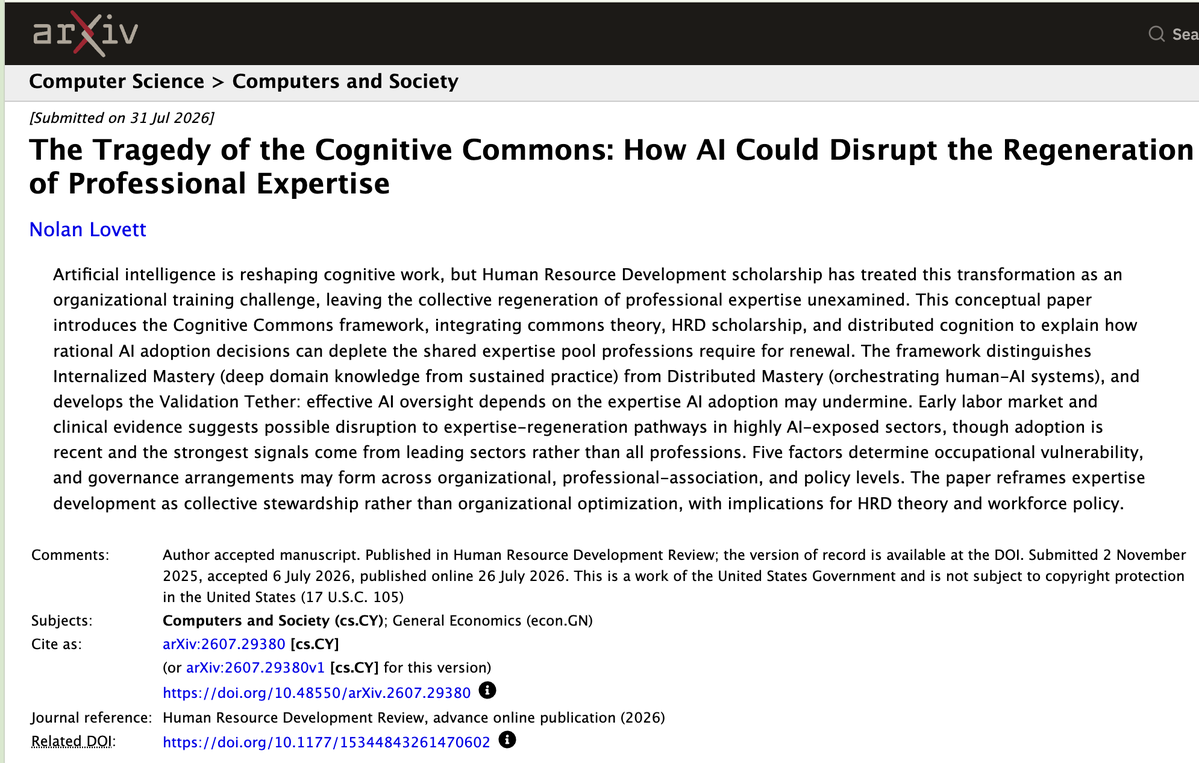
"The Tragedy of the Cognitive Commons." Checking AI output requires deep expertise. Deep expertise comes from doing grunt work for years. And grunt work is the first thing AI eats
So we're building systems that need expert supervision while dismantling the only known process for making experts
The paper calls the shared pool of human expertise the "cognitive commons." Every profession drinks from it. Nobody's refilling it.
By eliminating junior roles, each company is acting totally rationally, and the collective result: a profession that can't catch AI's mistakes anymore because it never learned to do the work in the first place
Who checks AI's homework in 15 years?
🦔AI companies are bulk-buying rare books, scanning them through high-speed machines that cut the spines off, and shredding the originals. A service called ISBNdb facilitates orders of up to a million books and keeps buyers anonymous. Pre-2022 books are premium because they're free of AI-generated text. A federal judge ruled the practice is fair use because eliminating the original means only one copy exists at a time. Anthropic hired the former head of Google Books partnerships to obtain "all the books in the world."
My Take
This got to me. A bookseller told 404 Media that rare books with almost no surviving copies are being fed into this pipeline. Books that survived wars, fires, and centuries of handling are being shredded so an AI can learn to write a better marketing email.
ISBNdb's website literally says "'AI company destroys two million books' is not a headline that generates sympathy," and they still built an entire business around making it happen quietly. They offer NDAs as a feature. They coach clients to call it "digital preservation."
I've covered AI companies scraping the internet, torrenting libraries, and stealing music. This is worse because it's irreversible. You can re-upload a website. You can reprint a bestseller. You can't replace the last three copies of an 18th-century botanical text once someone shreds them for training data. And the judge said it's legal. So it's going to accelerate.
"We shred rare books and offer NDAs so nobody finds out" is a legitimate business model in 2026. What a timeline.
Hedgie🤗
I can’t wrap my head around an economy where nursing homes cost enough to bankrupt families, yet the aides caring for our grandparents still rely on food banks. Or where daycare can consume an entire parent’s paycheck, while the people providing that care still can’t earn a living wage and need a second job. Something about that math just doesn’t add up.
Women are being advised to play Disney songs when they notice a man is recording them with Meta glasses without consent because Disney music is more protected than women
I saw a post on Reddit that said that “The underlying purpose of AI is to allow wealth to access skill while removing from the skilled the ability to access wealth.” And I don’t think I’ve ever seen AI described so incisively.