Most NFT collections have no income. The art trades, the floor moves, and the people holding it earn nothing from any of it.
PonkFun is one idea applied properly: when you launch a token, you pick an NFT collection, and every trade of that token pays the people holding it.
Here is exactly where 2% of every swap goes.
0.40% — Meteora protocol. Taken on chain before anything reaches us. Meteora fixes this at 20% of the trading fee; it is a constant in the program, not a setting, so nobody can negotiate it away.
0.25% — platform.
0.25% — buyback and burn of the official token.
The remaining 1.10% is the point. It goes to the holders of the collection you chose, split by rarity: a Legendary carries five times the weight of a Common, so it earns five times the share.
If you would rather keep a cut, you can. 0.30% to you, 0.80% to the holders. That choice is made once, at launch, and it is written into the pool.
Which brings up the part worth understanding before you trust any of this.
The fee is immutable. Not "we promise not to change it" — there is no function anywhere that can change it. It is set inside a Meteora pool config, and a pool config cannot be edited once it exists. Not by the creator. Not by us. The same property that stops us raising your fee later is the one that stops us lowering it, and we would rather have both than neither.
The distribution is not trustless yet. Today the platform's wallet claims the fees and pays the holders. On-chain distribution is planned, and until it ships we are not going to call this something it is not. Every number is published, every harvest is a transaction you can open, and ownership is read from chain at the moment of claiming rather than from a snapshot we control.
Ranks are frozen the moment a token launches. The item list and the rarity weights are fixed then and there, so nobody can reshuffle who earns what after the fact.
If you hold an NFT, this gives your collection a reason to be held rather than only traded. If you are launching a token, it gives you a community that is paid to care.
https://t.co/XDqulzA4Wy
We have implemented a claim feature that requires neither a wallet connection nor a signature, users simply need to paste their wallet address, and the system will detect their NFTs, calculate the fee allocation, and enable the claim.
@launchonponk can you automate the rewards so they go directly to nft holders’ addresses without them having to claim? that way people will start to notice money flowing into their wallets and you’ll get more eyes
How it works, in 45 seconds.
Launch a token → pick an NFT collection → its holders earn 1.00% of every trade.
Claiming needs no wallet connection. Paste your address, we read the chain.
https://t.co/O8OI2BRQV3
Friends, I’m taking a short break. I’m so happy you’ve supported $PONK through the tough times - let’s send $PONK higher!
❤️❤️
join tg community
https://t.co/fmwyyckBif
Why did we build this for NFT holders?
Because NFT holders should have more than just a picture in their wallet.
With $PONK, NFT communities can participate in the value generated by token trading.
Trade → Fees → NFT Holders.
We’re building a new way for NFT communities to benefit from the tokens they support.
$PONK
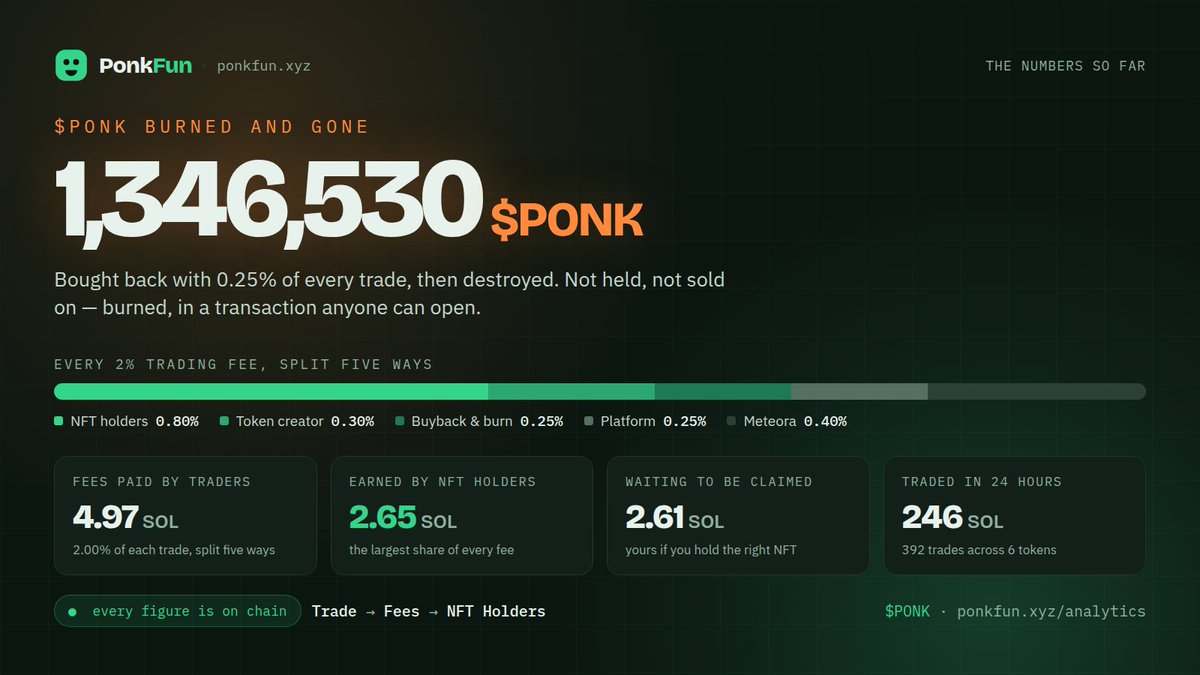
The numbers so far, and where they came from.
1,346,530 $PONK has been bought back and burned. Not held in a treasury, not quietly sold on — destroyed, in a transaction you can open and read.
Traders have paid 4.97 SOL in fees. 2.65 SOL of that has gone to NFT holders, which is the largest single share of every fee we charge. 2.61 SOL of it is still sitting there waiting to be claimed by whoever holds the right NFT — and if that's you, it takes one paste of your address at https://t.co/h0NeI0cDHz. No wallet connection needed.
246 SOL traded in the last 24 hours across 392 trades on 6 tokens.
The 2% fee splits five ways, and we'd rather show it than describe it:
0.80% to NFT holders
0.30% to the token creator
0.25% to buyback and burn
0.25% to the platform
0.40% to Meteora, taken on chain before we ever see it
Every figure on this card came from our own analytics page, and every one of them describes money that moved on chain. You don't have to take our word for any of it — that's the whole point of publishing them.
Trade → Fees → NFT Holders.
https://t.co/jATLQC8cH3
TG : https://t.co/lr1igb8Rjh
$PONK
@launchonponk Have you considered maybe have an active tg that. That could also give $ponk holders a platform to interact with each and give them a place to share their thoughts amd suggestions on the project.
@Sukunabi Exactly. Building is only half of it.
Keeping the community aligned, communicating openly, and continuing to listen during the difficult periods matters just as much.
We’re here for the long term, and we’re willing to keep working through the rough periods together.
We’re here for the long term.
We’re working every day to fix the problems, improve the product, and listen to your feedback.
We have also never sold $PONK from another wallet.
Market conditions are outside our control. All we can do is keep building interesting and useful technology for NFT holders.
But then you keep destroying the chart over and over again.
Honestly, I don’t know what you’re thinking.
We’re building for the long term.
https://t.co/XDqulzACM6
An upcoming feature — and it will take $PONK supply out of existence.
Every week, a draw. To enter, you burn $5 of $PONK and receive one ticket. One wallet, one ticket.
The round runs for seven days. When it closes, one of the wallets that burned $PONK to enter wins the NFT reward.
The tokens you burn don't come to us. Nobody collects them. They're destroyed, permanently, and the supply is smaller afterwards than it was before.
At today's price, a hundred entries would remove roughly 2.5% of the entire $PONK supply in a single week. The buyback already burns 0.25% of every trade made on PonkFun. This sits on top of that, and it's driven by holders rather than by volume — meaning it can keep working even during quieter weeks.
Now the part we care about most.
Most draws ask you to trust that the organiser didn't quietly pick their own wallet. We don't want to ask you for that trust, so we built it so you never have to give it.
When a round opens, we publish the exact Solana slot it will close on — before a single person has entered. When that slot arrives, the winner is derived from that block's hash, combined with the sorted list of every wallet that entered. A future blockhash cannot be predicted by anyone. Not by the people entering, and not by us.
Every entry is an on-chain burn, so the list of participants isn't a row in our database you have to take our word for. It's public. Anyone can rebuild that list, run the same calculation, and arrive at the same winner we did.
The wheel you'll see on the page is an animation. It shows the result — it doesn't decide it. Better you hear that from us now than wonder about it the first time you lose.
One more thing, said plainly: one wallet, one ticket limits entries per wallet, not per person. Someone determined enough can use several wallets, and there is no honest way to stop that at a sensible cost. We'd rather tell you where the rule ends than pretend it reaches further than it does.
Dates, the prize, and the exact ticket amount in tokens go out when the first round opens.
Trade → Fees → NFT Holders.
Burn → Ticket → NFT Reward.
https://t.co/XDqulzACM6
Of course, our goals go beyond the short term, there are many things we need to improve upon every day. You should also know that we cannot achieve everything overnight - we need time to get the work done.
Please be patient; we are here, and we are still in the early stages.
https://t.co/XDqulzACM6