@chelseacutting1 This is so hard Chelsea, I know. So many conflicting emotions to manage. Sometimes there is no sense to it for those who are left to wonder. Take care. L x
@SamandPeteEdu@pwharris@joboaler@kath_cartwright@mminas8@MattSextonACU@surfmaths Hey Sam & Pete, great to hear from you. I love that you are strategising & playing with ideas in this practice - mirroring the opportunities you are providing students. I tell everyone about the day I realised 16x4=8x8 - so exciting! @ctfosnot strings are worth a look too 😊
@matt_skoss Thanks Matt - this problem has fascinated me ever since the amazing Charlie Lovitt launched it with us at PMSI 😊 I like the cantilever and engineering cost connection - more complexity, more thinking and resource needs so more cost 👍
@bridgeenpritch @KrisWestcott1 Much appreciation to you and Kris for your interest. I am fascinated to hear about the discussion that you were having in relation to mathematics specialisation if you are happy to share them - was it at a school, or network level?
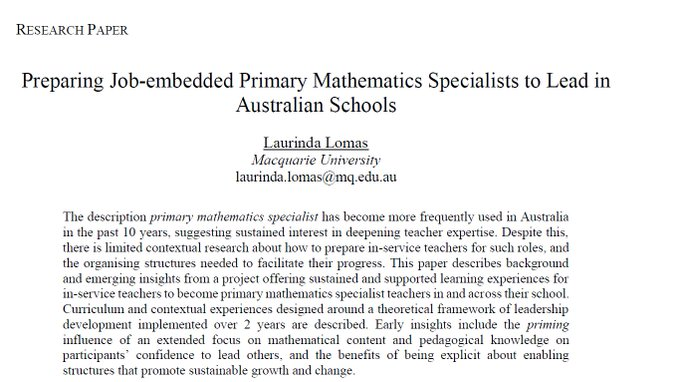
Specialisation and instructional leadership are topical in Australian education. It is timely, then, to think about how we prepare job-embedded primary mathematics specialists and the structures needed to support them. Emerging research insights from PMSI https://t.co/P2lp6W4ATu
@thevisionhub @misterAOY That is an accurate observation. Having written a few of these school plans, I know there is strong encouragement to include research & documents of the moment, & mandated L&N targets. Thanks for your responses. I am still curious & might investigate this further 😊
@thevisionhub @misterAOY I can see both of these as reasonable assumptions. Strategic directions are aspirational goals. If STEM has been embedded, it wouldn’t be a focus. I am curious to know - you have fed my fascination!
@SamandPeteEdu Thanks Sam and Pete. I am wondering if any of the insights resonate with your own experiences as maths specialists. Love to hear your thoughts 😊
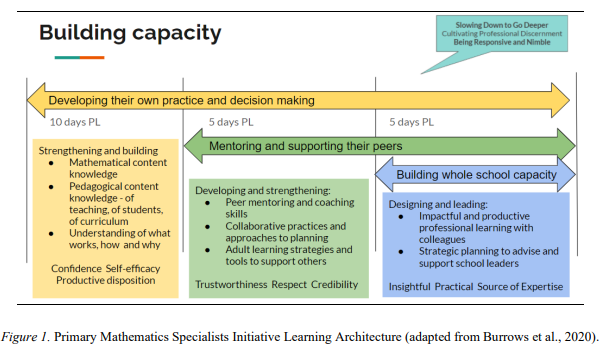
School context was considered part of the curriculum design for participating schools in this mathematics specialist (MS) initiative. School demographics, strategic plans, & current support structure data provided a near-vision view of the MS's learning community as PMSI began.
The three main areas of focus of the PMSI theoretical framework in this study were understanding and leading self, working with and influencing others, and being catalysts for change. Curriculum was designed around these three phases, adapted for each 2-yr cohort #mathspecialists
@mic_epstein Thanks Michaela, it is an ongoing fascination. Much more to come related to this research interest I think - it is such a growing field here in Australia. Peter has been such great support since the inception of PMSI in NSW, I am looking forward to chatting with him soon too!
This isn't always easy or comfortable. But it makes such a difference. There are really helpful resources about the signs to look for, ways to approach conversations, and other important considerations at https://t.co/kCWvSwGiNS
Notice and wonder is such a powerful approach associated with maths teaching. It is also the basis of support for people you know: noticing something is different; wondering about what they are saying and doing, and what is going on in their lives. Then having a conversation...
@DavidKButlerUoA When I was a young journalist, I was always told to write "more than" rather than "over" because readers would find this less ambiguous (perhaps because "over" might be confused with positional language?). I wonder if that is still the case?