Turning law into something you do, not just read.
Law Matters Online Academy’s Labs let you experiment with policy, markets, and competition cases. Free, interactive, and built for curious minds.
Test ideas. See outcomes. Learn by doing.
https://t.co/6I0AxzcS1A
#law#labs
Legal Theory Lexicon: Criminal Law Theory — theories of punishment, criminalization, and the general part. The latest entry in the Lexicon series, completing the first-year subjects. https://t.co/bwxt8TPSze
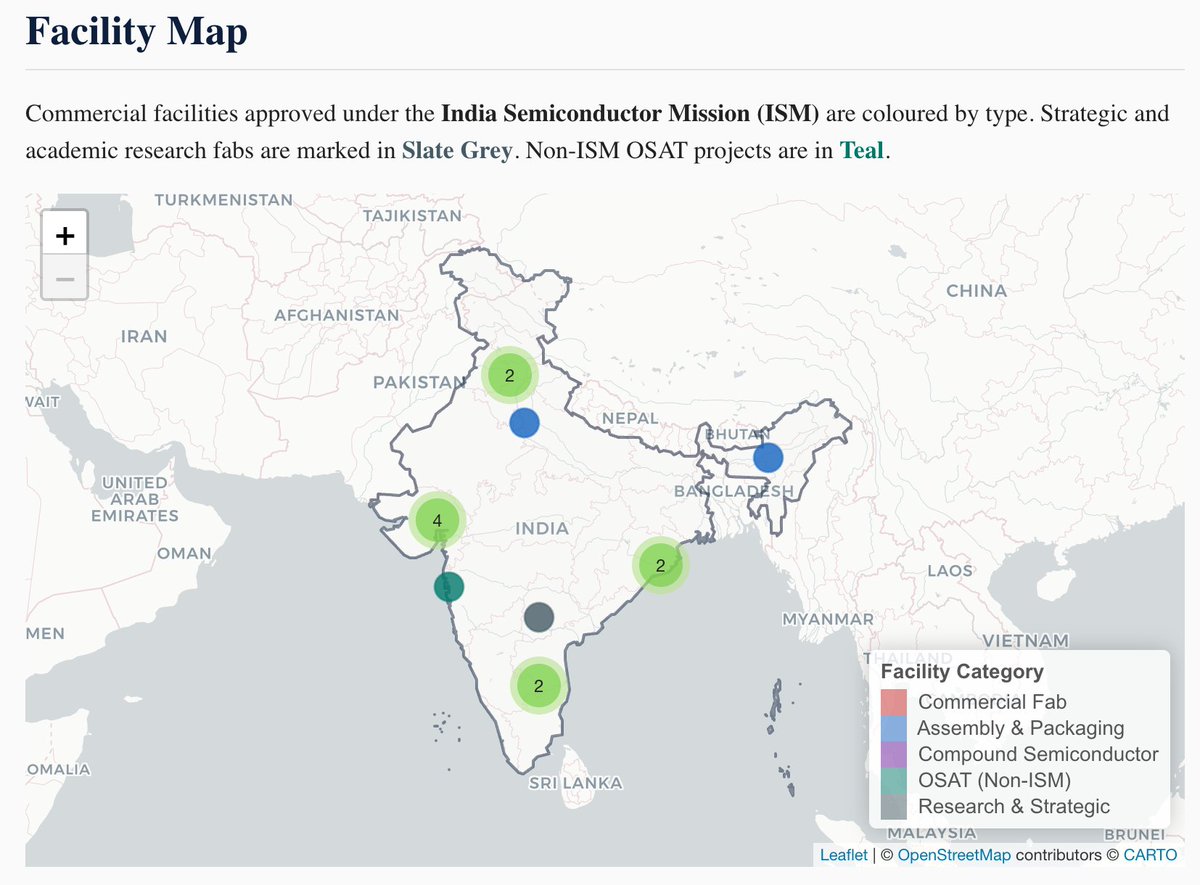
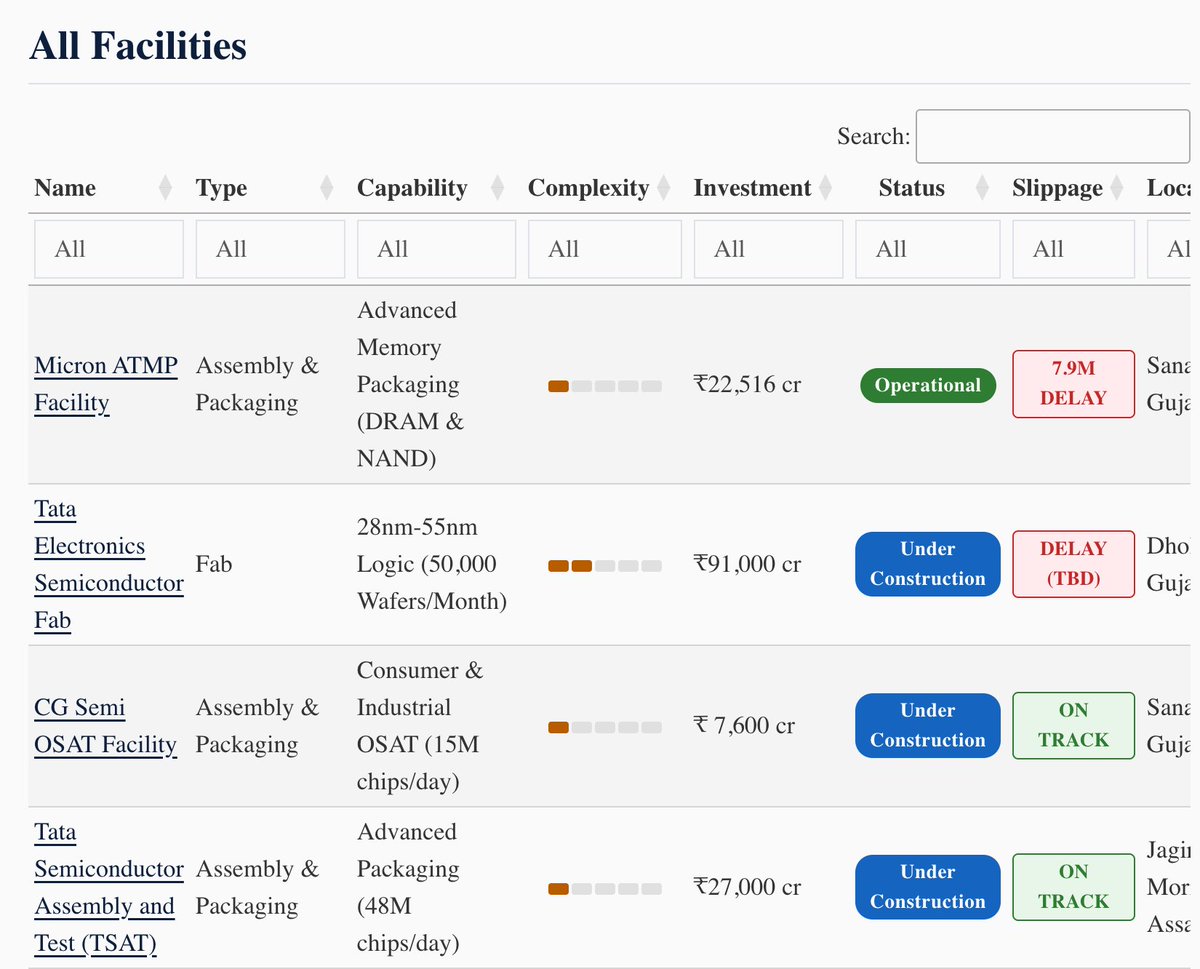
Details of India's semiconductor manufacturing projects are scattered across hundreds of press releases, news reports, and government announcements. There's also a lot of hype and misreporting. So I built a tracker using Claude Code to fix this. It scores each project on technical complexity (benchmarked against a 3nm fab), tracks slippage from original announced dates, and links every data point to its source.
It's open source. If you have a status update, a correction, or know about a new facility, there's a form to contribute. Let's build this together.
Famously (there is a beautiful Works in Progress piece on this) in 2016, Geoffrey Hinton told an audience in Toronto that medical schools should stop training radiologists, since AI would soon outperform them at reading scans. Ten years later, there are more radiologists than ever, and they earn more than they did then.
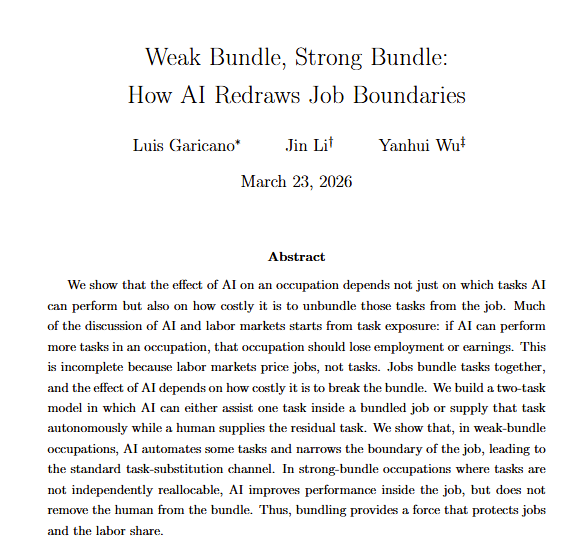
Hinton was right about the task, but he was wrong (so far!) on the future of the radiology profession. Times have never been better for them. The gap between those two claims, the difference between tasks and jobs, is the subject of a paper I have written with Jin Li and Yanhui Wu, and that we release today: "Weak Bundle, Strong Bundle: How AI Redraws Job Boundaries." (Very relatedly we are also finishing the first draft of our book "Messy Jobs" on AI and Jobs!! You will be the first to hear).
We start from the observation that the growing literature on AI and labor markets measures the AI shock by task exposure: people count how many tasks AI can perform in a given occupation AI can perform, and infer that more exposure means more displacement. Eloundou et al. published a paper in Science in 2024 that started this literature, and many follow the same logic. The inference they make is that the more exposed tasks, the worse the outcomes.
This is incomplete, because labor markets price jobs, not tasks. A radiologist does not just sell image classification, but does many other jobs: triages cases, communicates with other physicians, trains residents, makes the difficult decisions, and signs a diagnosis. The market buys a bundled service. The question AI poses is not whether it can do one task inside the bundle. The question is whether that task can be pulled out.
Thread (1/3)
https://t.co/wEYMfjGbeX
FTC vs Amazon opens this week over "dark patterns". "The question is when design crosses the line where a reasonable consumer doesn't have a fair shot of understanding what's going on" says
CIS Affiliate Andrea Matwyshyn https://t.co/FM4EdDf67E
CIS Affiliate @alexfeerst argues that learning - by humans or AI - isn't a copyright-relevant act in his latest @JoinFAI paper. "Regulate outputs, not inputs; legalize learning." https://t.co/qHwAdUQbKF
Planning to expand and improvise in future, all in the hopes of placing my hometown more prominently in the tourism and cultural map of Odisha. Would greatly appreciate any help/suggestions/collaborations
As someone who's always been proud to call Deogarh home, I always felt we lacked an immersive narrative guide for the history and heritage of Deogarh.
Here's a small attempt: https://t.co/OccgeHjHxb
@Deogarhdistadmn@odisha_tourism@LaMCRESA
SFI President David Krakauer joins StarTalk with Neil deGrasse Tyson to discuss emergence and the scientific frameworks that help us search for order in the complexity of evolving worlds.
Watch the full interview: https://t.co/AYVx17yFSB
23 luxuries in life
1. happy and healthy children
2. a boss you really respect or no boss
3. investors you really respect or no investors
4. 7h+/night quality sleep
5. best friends live within 5 mins of you
6. a group chat of homies that never dies
7. a dog that waits by the door when you get home
8. a local coffee shop where they know your order
9. being able to take a nap in the middle of the day
10. work that feels like play that also feels like you're unlocking your potential
11. a home you don’t need a vacation from
12. running into people you care about without planning it
13. friends who answer your random facetimes when you call them on first ring
14. the freedom to say “no” without guilt
15. watching a movie without checking your phone once
16. having more ideas than you have time for
17. memories that make you laugh out loud when you’re alone
18. never having to set an out-of-office reply
19. a hobby (that doesnt have to do with work) that makes you lose track of time
20. no debt hanging over your head (or paying it off and feeling like a million bucks after)
21. being able to hire someone to fix things you hate doing without second guessing it
22. a playlist that takes you back 10 years instantly
23. time to go to the gym in the middle of the day
To be a real Human, one needs intelligence, courage, tenacity, curiosity, and a strong moral backbone. Remove any one of the five and you end up with the equivalent of a lemon.
📦 Can industrial policy work? Yes—the East Asian experience shows it can (at least partially).
But its success rests on a key condition: labor control.
🇯🇵🇰🇷🇹🇼 Japan, South Korea, and Taiwan industrialized rapidly under authoritarian or semi-authoritarian regimes. Wages and labor rights were systematically repressed to favor capital accumulation and export competitiveness.
This was especially stark in South Korea during the 1980s–1990s, when unions clashed with the state and business. (If you’ve watched Squid Game, it’s in the backstory of Seong Gi-hun.)
⚠️ Authoritarianism wasn’t incidental—it was functional.
Not all authoritarian regimes succeed with industrial policy, but successful cases relied on the ability to suppress real wages and labor rights.
🇦🇷 This is why Latin America’s Big Push programs failed: their political base—urban working-class voters (e.g., Peronistas)—couldn’t sustain the wage repression required. The strategy collapsed under its own contradiction.
💥 You can’t push industrialization with cheap labor and depend politically on those who demand higher wages. The internal logic breaks. Latin America’s populism was a road to nowhere.
As far as I can tell, there are no examples of country-wide industrial policy success where real wages (and consumption) were not kept relatively low.
🇨🇳 China is not so different today.
🧾 Consumption as a share of GDP remains exceptionally low—even compared to countries at similar stages of development.
That wouldn’t be the case if China were a democracy. High savings and low consumption are features, not bugs, of its growth model.
🤔 That’s why I’m puzzled when advocates defend industrial policy from a progressive position that favors high wages and democratic institutions. You can’t have your cake and eat it too.
📚 This point isn’t new: @pseudoerasmus has made it for years. And long before him, it was central to Marx, Gerschenkron, and Dobb—and deeply embedded in the logic of socialist Big Push programs, from Stalin to Mao.
A whitepaper describing the background, purpose and tokenomics of the Sci-Hub token (SCI) is now available on the website: https://t.co/pGJxDefOQt
The primary goal is to accelerate transition of science towards Open Access, by rewarding knowledge sharing.
Sci-Hub token address:
https://t.co/TZUlZ8Gcax








![swapnakpanda's tweet photo. Mathematics for Computer Science [Free Book]](https://pbs.twimg.com/media/GtAAzHQaAAA79YP.png)







![swapnakpanda's tweet photo. Mathematics for Computer Science [Free Book]](https://pbs.twimg.com/media/GtAAzH3bcAAjUnp.png)