Open weights. Shared progress. MiniMax H3 is moving fast.
We built H3 for video generation with native stereo audio and multimodal reference control. The open-source community is making that capability faster, more accessible, and easier to build on.
Recent highlights:
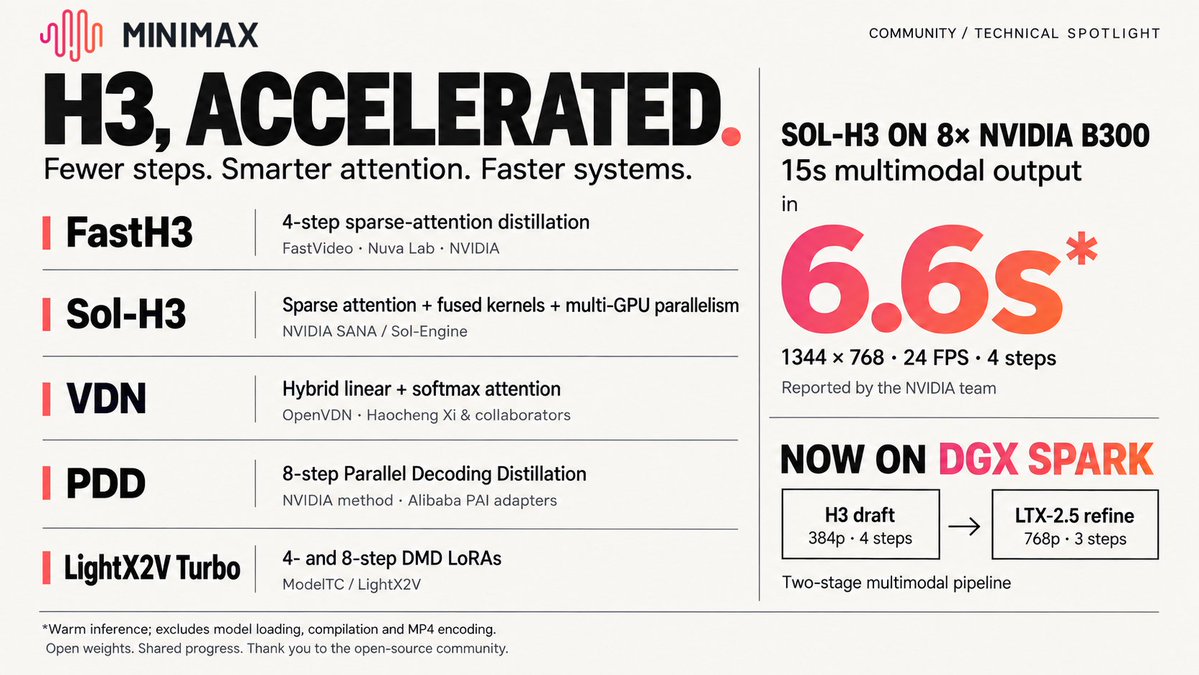
• FastH3 — FastVideo, Nuva Lab and NVIDIA: 4-step distillation, now running on DGX Spark and Apple Silicon.
• Sol-H3 — NVIDIA’s SANA team: 15 seconds of 768p video + audio in 6.6 seconds on 8×B300, in the team’s warm-inference benchmark.*
• VDN — Haocheng Xi and the OpenVDN team: rethinking attention for faster H3 inference, with weights, training and inference code released.
• PDD — NVIDIA’s distillation method, brought to H3 by Alibaba PAI as 8-step Acc-LoRAs, now supported in ComfyUI.
• LightX2V — 4- and 8-step Turbo LoRAs, with workflows for text, image and reference-conditioned video + audio.
Behind every release are people training, optimizing, quantizing, testing and sharing. Special thanks to:
@haoailab@nuvalab@NVIDIAAI@xieenze_jr@HaochengXiUCB@ArashVahdat@julberner@LightX2V@ComfyUI
And to the individual contributors pushing the work forward:
@haozhangml@cxlcl1@lawrence_cjs@yitongli165665@haopengl33@songhan_mit@shanasaimoe
Thank you for building with H3 and helping make it faster, more accessible, and more useful for the community. Powerful models go further when we build together. Keep pushing H3. Excited to see what comes next. 🚀
Explore the ecosystem: https://t.co/F1S5IjUNi1
Open weights. Shared progress. MiniMax H3 is moving fast.
We built H3 for video generation with native stereo audio and multimodal reference control. The open-source community is making that capability faster, more accessible, and easier to build on.
Recent highlights:
• FastH3 — FastVideo, Nuva Lab and NVIDIA: 4-step distillation, now running on DGX Spark and Apple Silicon.
• Sol-H3 — NVIDIA’s SANA team: 15 seconds of 768p video + audio in 6.6 seconds on 8×B300, in the team’s warm-inference benchmark.*
• VDN — Haocheng Xi and the OpenVDN team: rethinking attention for faster H3 inference, with weights, training and inference code released.
• PDD — NVIDIA’s distillation method, brought to H3 by Alibaba PAI as 8-step Acc-LoRAs, now supported in ComfyUI.
• LightX2V — 4- and 8-step Turbo LoRAs, with workflows for text, image and reference-conditioned video + audio.
Behind every release are people training, optimizing, quantizing, testing and sharing. Special thanks to:
@haoailab@nuvalab@NVIDIAAI@xieenze_jr@HaochengXiUCB@ArashVahdat@julberner@LightX2V@ComfyUI
And to the individual contributors pushing the work forward:
@haozhangml@cxlcl1@lawrence_cjs@yitongli165665@haopengl33@songhan_mit@shanasaimoe
Thank you for building with H3 and helping make it faster, more accessible, and more useful for the community. Powerful models go further when we build together. Keep pushing H3. Excited to see what comes next. 🚀
Explore the ecosystem: https://t.co/F1S5IjUNi1
🚀 Sol-H3 on DGX Spark: 768p in Under a Minute 🤩
Monday: 8×B300, 5s 768p in 1.65s — faster than playback.
Today: the same stack on one desktop Spark — about 56s hot E2E.
Five seconds of 1344×768 video at 24 FPS with stereo audio, on a single NVIDIA DGX Spark (GB10).
Two-stage, not the datacenter profile:
384p H3 draft → latent ×2 → H3-to-LTX VAE adapter → 768p LTX refine → VAE decode
No decode/re-encode between stages. Stage 2 is conditioned on the draft latent, so Gemma stays off the box. Quantized weights stay resident; sparse attention cuts the rest.
Stage 1 takes any MiniMax-H3 few-step LoRA. Timing is hot E2E (encode → both stages → video/audio VAE); cold start and MP4 mux are separate. Apache 2.0.
Server was realtime. Edge is one box, under a minute.
🔗 https://t.co/rfo0EVkJsI
Amazing team effort—full credits in the blog.
@haopengl33@lawrence_cjs@yitongli165665@shanasaimoe ,Jingyu Xin, @HaochengXiUCB@songhan_mit
🚀 Sol-H3 on DGX Spark: 768p in Under a Minute 🤩
Monday: 8×B300, 5s 768p in 1.65s — faster than playback.
Today: the same stack on one desktop Spark — about 56s hot E2E.
Five seconds of 1344×768 video at 24 FPS with stereo audio, on a single NVIDIA DGX Spark (GB10).
Two-stage, not the datacenter profile:
384p H3 draft → latent ×2 → H3-to-LTX VAE adapter → 768p LTX refine → VAE decode
No decode/re-encode between stages. Stage 2 is conditioned on the draft latent, so Gemma stays off the box. Quantized weights stay resident; sparse attention cuts the rest.
Stage 1 takes any MiniMax-H3 few-step LoRA. Timing is hot E2E (encode → both stages → video/audio VAE); cold start and MP4 mux are separate. Apache 2.0.
Server was realtime. Edge is one box, under a minute.
🔗 https://t.co/rfo0EVkJsI
Amazing team effort—full credits in the blog.
@haopengl33@lawrence_cjs@yitongli165665@shanasaimoe ,Jingyu Xin, @HaochengXiUCB@songhan_mit
New video generation acceleration for MiniMax-H3 from the NVIDIA Sol team!
Faster than playback, fully open-sourced, and available via the Reactor API so you can try it before committing your GPU😜
🚀 Sol-H3: @MiniMax_AI H3 Video Generation Faster Than Playback 🤩
Five seconds of world. 1.653 seconds to infer.
We’re releasing Sol-H3, our fastest end-to-end MiniMax-H3 inference stack yet. On one 8× NVIDIA B300 Blackwell system, it generates five seconds of 1344×768 video with stereo audio in 1.653 seconds. Across 1×, 4×, and 8× B300, Sol-H3 reaches up to a 15.54× speedup versus Base H3.
Compared with 50-step Base H3 Dense on the same 8× B300 system, the four-step Sol-H3 profile delivers:
• 5s: 18.250s → 1.653s (11.04×)
• 10s: 50.660s → 3.732s (13.57×)
• 15s: 99.513s → 6.612s (15.05×)
Sol-H3 also scales across GPU counts:
• 4× B300: 2.918s / 6.993s / 12.542s for 5s / 10s / 15s (12.11–15.54×)
• 1× B300: 13.745s / 37.813s / 52.260s for 5s / 10s / 15s (9.45–14.29×)
All figures are medians of three measured runs after one warmup at 1344×768 and 24 FPS with stereo audio. Base H3 uses 50 scheduler points (49 DiT forwards); Sol-H3 uses four DiT forwards, so this is a full-profile comparison—not an attention-only runtime change. Sol-H3 uses Dense attention on 1× B300 and SOL with INT8 QKV / FP8 output transport on 4× / 8×. Timing includes text encoding, DiT denoising, and video/audio VAE decoding; model loading, compilation warmup, and final MP4 encoding are excluded.
Sol-H3 brings Sol-Engine × Sol-Attn into one full-stack runtime:
• dynamic sparse attention with no retraining
• fused norm, RoPE, MLP, and sparse-attention setup
• fused INT8 QKV / FP8 output communication across 8 GPUs
• parallel, batched VAE decoding
• precomputed AdaLN caching
Inside the stack:
• sparse-attention setup: 1.206 → 0.285 ms (−76.4%)
• VAE decode: 7.55 → 0.602 s
• ~24 GB memory freed per GPU
Any MiniMax-H3 few-step LoRA can plug into the same engine, and the code is deployment-friendly under Apache 2.0.
For us, the bigger milestone is crossing from “fast generation” into “faster than playback.” That opens the path toward continuous 24 FPS generation and truly interactive video systems.
We’re excited to partner with @reactorworld to release Sol-H3 and make it available as an API day-0.
Try it now on Reactor: https://t.co/271z2uJBb8
🔗 https://t.co/YY56JrKpmA
Amazing team effort—full credits in the blog.
@shanasaimoe@lawrence_cjs@yitongli165665@haopengl33@HaochengXiUCB@songhan_mit
🚀 Sol-H3: @MiniMax_AI H3 Video Generation Faster Than Playback 🤩
Five seconds of world. 1.653 seconds to infer.
We’re releasing Sol-H3, our fastest end-to-end MiniMax-H3 inference stack yet. On one 8× NVIDIA B300 Blackwell system, it generates five seconds of 1344×768 video with stereo audio in 1.653 seconds. Across 1×, 4×, and 8× B300, Sol-H3 reaches up to a 15.54× speedup versus Base H3.
Compared with 50-step Base H3 Dense on the same 8× B300 system, the four-step Sol-H3 profile delivers:
• 5s: 18.250s → 1.653s (11.04×)
• 10s: 50.660s → 3.732s (13.57×)
• 15s: 99.513s → 6.612s (15.05×)
Sol-H3 also scales across GPU counts:
• 4× B300: 2.918s / 6.993s / 12.542s for 5s / 10s / 15s (12.11–15.54×)
• 1× B300: 13.745s / 37.813s / 52.260s for 5s / 10s / 15s (9.45–14.29×)
All figures are medians of three measured runs after one warmup at 1344×768 and 24 FPS with stereo audio. Base H3 uses 50 scheduler points (49 DiT forwards); Sol-H3 uses four DiT forwards, so this is a full-profile comparison—not an attention-only runtime change. Sol-H3 uses Dense attention on 1× B300 and SOL with INT8 QKV / FP8 output transport on 4× / 8×. Timing includes text encoding, DiT denoising, and video/audio VAE decoding; model loading, compilation warmup, and final MP4 encoding are excluded.
Sol-H3 brings Sol-Engine × Sol-Attn into one full-stack runtime:
• dynamic sparse attention with no retraining
• fused norm, RoPE, MLP, and sparse-attention setup
• fused INT8 QKV / FP8 output communication across 8 GPUs
• parallel, batched VAE decoding
• precomputed AdaLN caching
Inside the stack:
• sparse-attention setup: 1.206 → 0.285 ms (−76.4%)
• VAE decode: 7.55 → 0.602 s
• ~24 GB memory freed per GPU
Any MiniMax-H3 few-step LoRA can plug into the same engine, and the code is deployment-friendly under Apache 2.0.
For us, the bigger milestone is crossing from “fast generation” into “faster than playback.” That opens the path toward continuous 24 FPS generation and truly interactive video systems.
We’re excited to partner with @reactorworld to release Sol-H3 and make it available as an API day-0.
Try it now on Reactor: https://t.co/271z2uJBb8
🔗 https://t.co/YY56JrKpmA
Amazing team effort—full credits in the blog.
@shanasaimoe@lawrence_cjs@yitongli165665@haopengl33@HaochengXiUCB@songhan_mit
We're proud to partner with @nvidia's SANA team to ship FastH3 with Sol. For the first time, generate clips 3x faster than realtime.
Available day 0 via the Reactor API.
Try it here: https://t.co/4IQ7RnRm2i
🚀 MiniMax H3 Super Acceleration in Sol-Engine🤩
We pushed H3 far beyond our previous 3–4× optimization regime — reaching 22.2× speedup for 5s video and 27.7× for 10s video vs. the published SGLang baseline.
On a single NVIDIA GB200:
• 5s 768p: 152.3s → 6.85s (22.2×)
• 10s 768p: 414.1s → 14.93s (27.7×)
But the more interesting part may be what this means economically.
Using MiniMax’s published H3 API price as a reference, we translate inference speed directly into production economics. Under an ideal fully utilized GB200 scenario, Sol-Super can serve about 525 five-second videos/hour, corresponding to roughly $210/hour of output value at the reference API price.
Assuming $5.50/GPU-hour, that implies a 97%+ GPU-only gross margin in the idealized model.
At full utilization, one GB200 could produce:
• 12.6K 5s videos/day
• 378K videos/month
• equivalent to 525 hours of finished video per month
For us, this is the bigger point of inference optimization: a 20×+ speedup does not just reduce latency — it can fundamentally change the unit economics, serving capacity, and viable business models of video generation.
🔗 https://t.co/dI7uBD1dSo
The real breakthrough in the NVIDIA SANA team’s Sol Engine work on MiniMax H3!
By splitting generation into a 4-step low-res H3 draft and a 3-step LTX refinement pass at target resolution with Sol-Attn, they’ve crushed 10s 768p latency on a single GB200 from 414s down to 14.93s (27.7x speedup). Replacing heavy VAE decodes with TAEH3/TAEHV while holding the latents stable for refinement is a masterclass in co-designing sampling topology with hardware kernel acceleration.
When inference latency collapses this dramatically, unit economics fundamentally shift: a single node can suddenly serve 378K videos a month at 97%+ GPU margins. This is how high-fidelity AI video moves from asynchronous batch rendering to near-instant, interactive infrastructure. Huge respect to the team for setting a new engineering bar for our open-weights ecosystem! 🫡🩵
🚀 MiniMax H3 Super Acceleration in Sol-Engine🤩
We pushed H3 far beyond our previous 3–4× optimization regime — reaching 22.2× speedup for 5s video and 27.7× for 10s video vs. the published SGLang baseline.
On a single NVIDIA GB200:
• 5s 768p: 152.3s → 6.85s (22.2×)
• 10s 768p: 414.1s → 14.93s (27.7×)
But the more interesting part may be what this means economically.
Using MiniMax’s published H3 API price as a reference, we translate inference speed directly into production economics. Under an ideal fully utilized GB200 scenario, Sol-Super can serve about 525 five-second videos/hour, corresponding to roughly $210/hour of output value at the reference API price.
Assuming $5.50/GPU-hour, that implies a 97%+ GPU-only gross margin in the idealized model.
At full utilization, one GB200 could produce:
• 12.6K 5s videos/day
• 378K videos/month
• equivalent to 525 hours of finished video per month
For us, this is the bigger point of inference optimization: a 20×+ speedup does not just reduce latency — it can fundamentally change the unit economics, serving capacity, and viable business models of video generation.
🔗 https://t.co/dI7uBD1dSo
🔥MiniMax-H3 on GeForce RTX 4090 — reaches 4.44× end-to-end on RTX 4090. Sol-Attn now includes an optimized SM89 CuTe DSL kernel for RTX 4090.
https://t.co/CmUOaEhj5d
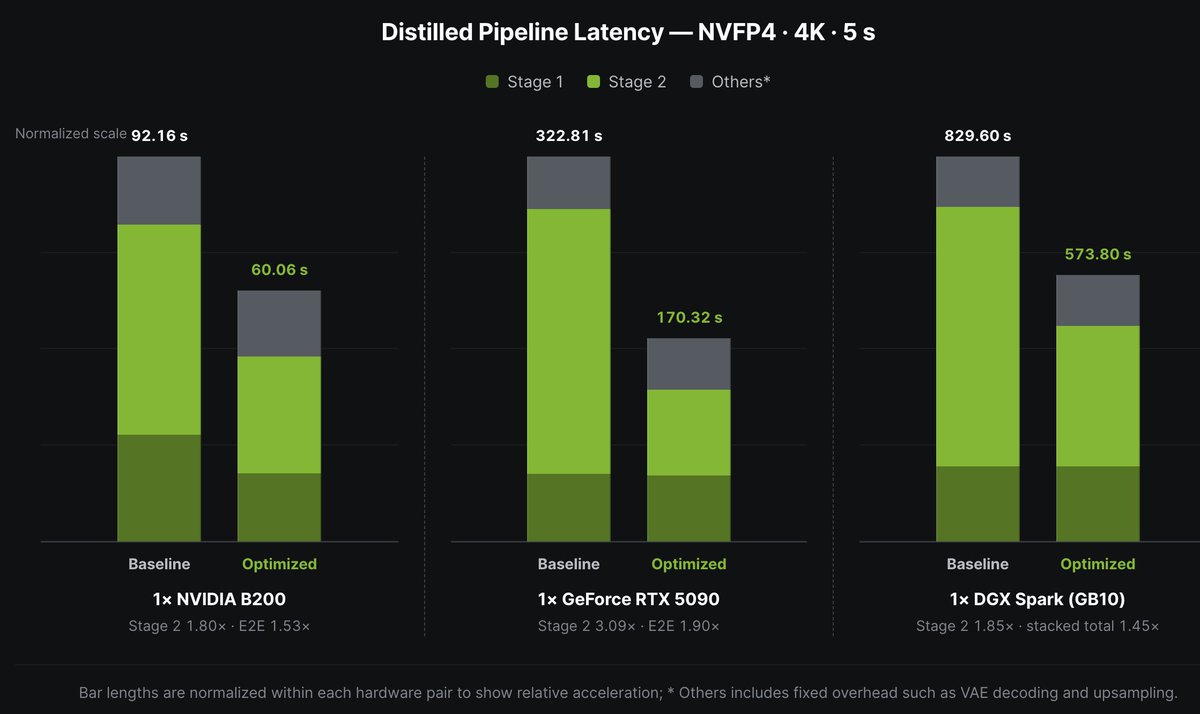
🚀 LTX-2.5 × Sol-Engine — from data center to desktop.
Just one day after the release of the new open-source LTX-2.5, we’ve brought it into Sol-Engine and optimized it across a wide range of deployment settings:
⚡ GB200 — high-performance data center inference
💻 DGX Spark — compact desktop AI deployment
🎮 GeForce RTX 5090 — consumer Blackwell GPU
LTX-2.5 comes with a more complex multi-stage inference pipeline and multiple generation configurations. Sol-Engine automatically adapts its full-stack optimization recipe across these different workloads and hardware targets — combining kernel optimization, attention acceleration, caching, and system-level optimization where they matter most.
Really excited to see another strong open video generation model released to the community — and to make it faster and easier to run everywhere from GB200 to desktop GPUs. 🚀
🔗 https://t.co/j0NZPddofC
If you're struggling with the inference speed of your local MiniMax H3 model, this is probably what you're missing.🫣
The community loves Sol Engine—thank you for setting so many GPUs on fire and making people feel GPU rich!🩵😝