Some classic ETFs to consider for your portfolio.
$VOO / $VTI - US market
$QQQ / $QQQJ - NASDAQ
$VYM / $SCHD - Div Yield
$DGRO / $VIG - Div Growth
$VB / $AVUV - Small Caps
$VNQ / $SCHH - Real Estate
$VXUS / $VWO - International
Can do it all with these.
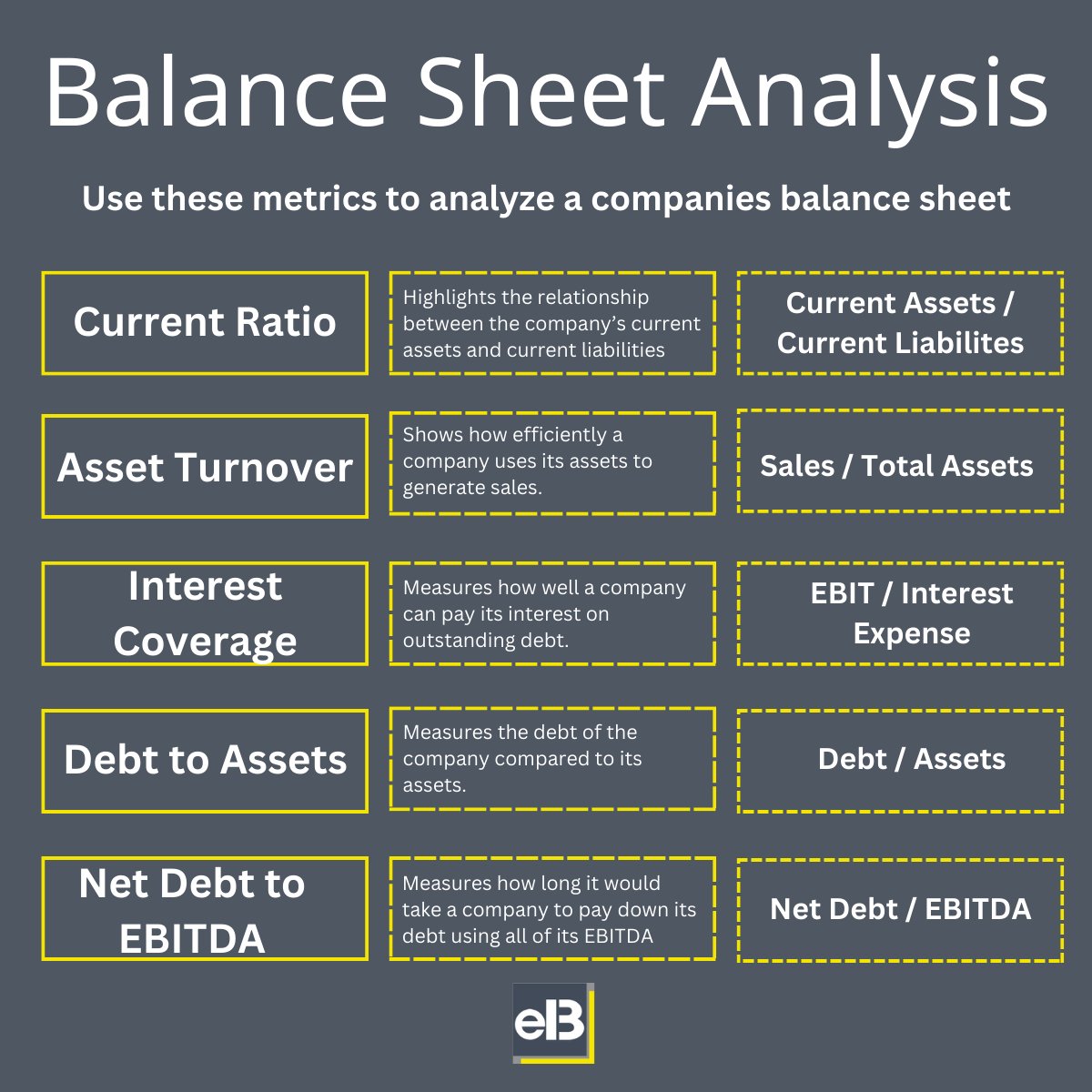
Want to find a fortress balance sheet?
Use these metrics to analyze balance sheets like a pro.
→ Current ratio > 1
→ Asset Turnover > 5%
→ Interest coverage > 5
→ Debt to Assets > 40%
→ Net debt to EBITA < 3
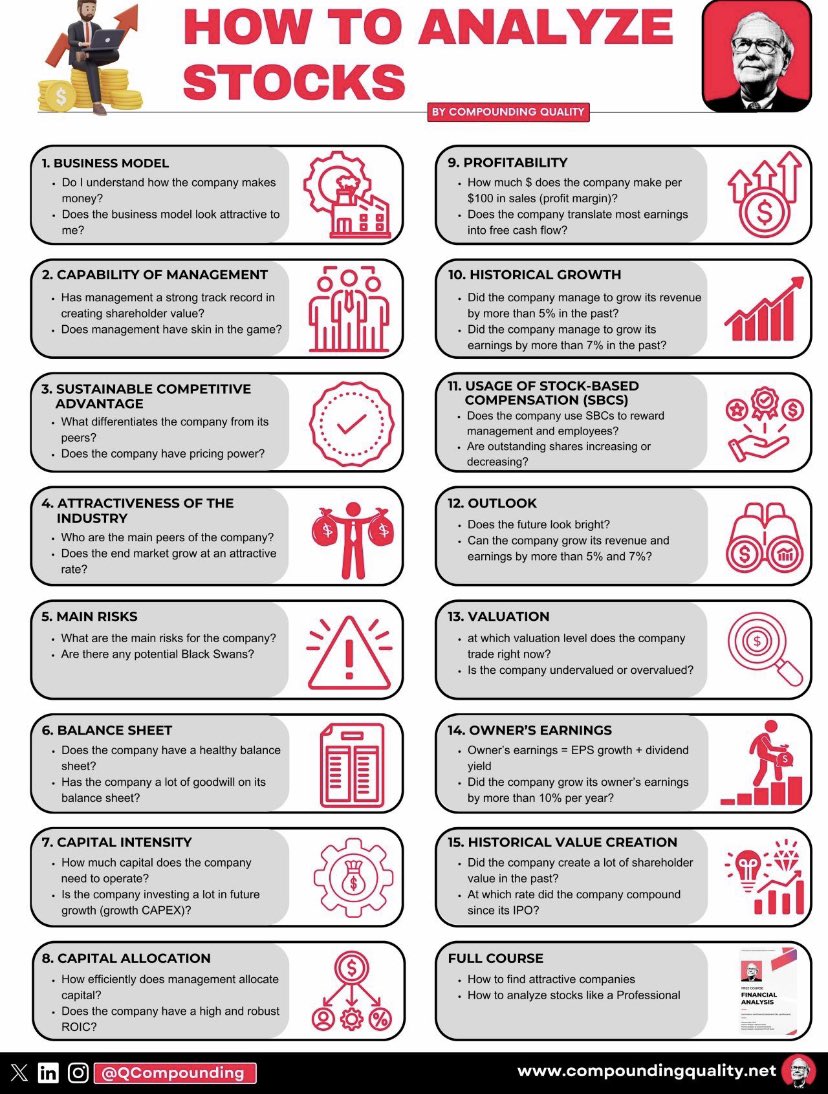
Do you know how to analyze stocks?
It's essential to make good investment decisions.
Here's a 15-step framework you can use:
1. Business model
- Do I understand how the company makes money?
- Does the business model look attractive to me?
2. Capability of management
- Has management a strong track record in creating shareholder value?
- Does management have skin in the game?
3. Sustainable competitive advantage
- What differentiates the company from its peers?
- Does the company have pricing power?
4. Attractiveness of the industry
- Who are the main peers of the company?
- Does the end market grow at an attractive rate?
5. Main risks
- What are the main risks for the company?
- Are there any Black Swans?
6. Balance sheet
- Does the company have a healthy balance sheet?
- Has the company a lot of goodwill on its balance sheet?
7. Capital intensity
- How much capital does the company need to operate?
- Is the company investing a lot in future growth (growth CAPEX)?
8. Capital allocation
- How efficient does management allocate capital?
- Does the company have a high and consistent ROIC?
9. Profitability
- How much $ does the company make per $100 in sales (profit margin)?
- Does the company translate most earnings into free cash flow?
10. Historical growth
- Did the company manage to grow its revenue > 5%
- Did the company manage to grow its earnings > 7%?
11. Usage of Stock-Based Compensation (SBCs)
- Does the company use SBCs to reward management and employees?
- Are outstanding shares increasing or decreasing?
12. Outlook
- Does the future look bright?
- Can the company grow its revenue and EPS by more than 5% and 7%?
13. Valuation
- At which valuation levels does the company trade right now?
- Is the company undervalued or overvalued?
14. Owner’s earnings
- Owner’s earnings = EPS Growth + dividend yield
- Did the company grow its owner’s earnings by more than 10% per year?
15. Historical value creation
- Did the company create a lot of shareholder value in the past?
- At which rate did the company compound since its IPO?
Seven Powers by Hamilton Helmer is one of the most respected frameworks for competitive advantage analysis in the business and investing world.
We have just created an infographic that features 50+ companies such as $COST, @OpenAI, and $LVMH that leverages at least one of the powers 👇
1. Scale Economies: Achieving cost advantages through size, efficiency, and scale in operations.
2. Network Effects: Gaining an advantage from the value of a network, where the product or service becomes more valuable as more people use it.
3. Counter-Positioning: Establishing a unique and difficult-to-replicate position in the market that makes it challenging for competitors to respond without disrupting their old business model.
4. Switching Costs: Creating barriers for customers to switch to a competitor's product or service, often through high initial investment or time and effort required for transition.
5. Branding: Building a strong and recognizable brand that fosters customer loyalty and allows for premium pricing, which often takes decades of even centuries.
6. Cornered Resource: Controlling or having exclusive access to essential resources that are difficult for competitors to replicate, such as valuable IP, patents, or an exclusive license of some sort.
7. Process Power: Developing proprietary processes, technology, or know-how that provides a competitive advantage. It could be an extremely advanced technology, or a very strong and unique culture developed over decades.
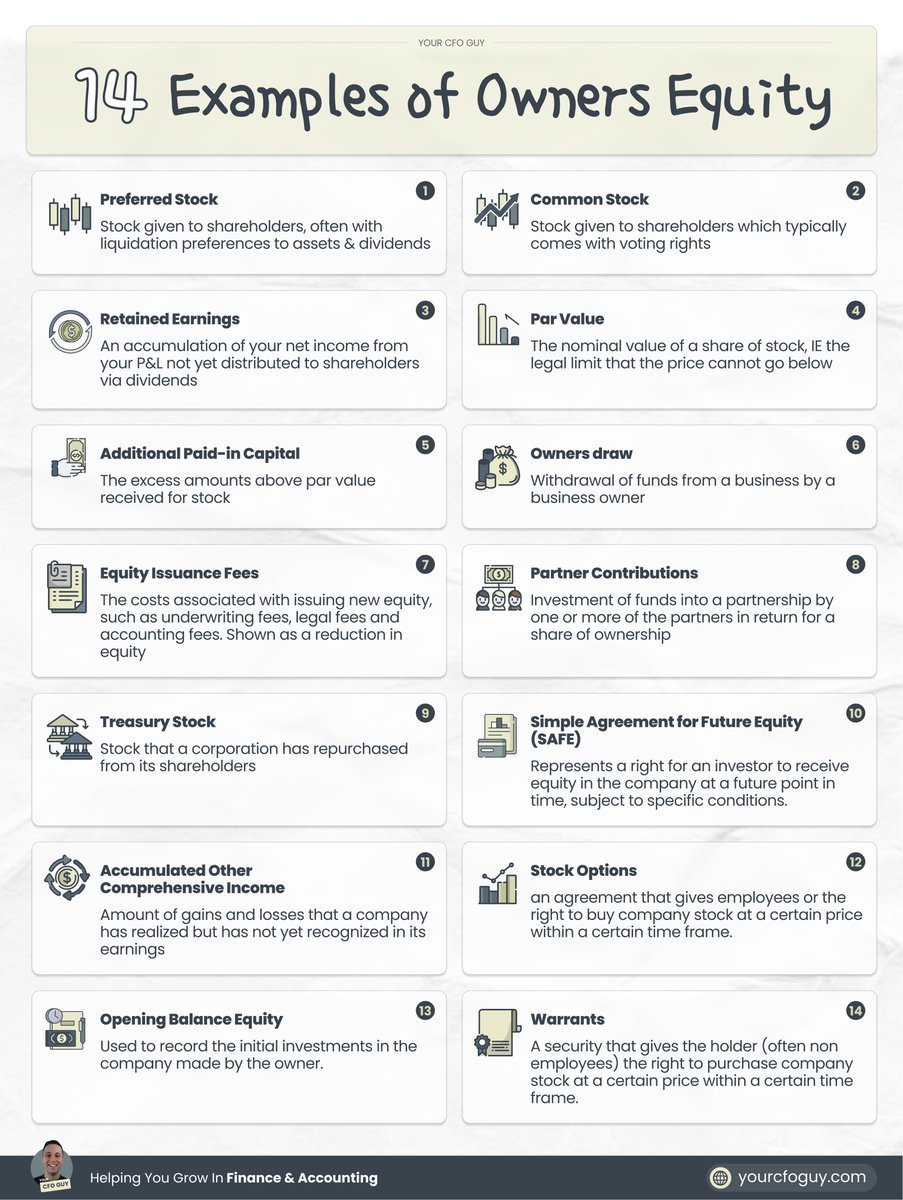
Owners Equity represents the owners right to the assets in the company
Here're the 14 Examples of Owners Equity you need to know
1️⃣ Preferred Stock ➡️ Stock given to shareholders, often with liquidation preferences to assets & dividends
2️⃣ Common Stock ➡️ Stock given to shareholders which typically comes with voting rights
3️⃣ Retained Earnings ➡️ An accumulation of your net income from your P&L not yet distributed to shareholders via dividends
4️⃣ Par Value ➡️ The nominal value of a share of stock, IE the legal limit that the price cannot go below
5️⃣ Additional Paid-in Capital ➡️ The excess amounts above par value received for stock
6️⃣ Owners draw ➡️ Withdrawal of funds from a business by a business owner
7️⃣ Equity Issuance Fees ➡️ The costs associated with issuing new equity, such as underwriting fees, legal fees and accounting fees. Shown as a reduction in equity (contra-equity account)
8️⃣ Partner Contributions ➡️ Investment of funds into a partnership by one or more of the partners in return for a share of ownership
9️⃣ Treasury Stock ➡️ Stock that a corporation has repurchased from its shareholders
🔟 Simple Agreement for Future Equity (SAFE): Represents a right for an investor to receive equity in the company at a future point in time, subject to specific conditions.
1️⃣1️⃣ Accumulated Other Comprehensive Income ➡️ Amount of gains and losses that a company has realized but has not yet recognized in its earnings
1️⃣2️⃣ Stock Options Stock Options ➡️ an agreement that gives employees or the right to buy company stock at a certain price within a certain time frame.
1️⃣3️⃣ Opening Balance Equity ➡️ Used to record the initial investments in the company made by the owner.
1️⃣4️⃣ Warrants ➡️ A security that gives the holder (often non employees) the right to purchase company stock at a certain price within a certain time frame.
Those are my examples of Owners Equity...what would you add?
Let me know in the comments below 👇