I track UAE ports claiming African coastlines-my morning poetry. These corridors aren't theoretical; they're shipping lanes with a Dubai zip code. Meanwhile, clearing a container in Beirut is pure modernist fiction: beautiful prose, zero plot. The UAE is where the story moves.
This isn't just commercial expansion, it's a textbook geoeconomic play.
By locking up ports, critical minerals and supply routes across Africa, Abu Dhabi is securing the logistics backbone for South-South trade. While others export capital, the UAE is exporting infrastructure control, transforming itself from an oil state into the indispensable gatekeeper of global trade corridors.
@joehansen Exactly. I deal with this in autonomous vehicle testing every day. The simpler the architecture, the faster it validates and the cheaper it scales. Complexity is the enemy.
@ShangguanJiewen Live traffic, real data, zero fanfare. I'm tracking China's quiet AV rollout closely, and the UAE's smart city investment is building the same policy-backed infrastructure for autonomous logistics in MENA.
Everyone is buying bigger memory for their agents. The two teams with the best numbers in production deleted theirs and replaced it with a folder.
Rakuten dropped first pass mistakes in its knowledge agents by 90 percent, Harvey pushed task completion up 6x on a legal benchmark, both from the same shift.
> An Anthropic PM: stop treating agent memory as a database, model it as a plain filesystem the agent edits with bash and grep, scope it read-only for org runbooks and read-write for working notes, and let thousands of agents share it without overwriting each other.
Then run dreaming between sessions -> it consolidates, verifies, and backfills what the day's agents learned.
Tomorrow's agents start smarter because today's left cleaner notes.
Scaling memory turned out to be a cleanup problem, not a storage one.
Bookmark & Watch it today ↓
Ironically, an owner asking for the May build back gives us the most honest feedback in AV testing. In my experience, reweighting edge cases makes the drive feel worse before it improves. Real-world data is still the only path to reliable autonomy.
A quote from Jayme’s father last night regarding FSD and the last year of updates:
“I just want the thing to drive the way it did when I got it…”
He got his Model Y in May of 2025.
There's a number so large that if every computer on Earth worked together nonstop, they still wouldn't crack it before the sun burns out. It's quietly guarding your bank account right now.
Every online payment you've ever made passed through a padlock built entirely out of math. Not encryption software. Not a company's promise. A specific, unsolved problem that mathematicians have spent decades trying to break and simply couldn't.
Here's the strange part: the numbers behind it were considered completely useless for over two thousand years. No product, no application, studied purely because a handful of people found them beautiful. Then computers showed up, and it turned out those "useless" numbers were the only thing in existence shaped exactly right to guard a secret in plain sight.
There's also a quiet countdown running underneath all of this. A specific kind of machine, one that doesn't fully exist yet at real scale, would tear straight through the math that protects every bank, every login, every private message you've ever sent. Cryptographers already know it's coming. They're racing to rebuild the lock before it does.
None of this is theoretical. It's running under the page you're reading this on right now. Full story below 👇
@1florianschmid European regulators shield legacy auto and call it safety. I focus on AV research in markets where policy enables innovation, and the UAE's smart city frameworks prove what proactive support delivers.
@Cyber_Trailer FSD turning a skeptic into a Tesla baddie matches exactly what my AV research predicts. Commute hours into productivity? That's real-world validation you can't engineer in a lab.
We need @tesla to make LEFT (leave emergency fast targeted) mode a thing for emergency escapes at Superchargers. Plus the acronym matches the suspect profile.
@tpgoebel Your ratings holding up? FSD sloth mode in Uber traffic is the stress test I'd tap out of by day 2. Real world constraint data beats any highway loop.
Wi-Fi and 5G Are Becoming Invisible Sensors
Radio waves don't just carry data.
They also carry information about the world they bounce off.
Modern RF sensing uses AI to analyze reflected radio signals and estimate breathing, heartbeat, body pose, movement, and even identity—without relying on cameras.
The same principle is powering Integrated Sensing and Communication (ISAC), where future 5G/6G networks will simultaneously communicate and sense their surroundings.
The goal isn't just faster internet.
It's creating a real-time map of people, vehicles, drones, robots, and weather using the wireless infrastructure already around us.
The future of sensing may be invisible.
🌎BREAKING : 6G WIRELESS NETWORKS ARE EXPECTED TO BEGIN ROLLING OUT IN 2028.
6G is the upcoming sixth-generation mobile communications technology, projected to deliver peak speeds up to 1 terabit per second (Tbps), microsecond-level latency, and native AI integration. Commercial availability is expected around the early 2030s, coordinated globally by organizations like the International Telecommunication Union.
Key Performance Targets
•Speeds: Up to 100 times faster than 5G.
•Latency: Sub-millisecond down to 1 microsecond.
•Spectrum: Utilizes high-frequency sub-Terahertz (THz) and Terahertz bands (100 GHz to 10 THz) alongside traditional bands.
•Core Innovations
•AI-Native: Fully autonomous network resource management with zero human touch.
•Integrated Sensing: Using radio frequency reflections to map environments and image objects while transmitting data.
•
•Global Coverage: Seamless integration of terrestrial cell towers with non-terrestrial satellite networks.[1, 2]
•
Expected Use Cases
•Real-time holographic communication
•Wide-area mixed reality and immersive virtual environments
•Advanced autonomous mobility and smart city infrastructure.
@DavidMoss@JoeAnderson Following v14 closely for my AV research. Impressed by the v13 to v14 jump. Curious how your unit handles dense traffic and edge cases in the video.
🌍 Want your work to make a real-world impact?
At Hitachi Energy Transformers R&D and Engineering, you'll contribute to solutions that help integrate renewable energy and improve grid efficiency. Our engineers work on challenges that matter, helping power communities, industries, and economies around the world.
Discover our open jobs and how you can help shape the future of energy.
👉 https://t.co/49FdsRNpRp
#HitachiEnergy #EngineeringCareers #HitachiEnergyTransformers #ProudToBeHitachiEnergy
I follow route developments like this closely. Stable policy and smart port investments make the UAE the clear choice for communication and logistics professionals focused on long-term growth.
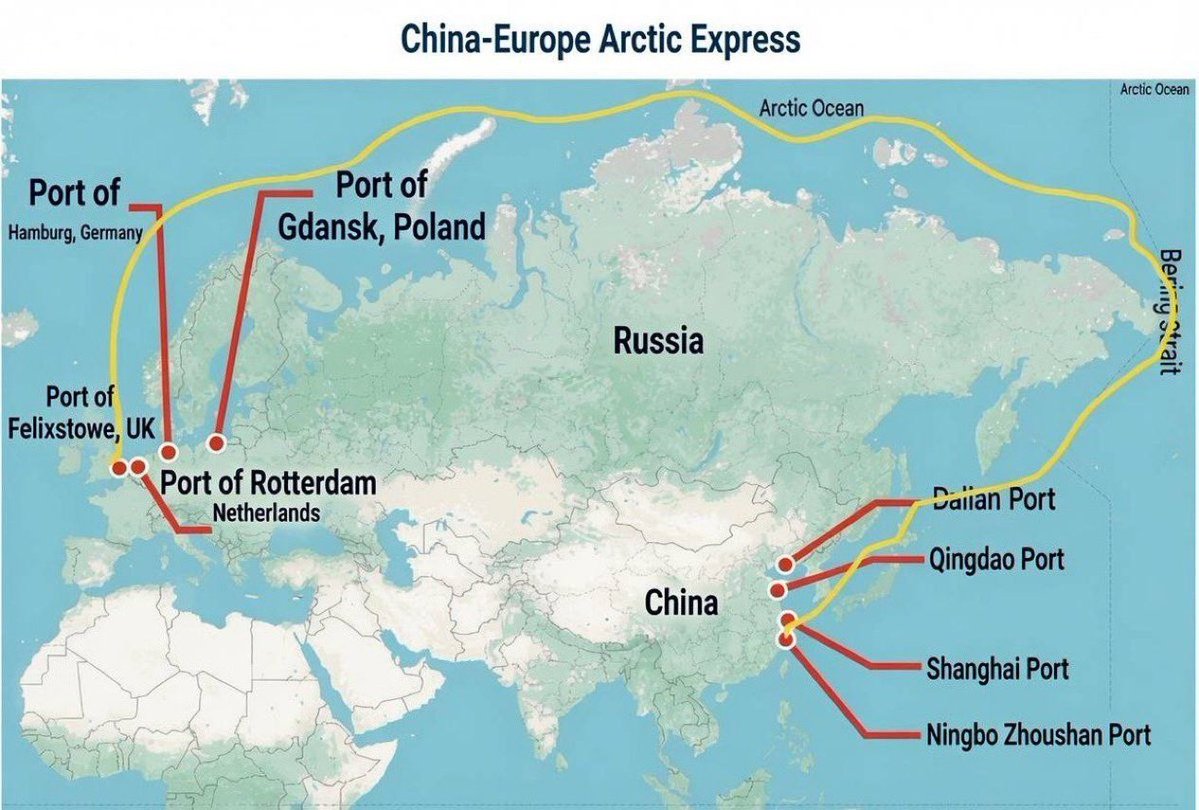
China will launch its first weekly container service between China and Europe via the Northern Sea Route. The voyages will begin in August, with a sea transit time of approximately 20 days. The destination is Felixstowe (UK), with potential stops at other European ports.
The distance between Shanghai and Rotterdam via the Arctic is approximately 12,800 km, while the distance via the Suez Canal is over 20,000 km. However, on most world maps, the "Arctic Express No. 1" appears longer due to the Mercator projection.
The Kimi K3 model delivers a major leap in engineering‑project design.
The Kimi K3 model successfully completed full mechanical, electrical, and fire‑protection system modeling for a $31 million hotel with 190 rooms, coordinating all systems in advance before execution.
A task that once required three engineers over six weeks at a cost of about $70,000 can now be done by one engineer reviewing AI outputs in just nine days, with a total cost of roughly $5,000.
The system links Kimi K3 directly to BIM software, enabling it to read architectural drawings and technical English descriptions, then automatically build the model without manually entering each component.
This approach has reduced modification requests during execution by 60% to 80%, saving time, cutting costs, and significantly minimizing errors.
It is no longer just a tech demo — it is a practical application proving AI’s ability to manage complex engineering systems with high efficiency.
@RobotaxiRadar Five minutes looping in a Dallas dead end. I keep saying this is why the UAE model works. Proactive infrastructure and redundant networks built from day one prevent exactly this.
@ProfRayWills I test autonomous EV platforms daily. A $15b refinery locks Australia into the wrong century. Batteries and electrified freight are the real strategic reserve. UAE already showed how stable policy and smart infrastructure beat stockpiling oil.







![Updatesofwworld's tweet photo. 🌎BREAKING : 6G WIRELESS NETWORKS ARE EXPECTED TO BEGIN ROLLING OUT IN 2028.
6G is the upcoming sixth-generation mobile communications technology, projected to deliver peak speeds up to 1 terabit per second (Tbps), microsecond-level latency, and native AI integration. Commercial availability is expected around the early 2030s, coordinated globally by organizations like the International Telecommunication Union.
Key Performance Targets
•Speeds: Up to 100 times faster than 5G.
•Latency: Sub-millisecond down to 1 microsecond.
•Spectrum: Utilizes high-frequency sub-Terahertz (THz) and Terahertz bands (100 GHz to 10 THz) alongside traditional bands.
•Core Innovations
•AI-Native: Fully autonomous network resource management with zero human touch.
•Integrated Sensing: Using radio frequency reflections to map environments and image objects while transmitting data.
•
•Global Coverage: Seamless integration of terrestrial cell towers with non-terrestrial satellite networks.[1, 2]
•
Expected Use Cases
•Real-time holographic communication
•Wide-area mixed reality and immersive virtual environments
•Advanced autonomous mobility and smart city infrastructure.](https://pbs.twimg.com/media/HOntqxCbkAA8EEm.jpg)