📘New book published! "Advancing the Study of Privacy Cynicism, Apathy and Resignation in the Digital Society" is now available from @ElgarPublishing.
The volume explores why so many feel powerless, resigned, or cynical about privacy in a datafied and AI-driven world. 1/4
This article serves as a brief preview of a book manuscript @MichaelaPopescu and I are developing, with chapters to be completed in the next couple of months. We're excited to expand on what it means to protect our privacy and temporal selves. Stay tuned! #BookPreview
It's time to rethink what privacy means in the AI era. In our new piece for @waccglobal Media Development, we (@LemiBaruh & @MichaelaPopescu) propose “Privacy as a Right to Becoming” .
Read it here: https://t.co/nuPaFScOfB
#Privacy#AI
AI puts this internal dialogue under siege. By curating our memories, shaping our present attention, and predicting and preempting our future paths, algorithms disrupt this essential process, interfering with the very tools we use for our own life stories. #Privacy#Autonomy
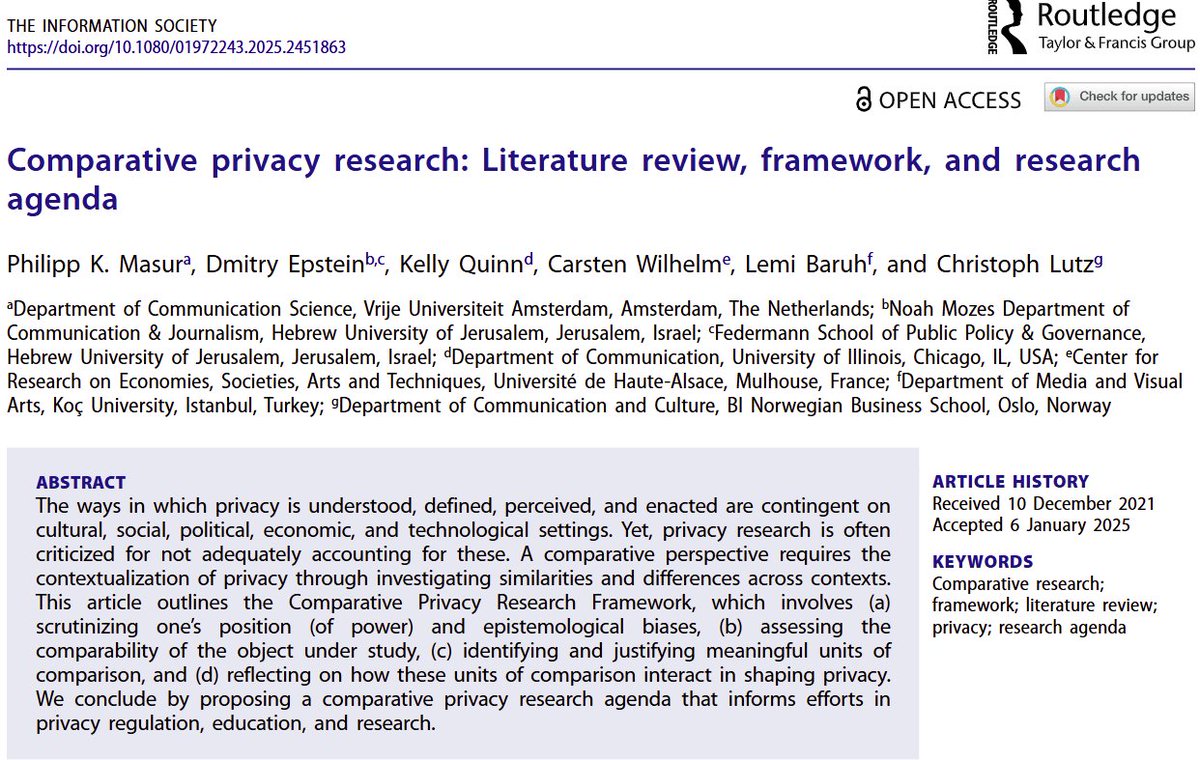
💡New Publication on comparative privacy research!
After almost 5 years in the making, @MasurPhil, @Think_Macro, @_kquinn_ , @CarstenWilhelm, @lbaruh and I are proud to have published this article in the Information Society: https://t.co/RkMfEfCPpV
🧵with key findings below
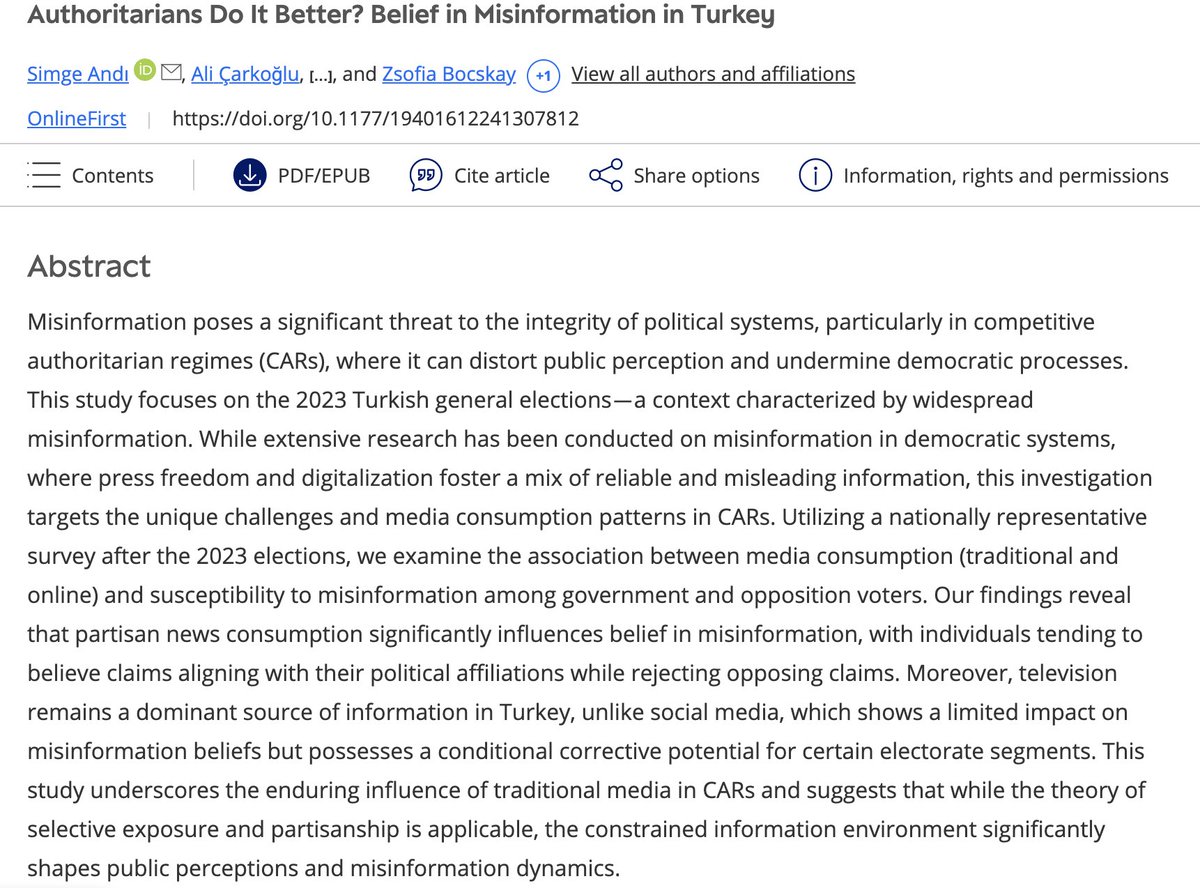
Starting 2025 with a new publication co-authored with Ali Çarkoğlu, @lbaruh@zsofiabocskay 💥
"Authoritarians Do It Better? Belief in Misinformation in Turkey" now available online and open access at the International Journal of Press/Politics 🇹🇷🔔 https://t.co/65Iqf1jmJW
🧵4/4 But superstitions play a role too. Superstitious respondents were more hesitant to report health predictions, especially if they frequently thought about the future - possibly fearing that discussing their expectations could jinx their health, temp fate. 🧿
Happy 2025 and🚨new publication. Why do some people refuse to predict their future health? We (@lbaruh, Celia K. Naivar Sen, @zcemalcilar, @tarcankumkale) explore how the answer might lie in superstition, fatalism, and how we cope with uncertainty. 🧵1/4 https://t.co/O5tw1YyDlj
🧵 3/4 People with ongoing health issues tend to be more fatalistic, making them less likely to make health predictions. So, current health challenges shape how confident we feel about making predictions about their future wellbeing.
Our (by @MichaelaPopescu, @lbaruh, Samuel Sudhakar) Big Data & Society Guest Blog is now online: Role-Based Privacy Cynicism and Local Privacy Activism. https://t.co/QJAwnH8A0d
It is a short summary of our recent article (https://t.co/8wFgBJ9Qwo)
@MichaelaPopescu@BigDataSoc@CSUSBITSVP@CSUSBNews@SIMLAB_KU@UQCom_Arts 3/4 The consequences of "privacy cynicism" could be far-reaching. Without proactive efforts to address it, we risk perpetuating a cycle where data professionals and data subjects alike feel powerless to protect privacy, exacerbating the challenges of privacy self-management.
6/6 Despite remarks to the contrary during the post-election verbal sparring, our results suggest that none of the candidates would have emerged as the “clear” choice that the coalition could have gone with.
5/6 We also explored the alternative candidates suggested by the IYIP: Mansur Yavaş and Ekrem İmamoğlu. Yavaş had a significant advantage in getting votes from the voters of the right-wing IYIP. However, Yavaş’s appeal was predictably lower among the Kurdish voter-base.