„organizations can avoid it by permanently shifting priorities—tolerating some problems ad hoc and devoting sustained effort to pruning obsolete processes“ 🙏🏼🙏🏼
Between 1985--2023, MIT's faculty grew 9%. Administrative staff grew 189%. 📈 Why? In new @PNASNews paper, we use dynamical system model to show administrative bloat can emerge without empire-building--just from well-intentioned problem-solving gone awry https://t.co/MZgGkxilZ2
1. Does drawing harder boundaries between science and "misinformation" increase or decrease public trust in science?
In four studies conducted in the context of COVID-19, we tested this question by comparing different approaches to science communication.
https://t.co/gCXWe5KscK
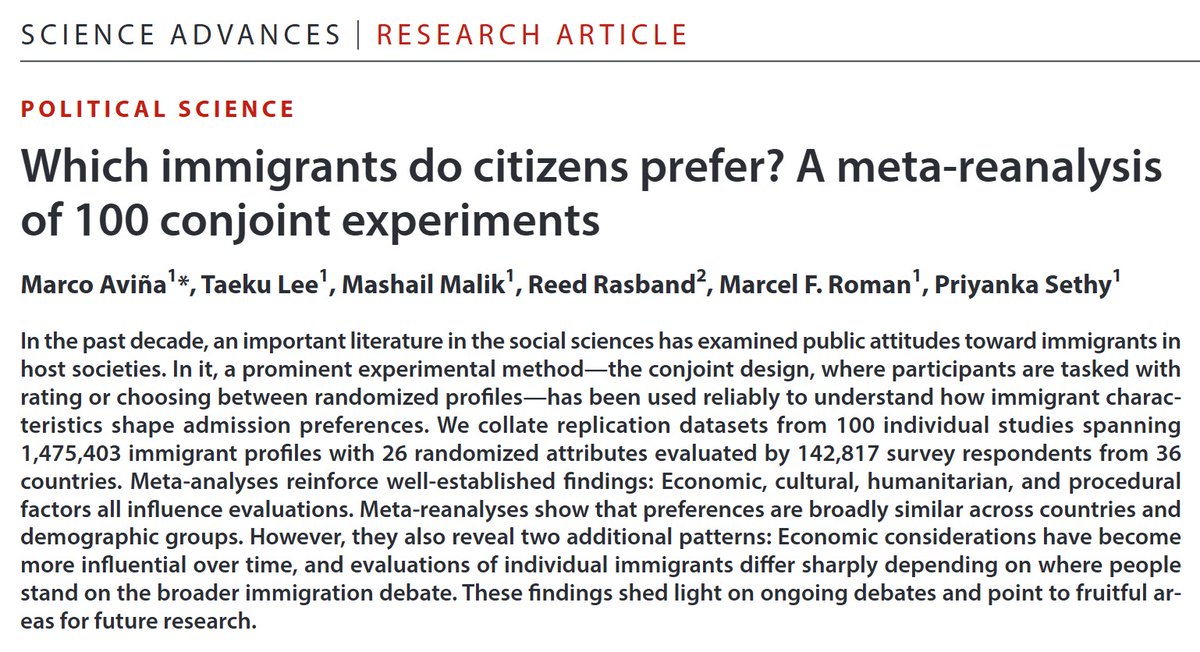
NEW in @ScienceAdvances, after 3 years of work with a great team:
We review and meta-analyze 100 immigrant conjoint experiments in 36 countries.
Immigration preferences are surprisingly similar across people and countries, but changing over time and structured by politics.
🧵
Was one of the best books I read last year, will be one of the best I read this year.
✨ $4 Kindle ✨
"What I can say, rereading the text now, is that I remain convinced by it. In many cases, new research has confirmed rather than challenged the core claims of the book."
Americans trust local and state governments more partly because they hear less about them; hearing more about national news is associated with lower trust in national government https://t.co/D1uIo7oCw4
About 1 in 4 Americans think the April shooting at the White House correspondents’ dinner was staged according to a new survey.
Roughly 1 in 3 Democratic respondents said they believed the event was staged, compared with about 1 in 8 Republicans. https://t.co/h30QujSIO2
Americans with Graduate degrees (now 14.5% of the population) are far more liberal & vote far more consistently Democratic than those with only undergraduate degrees; & local graduate degrees are very strong predictors of geographic voting patterns
https://t.co/FzxNiKSz3y
Excited to present my JMP at MPSA!
The post-Floyd “Great Awokening” was driven by affluent white liberals and emphasized recognition over redistribution.
Evidence from surveys, public discourse, and implicit bias data.
Consistent with elite capture of identity politics.
⬇️
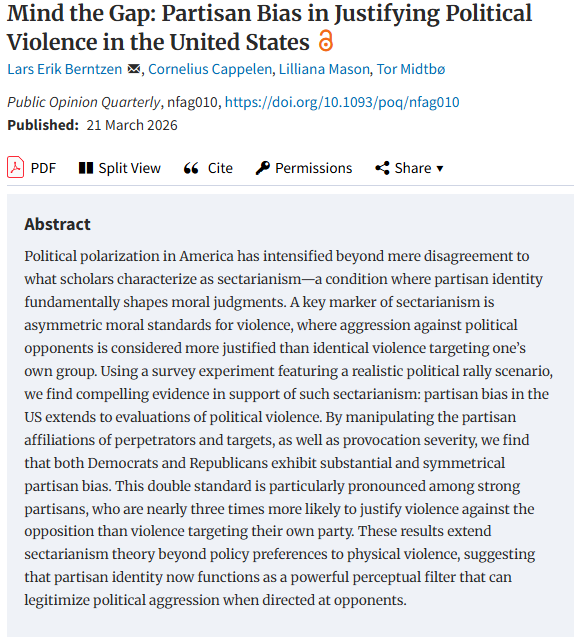
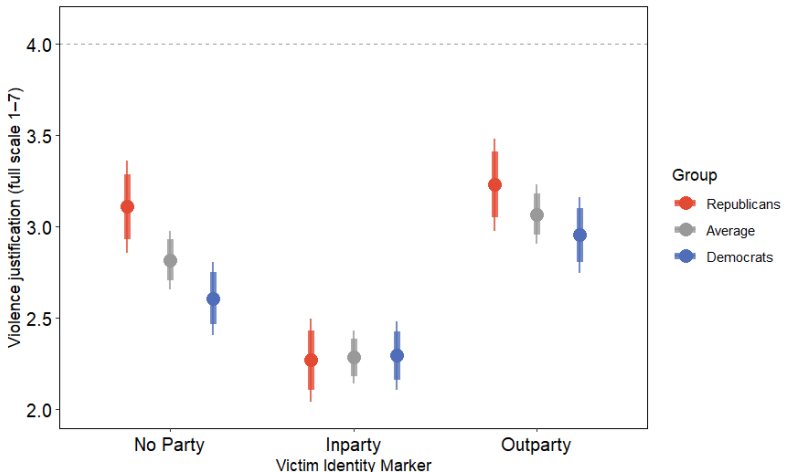
Does partisanship affect justifications of political violence?
Berntzen et al. find that both Democrats and Republicans are more likely to justify identical acts of political violence when the victims are from the opposing party.
Read now: https://t.co/a070u2lg2J
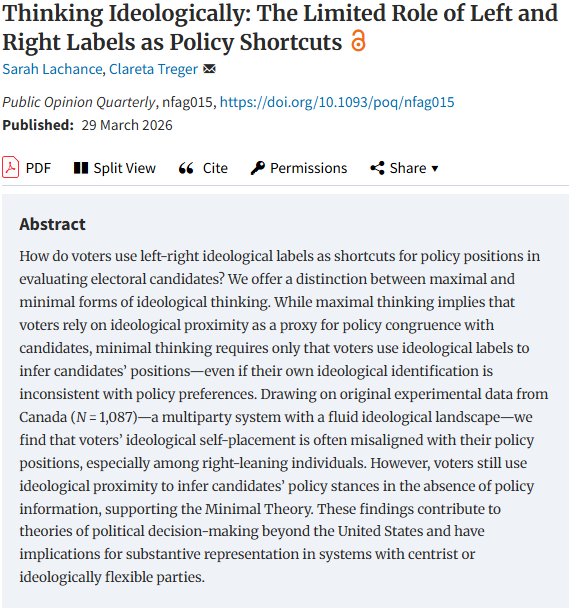
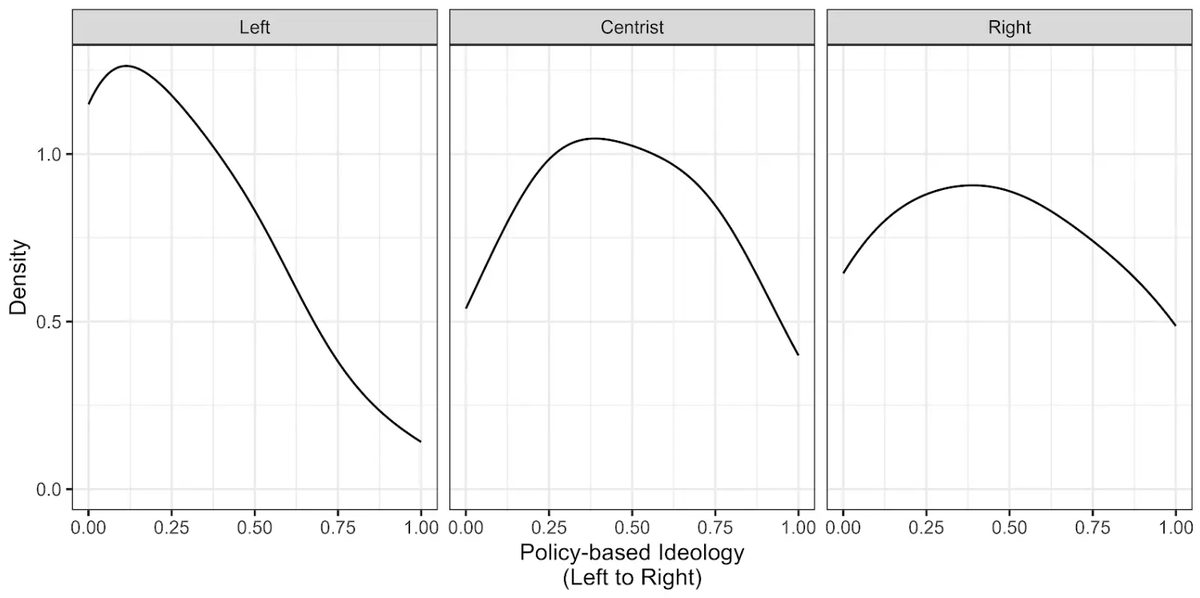
How do voters “think ideologically” in multiparty systems?
In POQ, Lachance & Treger find that Canadian voters use left–right labels as shortcuts to infer candidates’ positions, even when they don't fully align with their policy preferences.
Read now: https://t.co/1ToNrA5LgD
This new report from @Yale University explains why universities have lost public trust and how we can regain it.
The committee offered dozens of recommendations, like expanding financial aid, reducing admissions preferences, zealously protecting free speech and adjusting grading policies.
People in academia, the committee said, “must be willing to admit where we have been wrong and where we might improve, even as we defend what is essential about higher education and its academic mission.”
What do you think?
https://t.co/cJm5vYYhfe
Moral inversion and the rise of authoritarian sympathy
Ideologies that claim to be anti-oppressive, like antizionism and far-left progressivism, say they fight for the oppressed and against the violation of universal human rights.
We put these claims to the test, by asking 1270 Americans to assess the human rights records of democracies and authoritarian regimes, and take a battery of psychological tests.
The results were striking. Study link and highlights in 🧵
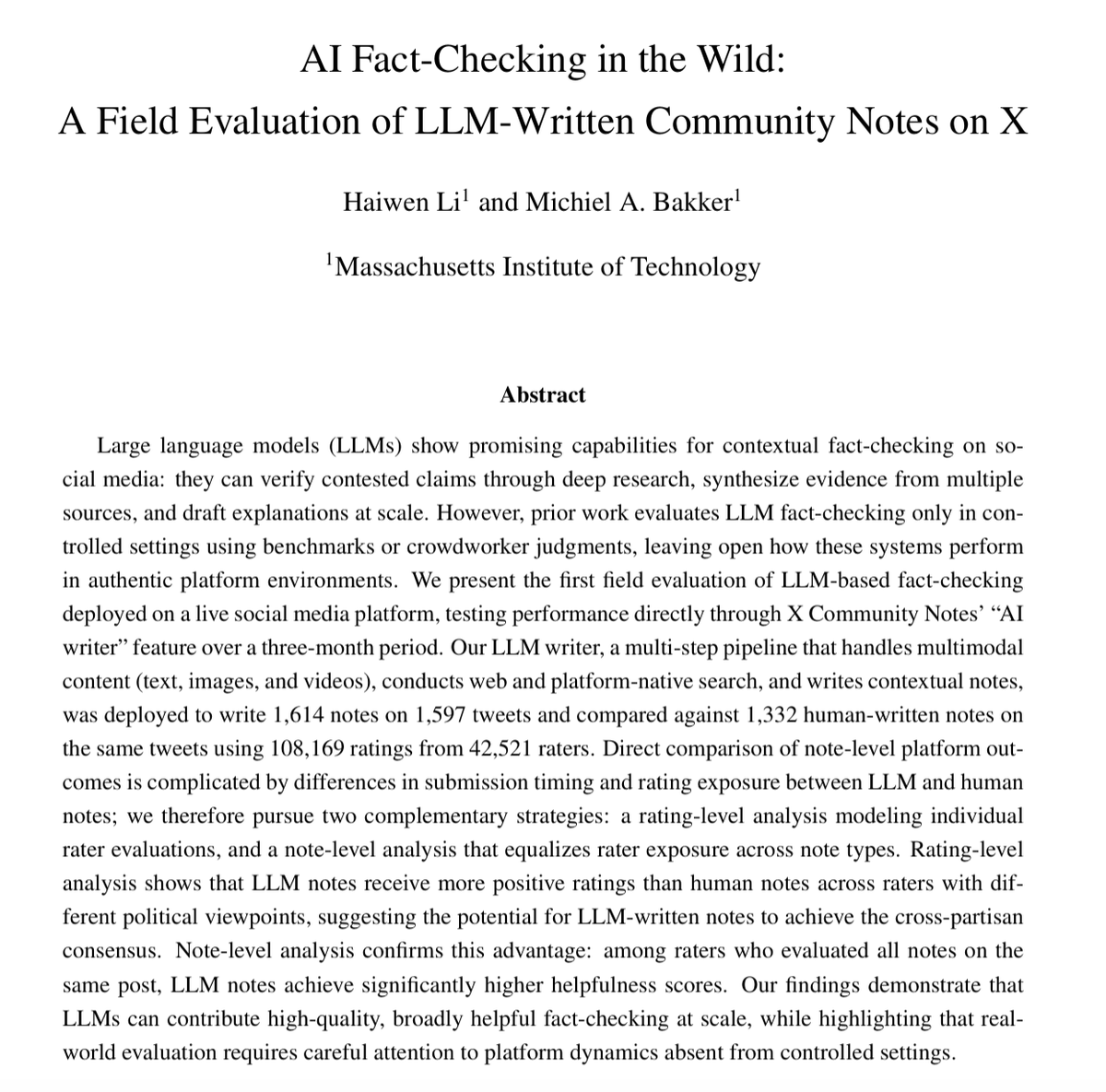
🚨New preprint. Many papers show AI can write fact-checks as well as humans (or better) in the lab, but very few test this in the real world.
We run the first online evaluation of AI fact-check writing with X Community Notes’ AI writer API.
Paper w. @bakkermichiel 1/
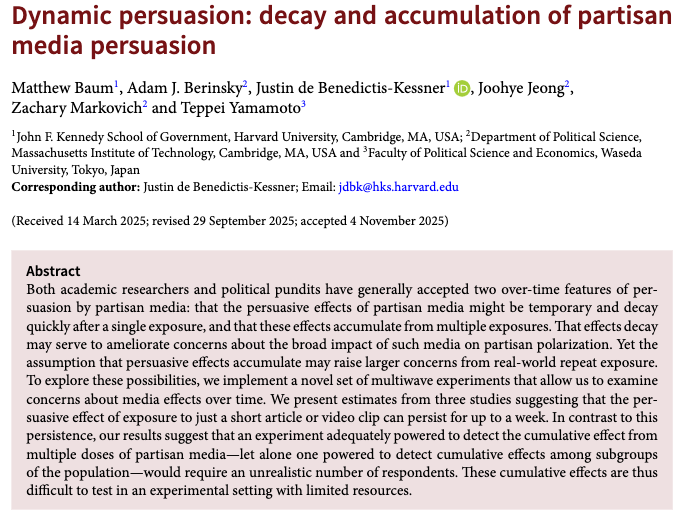
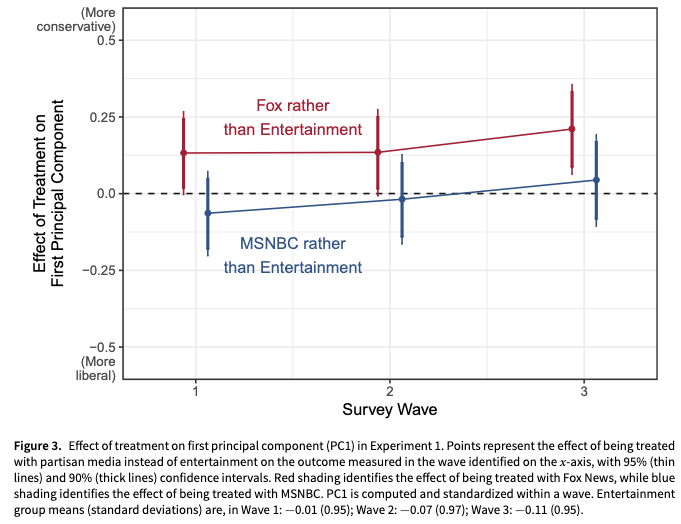
📰 Do the effects of partisan media fade quickly or accumulate over time?
➡️ Using multiwave experiments, M Baum et al. show a single exposure can have effects lasting up to a week, while cumulative effects are hard to detect https://t.co/zllYHJXEu5 #FirstView
Lisa Basil shows that not all conspiracy theory agreement reflects deep belief. She introduces a salience-based measure that separates fleeting endorsement from consequential belief—and suggests standard surveys may overstate it.
Read more here: https://t.co/nPzEOB3IUy
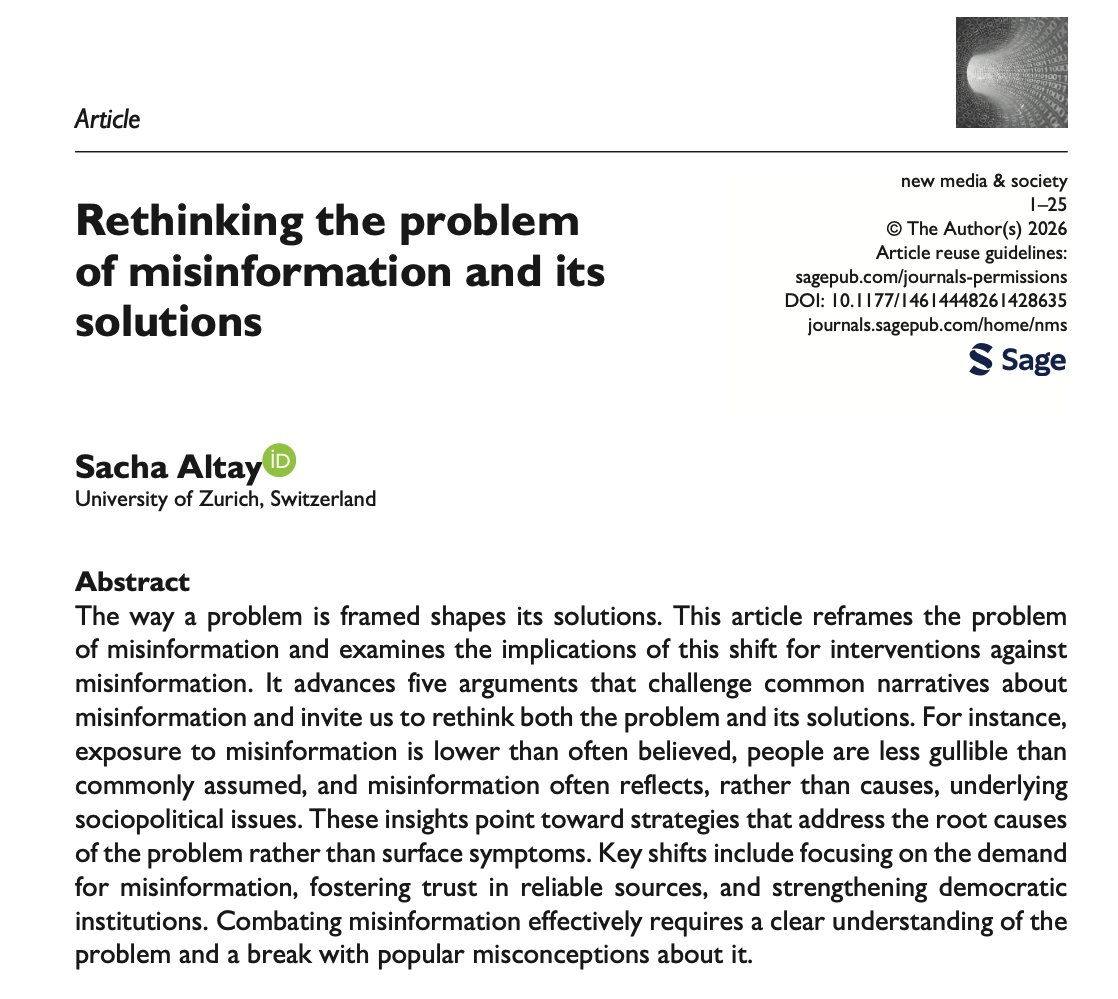
One of my favorites paper got published 🥳 It covers a lot of ground and it’s the best summary of my views on misinformation and what to do about it. Give it a read :)
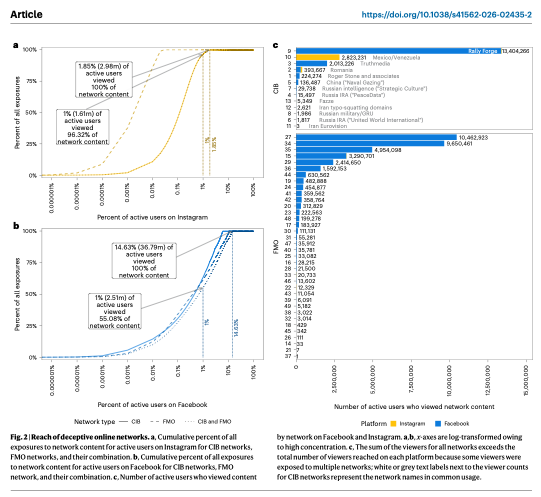
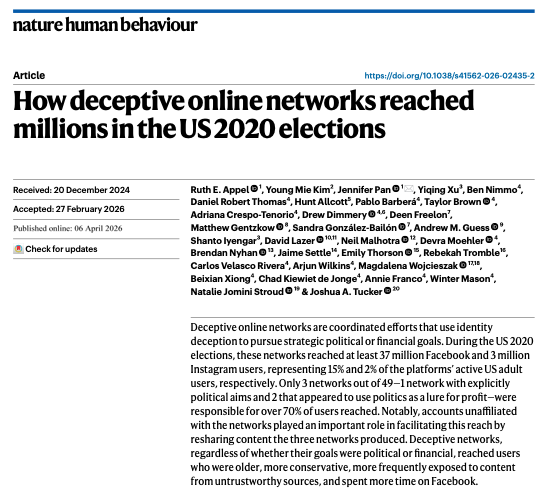
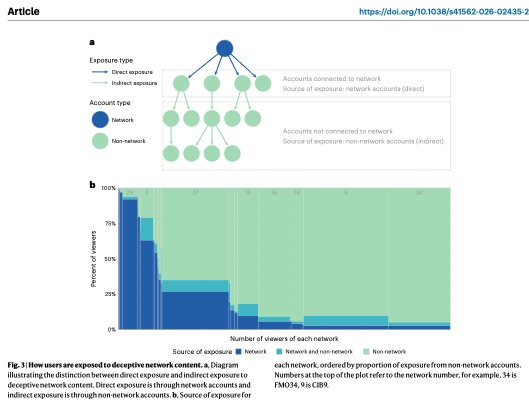
New in Nature Human Behaviour: How Deceptive Online Networks Reached Millions in the US 2020 Elections
-Reached at least 37M Facebook and 3M Instagram users
-3 networks out of 49 responsible for >70% of users reached
-Exposed users older, more conservative
Philip Moniz, Kyle Endres & @professorcostas show a key weakness in political microtargeting: the most persuadable voters may be the hardest to predict. Cross-pressured voters don’t fit neat party profiles—and campaign data often misses that.
Read more: https://t.co/B2Qhhyp1mb
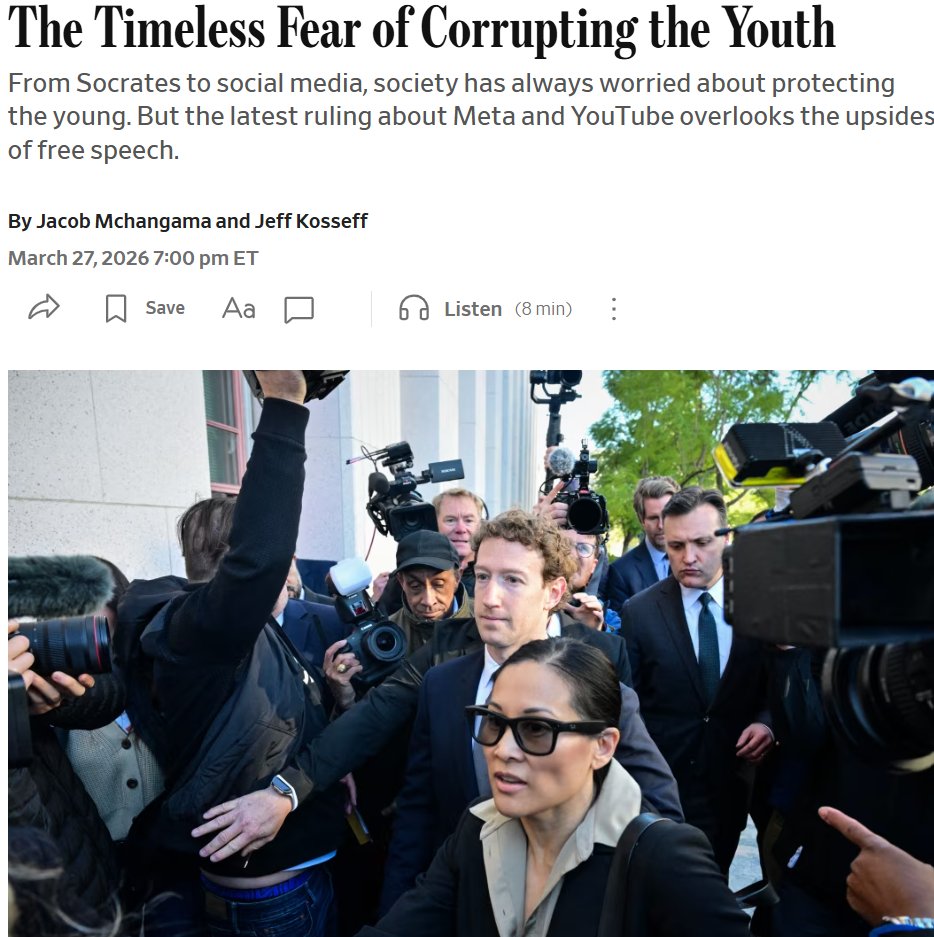
From Socrates to social media, the charge of "corrupting the youth" has always been the go-to justification for censorship.
Our new piece in @WSJ on why the global rush to ban kids from social media risks building surveillance infrastructure that threatens everyone's freedoms.