Really proud of our paper!! We show that U2 snRNP is required for Pol II pause release and new RNA synthesis!! Great collaboration with @SaraMM_4 @CramerLab .... and happy women’s day!!!!!! #WomenInScience#womensday2021
Our new paper suggests that co-transcriptional spliceosome assembly triggers efficient release of paused RNA polymerase II for active transcription.
Great contribution of first authors @LCaizzi and @SaraMM_4 to #womansday2021!
Paper: https://t.co/gEjvLpMN1g
Excited to highlight the new Special Issue of RNA showcasing advances in system-level RNA biology, from epitranscriptomics and RNA damage to deep learning–driven structure prediction and beyond. A strong snapshot of where the field is heading https://t.co/QRNi6RlAtO
This is really cool (and wild):
Scientists simulated a complete living cell for the first time. Every molecule, every reaction, from DNA replication to cell division.
The paper (Luthey-Schulten et al., Cell 2026, https://t.co/PXxXWKC8yp), just out today, used JCVI-Syn3A — a synthetic minimal bacterium with fewer than 500 genes. A 3D+time simulation of the full 105-minute cell cycle: DNA replication, protein translation, metabolism, division. Every gene, protein, RNA, and chemical reaction tracked through physical space.
It took years to build. Multiple GPUs. Six days of compute time per run.
And this is the simplest possible cell.
A human cell has ~20,000 genes. It lives in tissue. It interacts with neighbors. It differentiates. It responds to drugs in ways that depend on context we haven't fully measured.
Mechanistic simulation of the minimal cell costs 6 GPU-days for 105 minutes of biology. You cannot scale that to human cells. The complexity isn't 40x harder. It's exponentially harder.
This is why the field pivoted to data-driven models. You can't hand-encode the regulatory wiring of a human hepatocyte. But you can learn it — if you have the right perturbation data collected across enough diverse biological contexts.
The two approaches aren't competing. Papers like this generate the ground truth that future ML models need for validation. But the path to a clinically useful virtual cell runs through foundation models, not through scaling up mechanistic simulation.
Amazing work!
Just a reminder that the IncaRNAto lab is still looking for 2 Post-docs (either wet or dry) to work on #RNA structural ensembles in living cells, and their therapeutic targeting!
Please retweet: https://t.co/pYJ3H3j705
🚀 Our #CultMeat crowdfunding is off to an amazing start, hitting nearly 50% of our initial goal in just 24 hours! Every donation, no matter how small, will be MATCHED by the University of Turin once we reach our goal. Help us keep up the momentum! 🌱🍖 https://t.co/YtSouUbeP9
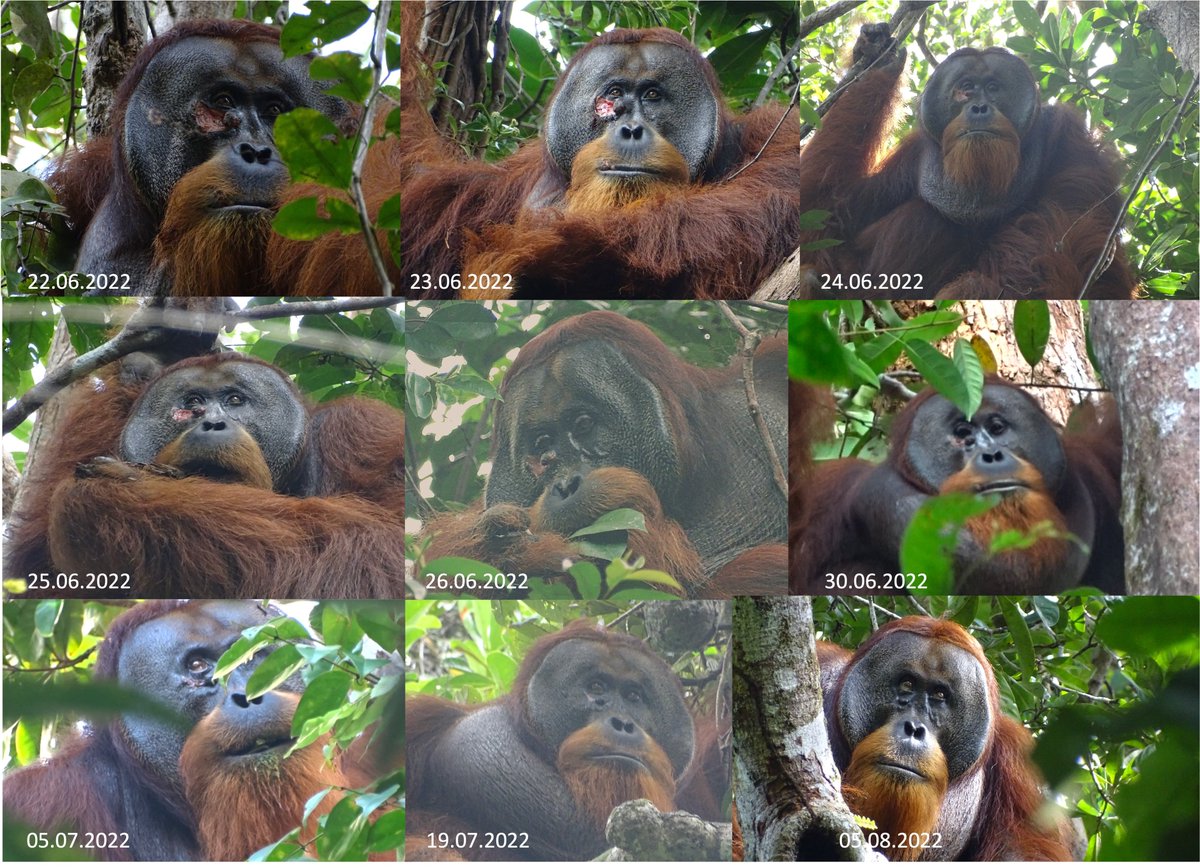
Researchers have observed a Sumatran #orangutan in the wild repeatedly treating its own wound with a plant with several known medicinal properties - the first scientific record of this behaviour in a wild animal https://t.co/8KE8wnVdsa @IsabelleLaumer@carolschuppli@MPI_animalbehav
Since the seasonal dunking-on-lncRNAs is back, and I do 💕 lncRNAs, a 🧵 on what I think have been the sources of the main problems in the 15 years of the field so far:
Happy to share the results of a great collaboration with Thomas Pfannschmidt (LU Hannover), led by the amazing @paulafprado and Frederik Ahrens. Together, we determined the structure of the multi-subunit plastid-encoded RNA polymerase from chloroplasts!
https://t.co/3sBbq6pevn
🧵