@ryankatzrosene The only way is dialogue. There has to be an open, honest continuing dialogue between Alto and farmers in the affected regions of the proposed corridor. And the message has to be that they will not reproduce the errors of the past.
The Prime Minister is expected to unveil new measures tomorrow to strengthen Canada's food system and improve affordability. I recently discussed this idea with the Minister of Agriculture (Picture).
If I were Prime Minister, my priorities would be straightforward:
• Make food affordability a national priority and require all new policies and regulations to be assessed through a food affordability lens.
• Increase competition across the food supply chain.
• Modernize supply management to improve competitiveness and trade flexibility.
• Mandate Farm Credit Canada to play a much larger role in supporting agri-food startups, scale-ups, and accelerator programs.
• Accelerate AI and automation adoption to boost productivity.
• Invest in trade infrastructure and logistics.
• Cut regulatory duplication that raises costs.
• Expand domestic food processing capacity.
• Focus on food security through innovation, investment, and competitiveness.
Canada doesn't have a food shortage problem. It has a productivity and competitiveness problem.
I’m a chemist. I need to say this - because it’s getting dangerous out there. The biggest health myth in the world isn’t about vaccines.
Or GMOs. Or fluoride.
It’s the root of all of them.
It’s called chemophobia - and it’s killing science.
Fear of “chemicals” now drives vaccine rejection, GMO bans, food hysteria, and entire political movements.
From tampons to tap water, people have been taught to fear chemistry - the very thing that keeps us alive.
Chemophobia tells us:
“Natural is good.”
“Synthetic is bad.”
That’s a lie.
Botulinum toxin is 100% natural and one of the deadliest molecules known. Aspirin is synthetic and life-saving.
We’ve gone from banning harmful substances for good reason…to banning safe, well-tested molecules for emotional reasons.
You’ve seen the slogans: “If you can’t pronounce it, don’t eat it.” “Paraben-free.” “Clean beauty.”
They sound empowering. But they’re not science - they’re marketing. And they’re making the world dumber, poorer, and sicker.
Your body doesn’t care if a molecule comes from a plant or a lab. Vitamin C is vitamin C.
Formaldehyde is formaldehyde and your body makes more of it every day than any vaccine ever could.
Dose matters. Source doesn’t.
This fear isn’t harmless.
It shapes public policy.
It blocks innovation.
It raises food prices.
It slows down cancer treatments.
Chemophobia is now mainstream and it’s costing lives. Scientists aren’t losing because we’re wrong.
We’re losing because fear spreads faster than facts. Because influencers sell fear for clicks.
Because lawyers monetize doubt. And because scientists are too tired to fight back.
So here’s my message, as a chemist and as a citizen: Learn how toxicology works.
Call out chemical fear-mongering. Support policies based on evidence, not emotion.
Chemistry isn’t the enemy. It’s the reason you have clean water, safe food, and modern medicine.
If we let fear win, we lose all of it.
@KobeissiLetter While true in absolute terms, it is easing because demand is falling; the spring planting season is over. The damage, however, has already been done. The proof won’t show up until the Fall, when crop yields are revealed. And, in Asia, they will be lower, driving hunger.
84% of Asia already leapfrogged the US in electrification, with electricity making up 26% of Asia's final energy mix compared to just 21% in the US
And that's just the start: Asia is now electrifying 5 times faster
More than a billion barrels of oil have not reached the market since February. The IEA calls it the largest supply disruption in history. This morning Iran sealed it, declaring the Strait of Hormuz closed to every ship on earth. Oil rose 2%.
That 2% is the most important number in the world right now, because it hides the others. Crude sits near $95 not because the shock is small but because the rich world has spent the months since February burying it, draining emergency reserves, rerouting tankers around Africa, letting savage prices kill its own demand. The IEA expects those buffers to run dry by mid-July. After that, there is nothing left to hide behind.
The countries that import their food never had anything to hide behind. Hormuz carries roughly a third of the world’s seaborne fertilizer trade, the urea and ammonia the Gulf ships to farms across Asia and Africa. With that line cut, fertilizer prices are up 30% and the World Food Programme projects 45 million more people driven into acute hunger. Its chief says aid agencies are now reduced to taking, in his words, from the hungry to give to the starving. The shock does not show up as a spike on a chart. It shows up as crop failure in a country already one bad season from famine.
And the safety net is fraying. The US has pulled 66 million barrels from its strategic reserve, down to 349 million, with no plan to refill until 2028, just as hurricane season opens. A reserve built to survive a crisis at home is being spent to disguise one abroad.
The story today is the calm, not the chaos. The most violent number is the one that did not move, and the silence it buys is being paid for in food.
Declaring victory on our broadband objective | @Mark_Goldberg@TheHillTimes https://t.co/OutxDQ8o3y
It is time to engage partnerships between service providers, government social service agencies, and training facilities to drive adoption, ensuring no Canadians are left offline.
While so many countries are paralyzed with fragmented grids, zoning headaches and 5-year waiting lists just to plug in 1 solar farm, China has already built 46 UHV (Ultra-High Voltage) transmission lines spanning over 60,000 kilometers (enough high-tech wires to circle the Earth 1.5 times)
The rest of the world combined has built exactly two.
>Standard high-voltage lines bleed 10% of their electricity over long distances
>China’s UHV lines operating at a massive 1,100kV slash that loss to basically nothing
>This allows large volumes of clean, zero-marginal-cost electrons in the Gobi Desert to drop instantly into the industrial heartlands of Beijing, Shanghai, and Shenzhen over 2,500 kilometers away
>Just 1 of their new lines from Xizang to Shenzhen carries 10GW of capacity, delivering 43 billion kWh of clean power every single year. (That's the equivalent output of 10 massive nuclear reactors flowing down a wire)
The most arresting thing is that China is not slowing down any of it
>Under the newly released 15th Five-Year Plan (2026–2030), its State Grid is spending $550b (a 40% capex hike) to build 15 more UHV lines
>This will expand cross-provincial clean energy transmission capacity by another 35%, allowing renewables to take over the majority of energy use in the world’s manufacturing superpower
Wires chewing pipelines - fast
@Patrickdery Looks suspiciously like 'news creation' rather than 'news reporting'. Should actually be a good news story, but they've twisted the data to make into a bad news story that drives anger and engagement across social media.
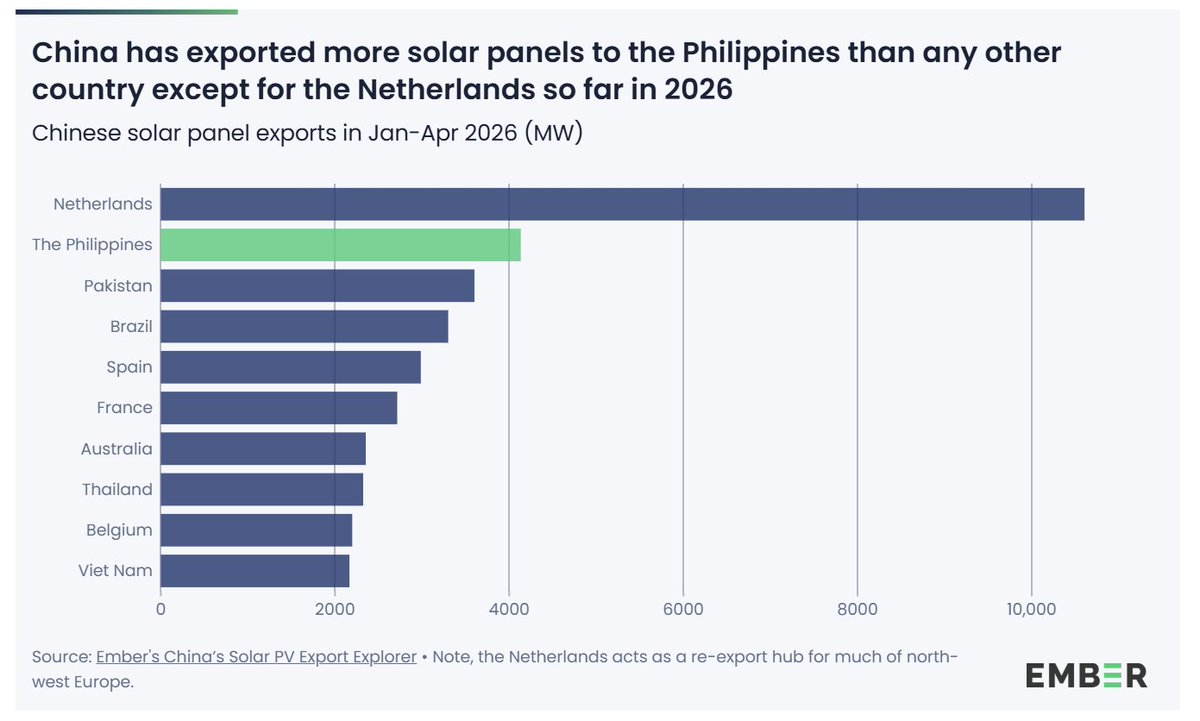
The Philippines abruptly became China's 2nd-largest solar panel export market in 2026, eclipsing Pakistan. In March and April alone, 3,000MW of solar panels were exported to the country
The Philippines has Southeast Asia's costliest residential power. So the people staged a revolt, having figured out that solar payback collapsed to 3.1 years for homes and 2.3 for businesses - because:
a) the grids was addicted to volatile, USD-denominated imported fossil fuels (like LNG), leading to an explosion of retail electricity prices up 17% or more for homes; and,
b) solar costs plunged 10% over the past 12 months
Wire chewing pipelines - everywhere, all at once
The US government is becoming increasingly dependent on private investors to finance its growing debt burden:
Privately held US Treasury debt maturing within 1 year is up to a record $8.3 trillion.
This figure has DOUBLED over the last 5 years, reflecting the government's growing reliance on short-term financing from private investors.
As more debt shifts into Treasury bills, a larger amount must be refinanced every year, leaving borrowing costs increasingly sensitive to interest rates and investor demand.
At the same time, foreign central banks are reducing their share of Treasury holdings, making private investors absorb a larger portion of new issuances.
As a result, the Treasury market is becoming increasingly dependent on investor demand and liquidity conditions rather than the stable long-term buyers that have traditionally anchored it.
With US public debt at an all-time high, even modest disruptions in funding markets could have an outsized impact on borrowing costs.
Treasury refinancing risks are intensifying.
New polling shows the stay camp gaining momentum as economic concerns rise. 73% of Albertans now say they want to stay in Canada!
You can read the full survey here ➡️ https://t.co/O4xxTzrIlD
Pledge your vote I https://t.co/orbO13zfAY
Laos just implemented a total ban on all petrol- and diesel-vehicle imports, to at least end-2026
>EV and hybrid sales are already 36% of new sales
>Laos wants 30% of all vehicles on the road to be electric by 2030, so EVs will be 75% to 100% of all vehicle sales over the next few years (that's just the math)
>Laos bleeds $1.27b/year on refined petroleum imports alone, in a country with a GDP of $17b. Laos has zero domestic oil reserves and imports 100% of its refined petroleum products. That's macro-economic suicide for a hydro powerhouse with 26.5GW of water-based energy potential, positioned as the “battery of SE Asia”. The ban will drastically cut that import bill
Wires are chewing pipelines
@FoodProfessor Totally agree that this is good reporting. Two issues in my mind that require answers: the energy use to power the bioreactors, and the disposal of the waste growth medium. These are real issues that are slowing scale up.
The CBC did a very good job last night on The National explaining why Canada is lagging behind many other countries in its review of the safety of cultivated meat (lab-grown meat).
Excellent reporting by Johanna Wagstaffe.
One in 10 two- and three-wheelers worldwide are already electric. And the trend is accelerating.
>In 2025, EVs wiped out 2.3m barrels of oil demand/ day, of which electric 2- and 3-wheelers were ~50%
>There are now 350m electric 2- and 3-wheelers on the road globally
>In India, electric models captured 70% of the entire new 3-wheeler market, because their cost of ownership has gone below diesel and gas
>In Viet Nam, electric 2-wheelers market crossed 20% share. In Türkiye, electric 3-wheeler sales went from zero to over 100,000 units inside 5 years. Across Sub-Saharan Africa, commercial moto-taxi drivers are cutting their daily energy bills to under $2/day using modular battery-swapping networks. And so on.
Wires are chewing pipelines