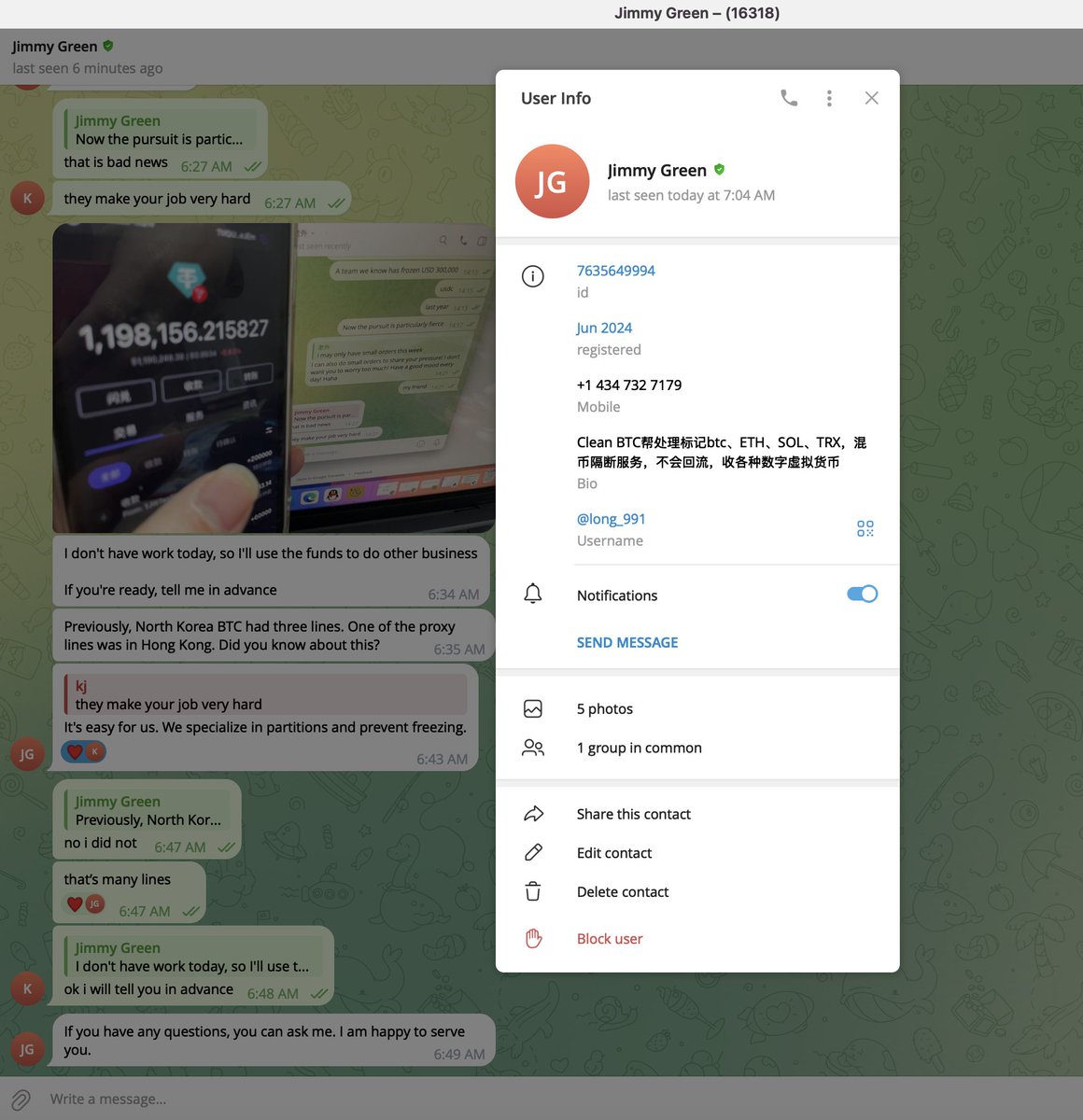
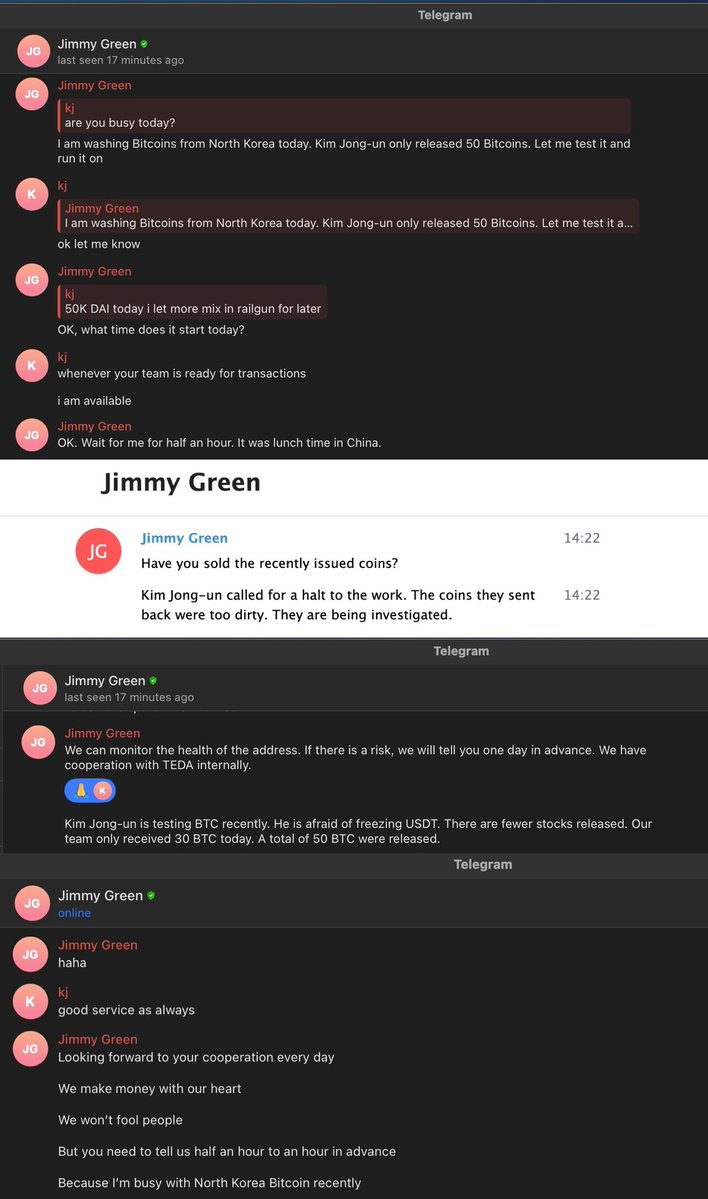
1/ How I infiltrated a Chinese organized crime syndicate that has laundered $1B+ across multiple exploits for Lazarus Group.
Posing as a client, I gathered intel that helped action freezes for the Feb 2025 Bybit exploit and attribute illicit activity onchain.
I think ambitious people should treat life in “seasons” rather than trying to balance everything every day.
A few years massively overallocated to work. A period getting seriously fit. A year or two nomading. Then family takes priority for a while. Then maybe at 35 you go completely insane again and spend four years building a new company, and so on.
The mistake is thinking every metric needs to stay green all the time. Most great outcomes (building a company, writing sth serious, training for an event) need uninterrupted runs, not daily moderation. Sometimes work should suffer cause you’re travelling, sometimes your social life should suffer cause you’re building, sometimes career progression should slow cause family matters more. That’s fine.
And tbh it probably makes life more fun too. You get actual chapters and completely different versions of yourself instead of spending 40 years maintaining the same perfectly optimised routine. A few intense years in one city, a weird nomad phase, an obsession that takes over your life, then something completely different. Probably much more memorable than one very long well-optimised Tuesday.
It's why I encourage everyone to think of balance in years, not days. A good life can look horribly unbalanced on some random Tuesday and still be very balanced over 10 years.
Introducing Startale Card.
The easiest way to spend your onchain assets anywhere Visa is accepted, while you continue earning yield. The waitlist is now open.
Secure your early access 👇🏻
As engineering, product, design, DS, etc. melt into a new kind of role, I was reflecting on what roles might look like in the future. For example, when I look at the Claude Code team I see what I think is five archetypes:
1. Prototyper: comes up with brand new ideas; churns out many ideas, most of which don't ship
2. Builder: quickly turns a prototype/idea into production-grade product/infra
3. Sweeper: cleans up the UI, simplifies the code and system, unships, optimizes performance
4. Grower: takes a product that has been built and iterates on it to improve Product-Market Fit
5. Maintainer: owns a mature system to make it secure, reliable, fast, and efficient as it scales
Many people span across 2 roles, and sometimes 3 roles. I also notice that these roles are not really tied to job function -- eg. across Anthropic, some designers match category 1, some 2, some 3; same for engineers, PM, DS.
A healthy team needs a mix of these, depending on the product:
- A product that is new and pre-PMF needs people that are strong at 1+2+3
- A product that is growing and has found PMF needs 2+3+4 and some 5
- A product that has strong PMF needs 3+4+5 and some 2
Maybe product roles of the future will look more like this, and less like the domain-specific roles of today?
1/ Where is the #Bitcoin bottom?
$BTC has fallen to $62K, nearly 50% below its ATH and down 24% in a month.
Price has now worked through the upper rungs of our pricing framework, moving into the cluster of valuation levels where past cycles have found their floor.
🧵
Permissionless listing for perps. Everyone talks about it. Nobody's actually built it right.
Until now.
Orderly is launching true permissionless perp listing
Any DEX can self-list a perpetual futures market. No approvals. No waiting. Live and tradeable.
🧵/
We’re proud to announce that Startale Group has closed its $63M Series A, with an additional $50M investment from SBI Group.
With backing from Sony Innovation Fund and SBI Group, Startale is building the global SuperApp and accelerating its vision of a fully integrated onchain financial and consumer ecosystem.
One seamless experience on the @StartaleApp, connecting @soneium, Strium, @JPYStableCoin and USDSC.
🇯🇵 Startale Group and SBI Holdings introduce JPYSC, the first trust bank–backed JPY stablecoin issued by Shinsei Trust & Banking, with Startale Group building the technical foundation for regulated digital yen infrastructure.
Here's what makes JPYSC a landmark moment 👇🏻
Agent's need to:
- Send
- Receive
- Pay
- Trade
Now they can.
Introducing awal, an agentic wallet purpose built to AI.
Try it for yourself:
npx awal@latest --help
Give it to your agent, they can figure it out:
npx skills add coinbase/agentic-wallet-skills
🧵
Startale Group is proud to announce a $13M follow-on investment from Sony Innovation Fund, reinforcing the long-term shared vision between @Sony and Startale to build infrastructure for onchain entertainment.
“Ethereum was not created to make finance efficient or apps convenient. It was created to set people free”
This was an important - and controversial - line from the Trustless Manifesto ( https://t.co/QAvZfiNxpe ), and it is worth revisiting it and better understanding what it means.
“efficient” and “convenient” have the connotation of improving the average case, in situations where it’s already pretty good. Efficiency is about telling the world's best engineers to put their souls into reducing latency from 473 ms to 368ms, or increasing yields from 4.5% APY to 5.3% APY. Convenience is about people making one click instead of three, and reducing signup times from 1 min to 20 sec.
These things can be good to do. But we must do them under the understanding that we will never be as good at this game as the Silicon Valley corporate players. And so the primary underlying game that Ethereum plays must be a different game. What is the game? Resilience.
Resilience is the game where it’s not about 4.5% APY vs 5.3% APY - rather, it’s about minimizing the chance that you get -100% APY.
Resilience is the game where if you become politically unpopular and get deplatformed, or if a the developers of your application go bankrupt or disappear, or if Cloudflare goes down, or if an internet cyberwar breaks out, your 2000ms latency continues to be 2000ms.
Resilience is the game where anyone, anywhere in the world will be able to access the network and be a first-class participant.
Resilience is sovereignty. Not sovereignty in the sense of lobbying to become a UN member state and shaking hands at Davos in two weeks, but sovereignty in the sense that people talk about "digital sovereignty" or "food sovereignty" - aggressively reducing your vulnerabilities to external dependencies that can be taken away from you on a whim. This is the sense in which the world computer can be sovereign, and in doing so make its users also sovereign.
This baseline is what enables interdependence as equals, and not as vassals of corporate overlords thousands of kilometers away.
This is the game that Ethereum is suited to win, and it delivers a type of value that, in our increasingly unstable world, a lot of people are going to need.
The fundamental DNA of web2 consumer tech is not suited to resilience. The fundamental DNA of _finance_ often spends considerable effort on resilience, but it is a very partial form of resilience, good at solving for some types of risks but not others.
Blockspace is abundant. Decentralized, permissionless and resilient blockspace is not. Ethereum must first and foremost be decentralized, permissionless and resilient block space - and then make that abundant.
Announcing Startale USD (USDSC), our stablecoin native to @soneium.
Stable by design.
Scaled by innovation.
Powered by @m0's universal stablecoin platform, Startale USD is the digital dollar that is designed to bring stability, scale, and liquidity to the Soneium ecosystem through our Startale App.
Read more 👇🏻