I can’t believe how many people are still picking up the Hyperwave Theory book! Just checked in with our publisher and it’s still getting purchased each month 🤯
Tyler Jenks developed Hyperwave Theory in 1979 and spent his entire career refining it. Tyler C, Tyler J and I were writing the book together when he passed, and finishing it without him was one of the hardest things I’ve ever done. He poured decades into understanding what happens when markets refuse to let the numbers add up, when human emotion overrides reality and prices accelerate through phases that become unsustainable. Hyperwave isn’t just a chart pattern; it’s a model for collective human psychology that tells you what happens when people chase dreams and trip over reality.
For the record, Tyler never saw BTC wick to ~$3,850 on Black Thursday, March 12, 2020, when it dropped nearly 50% in a single day and $1.4 billion in positions were liquidated on BitMEX alone. But it didn’t dip and hold below $1k, so the BTC hyperwave he thought was active was negated into funky territory. He would’ve been the first to say that’s exactly how the theory works. It tells you what it tells you, no ego, no narrative, just the pattern. And you better keep your eyes open and triggers ready for when lines are negated.
What I think matters most right now is that he examined and taught about a plethora of historical hyperwaves across asset classes, the phases of how bubbles form and collapse, and a TA framework for reading what markets are actually doing beneath the noise. That stuff doesn’t expire. And we’re in one of the strangest markets we’ve ever seen: the S&P closed Friday at ~6,910, hovering near ATHs, while BTC is sitting around $65K after a nearly 50% drawdown from its $126K peak in October. Bitcoin ETFs have bled almost $4 billion across five straight weeks of outflows. The disconnect between traditional equities and crypto right now is real, and it’s exactly the kind of environment where people get hurt if they’re not paying attention.
If there’s one thing Tyler drilled into me, it’s that bear markets are where the real damage happens, not because of the drawdown itself but because people refuse to accept the reality of one. They hold onto hope past the point of reason, mistake a Phase 6 bounce for a new bull, and let ideology override the chart. BTC is in a weird phase, semper paratus.
Take care of yourselves out there. Respect the trends. The system always cleanses itself, and the survivors of vol are the ones who stayed humble and let the numbers add up. Tyler Jenks would be absolutely blown away that people are still learning from his life’s work. I know @Sawcruhteez and I are. 🤍🤍
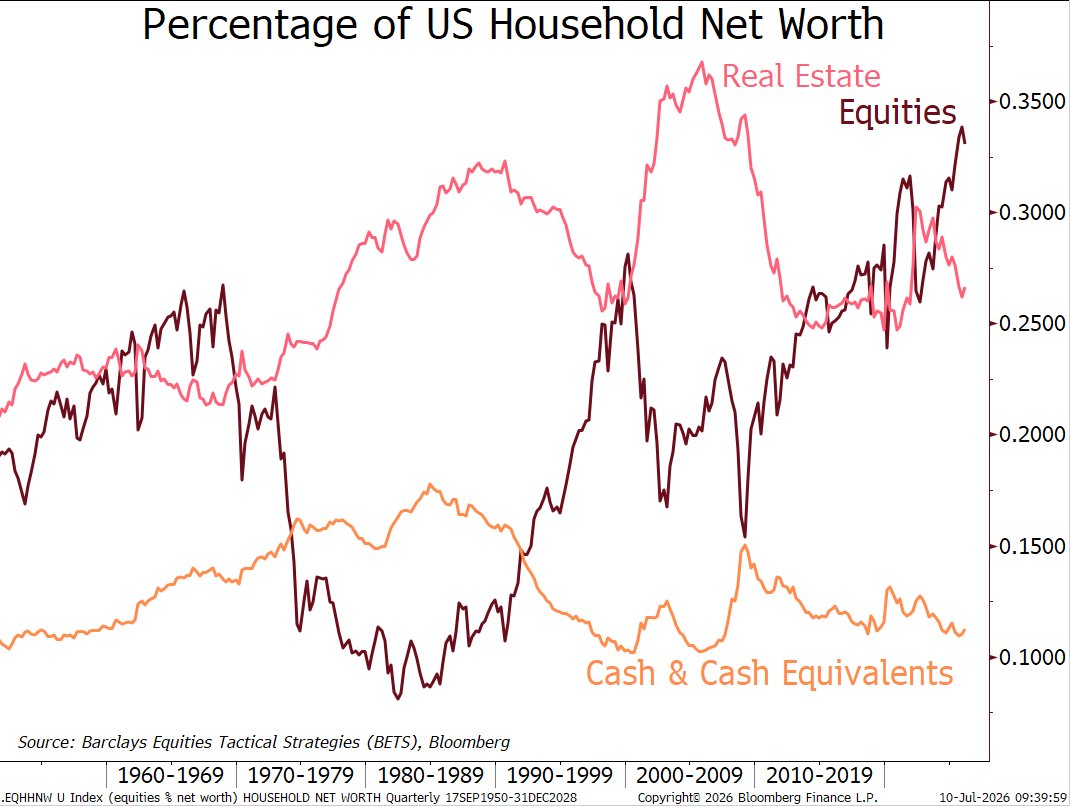
Amazing chart from today's episode:
It's not just that US household exposure to equities is at a record high, but that the stock market is a SIGNIFICANTLY greater component of total household net worth than real estate now, which blows my mind.
The stock market is the economy.
The First Stratum V2 Block: What It Means for Bitcoin Mining | SLP750
In this episode, @bitentrepreneur, CEO of @DMND_Sv2, joins me to discuss the mining of Bitcoin block 955,318, the first known Stratum V2 block on mainnet.
We break down what happened and the benefits of Stratum V2.
Timestamps:
00:00 The First Stratum V2 Block: What Happened?
01:08 How Does Miner Transaction Selection Change Bitcoin Mining?
01:58 Can SV2 Mining Pools Still Reject Blocks Though?
03:19 Can Miners Easily Switch Pools with Stratum V2?
04:45 Major Mining Pools Joining the Stratum V2 Working Group
05:40 Hardware & Firmware Support for Stratum V2
07:43 Is Miner Interest in Stratum V2 Growing?
09:00 The Biggest Benefits of Stratum V2 for Miners
10:21 How Does DMND's SLICE Payout System Compare to FPPS?
11:50 What Needs to Happen for Stratum V2 to Become the Standard?
13:21 Should Miners Start Building Their Own Block Templates?
As engineering, product, design, DS, etc. melt into a new kind of role, I was reflecting on what roles might look like in the future. For example, when I look at the Claude Code team I see what I think is five archetypes:
1. Prototyper: comes up with brand new ideas; churns out many ideas, most of which don't ship
2. Builder: quickly turns a prototype/idea into production-grade product/infra
3. Sweeper: cleans up the UI, simplifies the code and system, unships, optimizes performance
4. Grower: takes a product that has been built and iterates on it to improve Product-Market Fit
5. Maintainer: owns a mature system to make it secure, reliable, fast, and efficient as it scales
Many people span across 2 roles, and sometimes 3 roles. I also notice that these roles are not really tied to job function -- eg. across Anthropic, some designers match category 1, some 2, some 3; same for engineers, PM, DS.
A healthy team needs a mix of these, depending on the product:
- A product that is new and pre-PMF needs people that are strong at 1+2+3
- A product that is growing and has found PMF needs 2+3+4 and some 5
- A product that has strong PMF needs 3+4+5 and some 2
Maybe product roles of the future will look more like this, and less like the domain-specific roles of today?
BTW, the entire Cembalest piece is fantastic, including several pages on AI, and you have to be incredibly impressed, as always, by the degree to which he does his homework on whatever market he's talking about.
Introducing Stack the Shelves 📚🎲
7,000+ Bitcoin books & games headed to U.S. schools and STEM centers for as low as $2.99/unit.
→ Class (30): $149.70
→ Grade (250): $997.50
→ School (1,000): $2,990
You pick the recipient. Our monsters do the rest.
Start stacking 👇
https://t.co/koxmyJk2iS
the SEC just proposed rescinding Rule 611 of Reg NMS, the trade-through rule that has defined US equity market structure since 2005
this is a tradfi story, yes, but this is also one of the biggest unlocks yet for tokenized stocks 👇
Fully agree the alpha is real and that domain expertise finally outlasting the opportunity set (thank you to all the educators who made it happen!) is the actual unlock here. But “durable, scalable, repeatable” skips the axis many, esp international, tradfi allocators underwrite, which is “explainable”: perps basis looks like clean futures basis right up until the leg with the risk that has no equivalent in traditional markets shows up (depeg, exploit, sequencer/multisig failure, unseen regulatory and tax issues).
An unexplained and misunderstood +40% disqualifies you almost as fast as an unexplained -40%. But the deeper issue IMO is that most of the industry outside BTC still sells “decentralized” while running centralized token “printing” machines (BRRR) creating massive single points of failure (some explained above) and that illusion hides what an allocator needs explained and understood before sizing into it.
And unfortunately the nuances are hard to discern when there’s a CEO with an expensive marketing department (Bitcoin has neither) saying funds are SAFU.
Something I shared at our offsite this week—
The historical problem with capturing crypto alpha in a genuine multi-strat format has always been that each underlying strategy felt flimsy, fleeting, and fishy. Jargon like “recursive looping strategies” and “MEV arbitrage” sounds intriguing at first blush, but ultimately creates friction for what serious allocators care about most: 1) Is it durable, 2) is it scalable, and above all, 3) is it repeatable?
In 2026, I’m convinced that crypto alpha has finally found permanence. But that permanence isn’t coming from crypto prices themselves (you don’t need me to tell you that!). It’s coming from crypto’s financial primitives, which have now seeped irreversibly into the institutional conscience. Just as pod shops have “index inclusion arbitrage” as one of twenty evergreen alpha engines, we will soon have “pre-IPO arbitrage” as a permanent fixture too. Just as “convertible arbitrage,” once considered recklessly exotic in the ‘80s, became a mainstay of the CSA toolkit, so too will the “perpetual preferreds arbitrage” pod inevitably take its seat at the table. Just as “futures basis trading” has been the dominant leveraged strategy in tradfi for decades, Wall Street will one day inaugurate the “perps basis trading” era. Despite years of reflexive skepticism, all of these will be enduring strategies worth deploying institutional IP against, strategies where, for the first time, domain expertise can outlast the cyclical opportunity set itself that has plagued crypto for so long.
I share this because the industry’s collective mood disorder tends to mirror price action with exaggerated drama. But zoom out far enough and the picture sharpens to reveal that the market has structurally transformed to support what crypto has always done best: the hyperfinancialization of capital efficiency, duration, and distribution. We are entering the golden era of crypto alpha, where the technology enables a new frontier of financial experimentation that is, at long last, genuinely durable, scalable, and repeatable.
This doesn’t render crypto ethos irrelevant either. Far from it, in fact. Most of the arbitrage enabled by these novel capital structures will still collide head-on with tradfi’s centralized, oligopolistic gatekeeping. Consider this: do you really believe that something as globally consequential as prediction markets, your gateway to the world’s distributed knowledge, will confine itself onshore? Just as the extraordinary reach of US dollarization was only possible through the offshore murkiness of eurodollar markets, so too will come the great eurodollarization of information, the great eurodollarization of retail access, the great eurodollarization of the longtail asset: all of it operating by empowering decentralized financial sovereignty outside the incumbent system. The prevailing narrative says tradfi is swallowing crypto—I’d argue the opposite is true: crypto is forcing traditional finance to adapt to borderless innovations that ultimately prevail by design by being open source.
I know prices are brutal right now, and that kind of pain is genuinely demoralizing. But crypto cannot succeed as an industry built solely around pumping bags. It has to deliver durable value, and we have to develop the frameworks to identify, seize, and compound it. As a Riverian, there has never been a better time in history to be alive, where the current stands with us this moment of the turning. And history has constantly shown that success accrues to the stoics who show up for the bad days with the same conviction as the good ones. So for those who are excited for the golden era of crypto alpha to finally begin: the calling is clear, and the time to row is now.
It’s time to pick up your oar.
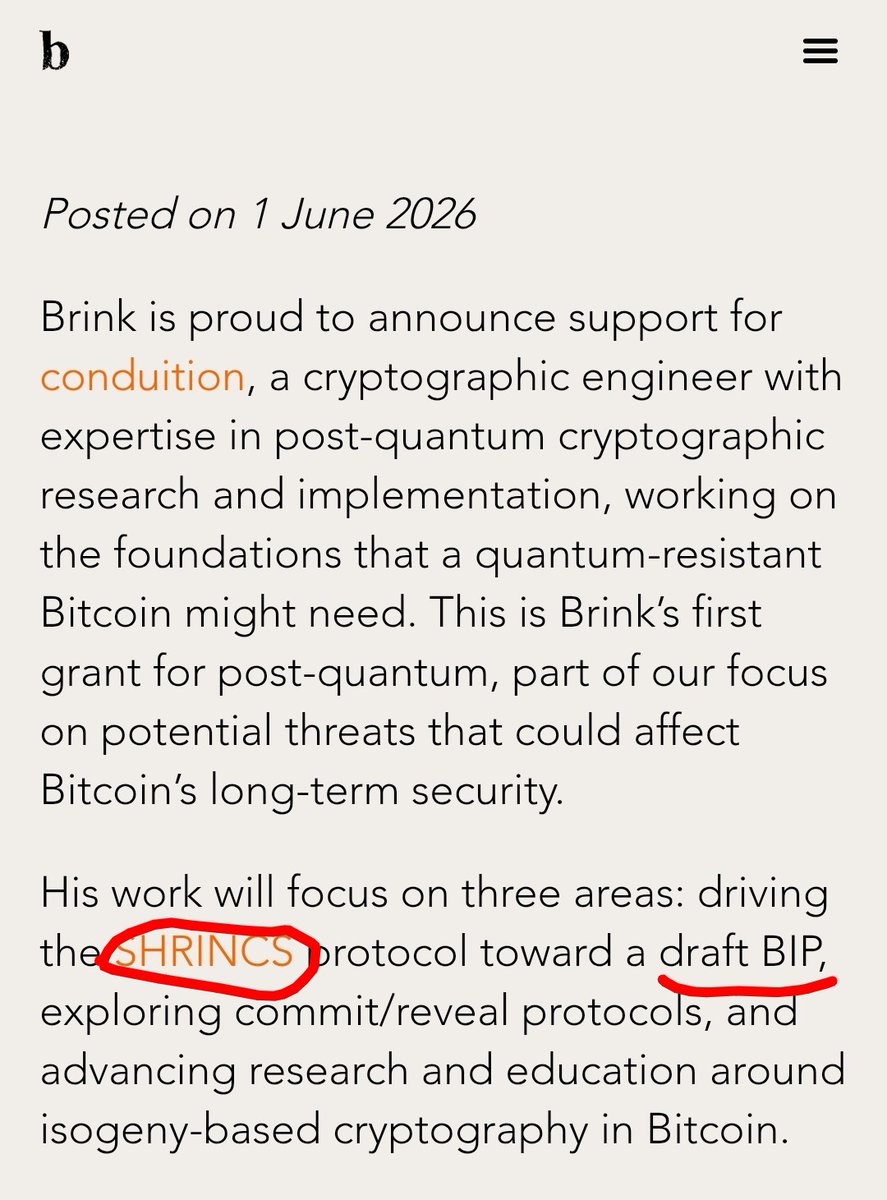
We're proud to support organizations like Brink that invest in Bitcoin's long-term resilience.
Congratulations to @conduition_io & the Brink team on advancing SHRINCS toward a draft BIP.
For those following the post-quantum discussion: BIP-360 focuses on the migration framework. SHRINCS is a specific quantum-resistant signature scheme being evaluated as a potential implementation path.
NEW ODD LOTS:
How commodity finance really works
@tracyalloway and I talk to Lewis Hart, head of corporate advisory and banking at Brown Brothers Harriman about the business of shipping commodities -- from oil to cashews -- all around the world https://t.co/lfx7cTmQ5A
New L2 design by Burak: Cube
A Bitcoin-native execution layer that combines Ark-style unilateral exits, BitVM dispute resolution, and a programmable virtual machine.
https://t.co/EWb4MvCSbr
Commission Staff Confirms the Categorization of Certain Crypto Asset Perpetuals as Foreign Futures and Issues No-Action Letter Regarding FCM Transfers of Customer Crypto Assets to Foreign Brokers as Margin:
https://t.co/mNzwFL6Wve
CEOs are quietly realizing the AI replacement plan has a problem.
Two problems, actually.
One: the token costs for running AI agents are now exceeding what they were paying the employees they fired.
Two: when the tokens run out, the AI stops. Just stops. No continuity. No workaround. Just a spinning wheel where your workforce used to be.
You fired humans to save money and bought a subscription that bills you into a corner.
The employees you let go knew what to do when things broke.
The AI just invoices you for the outage.
And then there’s the permission problem nobody wants to talk about.
To do its job, the AI agent needs access. Full access. Your systems, your patents, your contracts, your future plans. Everything you spent years building, handed over to a process that has no loyalty, no discretion, and no skin in the game.
You didn’t hire a replacement.
You gave a stranger with no soul the keys to everything you own.
Enjoy.
Exactly! Something Abaxx knows and breathes.
And while we’re on it, it’s key to understand that when an agent acts in your name, accountability (my favorite word it seems) has to live somewhere, and right now it lives nowhere. The human consents once, the agent is a stranger holding a valid token, and when it goes wrong the only one named is the person who trusted the system. That is not a technical gap, it is a moral one. A handful of platforms are putting agents in charge of people’s wealth (prudent stewardship of people’s assets should matter!) and identity while designing things so no one can be held answerable when it fails, and then calling that progress.
Carrie’s point is what gives me hope. Secops, riskops, and soon govops already exist inside corporate walls, which means we know how to make actors accountable when we decide they matter enough. The task is giving individuals that same dignity, the ability to secure their own agents and their own data supply chains rather than renting trust from whoever owns the platform. Identity, authorization, and scope, kept in an audit trail anyone can verify, built on open standards so no single company becomes the sole keeper of the truth. Know who acted, know who is answerable, keep your data your own! Everyone deserves that.
https://t.co/JAhnfZi0QR
@LeahWald Yes! Reg’d cos already run trading automations “inside corp walls” like in-house data supply chains. They include secops, riskops, and soon govops. Big opportunity to make it possible for customers to secure their personal agents & data supply chains. hint: id++ & agents++
A lot of people are excited about this and see it as an opportunity for agents to “meet financial markets. However, handing something (holding your hard earned wealth) the power to act in your name, when it has no identity of its own and no one accountable for what it does, is not sovereignty. It is the opposite.
In fairness, I am going off what Robinhood has published (https://t.co/OdD9ciyFe5) so maybe there’s more to it under the hood (pun not intended). But from what I’m reading, they’re clear that they do not supervise or audit these agents, the risk is yours, and your data leaves their environment the moment it reaches your AI provider.
I want this to work because it’s where the future of automated finance is likely headed, which is why I want to see it built right so no one is harmed. So, I would want to know who is acting, know who is answerable, and ensure users are keeping their own data. But, I guess we will see what happens the first time someone funds a large bag and lets it run….
Your strategy shouldn't sleep just because you do.
Connect your AI agent to a Robinhood Agentic Account to explore trade ideas, build and rebalance portfolios, program custom tools, and place trades as your strategy evolves.
Rolling out now.
Learn more: https://t.co/Vs3yjWkjTN
Good point. I think accountability is the missing layer. However I’d flip your point a bit: I believe that skin in the game only works if the person on the hook has the experience to see the risk coming; monetary skin in the game means little for outcomes if they’re untrained. Tenured people own outcomes because experience gives them the confidence to lead, make the call and stand behind it and the people you want have earned that role rather than assigned it. If you cut that experience to move fast on AI without deliberation then you lose the exact people who’d confidently and expertly steer it.
When a company uses AI as "the reason" to cut staff, it's quietly admitting it never had a growth plan. Only a cost one.
AI didn't tell you to fire anyone. It could have made your people faster, sharper, better supported. But subtraction is easier than imagination, so that’s what got chosen. Comms called it decisive.
The thing nobody is pricing in: experience. Not the resume line or the gray hair slide on a deck. The quiet judgment that recognizes the rare case before it happens. Thats the person who's watched the thing go wrong twice and can name what it looks like on the way down. That knowledge isn't written anywhere because it lives in people.
AI is trained on what usually happens. Experience is what handles what usually doesn't. Let those people go to save 20% and you're not trimming cost; you’re selling off the only insurance you had against what the model has never seen.
It compounds. People build judgment by doing the work. The early reps are the apprenticeship. Hand all of that to the machine and you remove the path by which the next person learns to catch the mistake. You end up with a thinner and thinner bench of people who can actually review what ships. And checking falls to AI that's built to agree with you, not flag the problem. That's not quality control.
So the question was never how many jobs survive this. It's what we decide a person is worth once output is the only thing that counts. A quarter of AI-written code ships with a real security vulnerability. AI code is already behind one in five breaches. The judgment that catches that before it goes out is built over years. Yet that’s the first thing being treated as optional.
https://t.co/cRM3kvqXmL
Today we reduced headcount by 22%. The business is the strongest it's ever been. So I think it's important to be direct about what I'm seeing and why.
First, I made this decision and I own it. I did it because the way to operate at the highest level of productivity is changing, and to win the future, ClickUp needs to change with it.
Second, this wasn't about cutting costs. Most savings from this change will flow directly back into the people who stay. We'll be introducing million-dollar salary bands. If you create outsized impact using AI, you'll be paid outside of traditional bands.
Most importantly, I have the deepest gratitude for those affected. We're doing this from a position of strength specifically so we can take care of people properly. Everyone affected receives a package aimed at honoring their contributions and easing the transition.
I only see two options: wait for this to play out gradually in the market or be honest about what I'm seeing and act proactively.
THE 100X ORGANIZATION
The primary change is that we're restructuring around what I call 100x org. The goal is 100x output. The roles required to build at the highest level are fundamentally different than they were a year ago.
Incremental improvements to existing systems won't get us there. We need new ones. That means creating enough disruption to rebuild rather than iterate on what's already broken.
The common narrative is that AI makes everyone more productive. It doesn't. Many of the workflows of today, if left unchanged, create bottlenecks in AI systems.
These roles will evolve. But waiting for that to happen naturally means falling behind now.
The 100x org is actually heavily dependent on people - infinitely more than today. This is only possible with 10x people that have embraced and adopted new ways of working.
THE BUILDERS, AGENT MANAGERS, AND FRONT-LINERS
— THE BUILDERS: 10X ENGINEERS
I don't think most companies have internalized what's actually happening with AI in engineering. The common narrative is that AI makes all engineers more productive. That may be true in isolation, but at an organization level - that is the farthest thing from reality.
Here's what we've validated recently at ClickUp: the great engineers, the ones who can orchestrate, architect, and review, are becoming 100x engineers. They're not writing code. They're directing agents that write code. The skill is judgment.
AI makes the best engineers wildly more productive, and everyone else using AI slows these engineers down.
Think about it - the bottlenecks are (1) orchestration - telling AI what to do, and (2) reviewing - what AI did. Everything is leapfrogged and no longer needed.
So who do you want orchestrating and reviewing code?
And how do you want your best engineers to spend their time?
If your best engineers are spending time reviewing other people's code, then this is inherently an inefficient bottleneck. These engineers can review their agent's code much faster than reviewing human code.
The new world is about enabling your 10x engineers to become 100x.
The wrong strategy is to push every engineer to use infinite tokens. Companies doing this are celebrating 500% more pull requests. But customer outcomes don't match the volume of code being generated.
I call this the great reckoning of AI coding, and every company will face this soon if not already.
More code is just another bottleneck to the best engineers, and ultimately to your company's impact as well.
— THE BUILDERS: 10X PRODUCT MANAGERS
Product management and design roles are merging.
Designers that have customer focus, become more like product managers.
And product managers that have intuition for UX become more like designers.
The bottleneck of user research is gone. It takes us just one mention of an agent to kickoff research and analyze results.
The bottleneck of product <> design iteration is also gone. The product builder iterates on their own, along with agents and skills that ensure alignment with quality and strategy.
Also controversial today - I believe that the wrong strategy is to have your PMs shipping code - that just introduces another bottleneck that the best engineers will waste their time on.
To be clear, PMs should be coding but they should do this in a playground to iterate, validate, and scope. That code should not go to production.
Everything outside of managing systems, orchestrating AI, and reviewing output becomes a bottleneck.
That's why the other roles that are critical along with these are the systems managers (to reduce bottlenecks) along with a bottleneck you can't replace - customer meeting time.
— THE SYSTEM MANAGERS
Ironically, the people that automate their jobs with AI will always have a job. They become owners of the AI systems - agent managers. We have many examples of these people at ClickUp.
The underlying systems in which we operate are absolutely critical to get right. I think most companies are delusional to think they can iterate on existing systems and compete in this new world.
You must create enough disruption so that old systems are deprecated entirely. If there's any definition for 'AI native' that's what it is.
— THE FRONT-LINERS
In a world that will become saturated with AI communication, the human touch will matter more than anything to customers.
This is a bottleneck that you shouldn't replace - even when agents are high enough quality to do video meetings.
One-on-one meeting time with customers is something that shouldn't be automated. The systems around the meetings should be - so that front-liners spend nearly 100% of their time with customers.
REWARDING 100X IMPACT
In a world where companies are able to do so much more with less, where does that excess money go?
In our case, much of the savings in this new operating model will flow directly back to those that enabled it.
We must reward people that create productivity accordingly. This aligns incentives on both sides. Plus, in a world where your best people create 100x impact, you can't afford to lose them.
You should aim to retain these employees for decades. The context they have and their ability to efficiently orchestrate and review will be nearly impossible to replace.
Compensation bands of today should be thrown out the door. We're introducing $1 million cash/year salary bands with a path available to nearly everyone in the company if they produce 100x impact by creating or managing AI systems.
THE FUTURE
Nearly every company will make changes like these. The ones that do it proactively will define what comes next.
The future is not fewer people. It's different work, new roles, and better rewards for those who embrace it. We're already seeing entirely new roles emerge, like Agent Managers, that didn't exist a year ago.
ClickUp is positioning to lead this shift, not just internally, but for our customers too. I've never been more certain about where we're headed.