Health care policy is controlled by Congress — that’s you.
Our health care system doesn’t suck because of Elon Musk. It sucks because of you. It wasn’t “the economy’s” job. It was yours.
Elon provides healthcare for over 150,000 people directly. The wealth his companies produce for our country is what allows us to invest in things like medical care for all.
The economy is doing its job. How about you do yours Senator? So much finger pointing, so little accountability.
And outward support or lack thereof is not necessarily a question of selfishness.
Sometimes supporting the world means to focus inwardly, truly become the shining city on the hill, and compassionately invite and help others to be like us, rather than to force them to be like us.
If @MassieforKY loses in 11 days it is proof that representation is *exclusively* purchased, it is not elected.
If congress isn’t representative, there’s no republic.
If a citizenry does not have agency over the laws that govern it, then it’s not a citizenry; it’s a slaveship.
@Parkeology One time the cast member walking the conveyor at the loading area jump-scared me right before we entered the “hallway”. I still have anxiety everytime the loading bar comes down.
"Every creature in the universe, every bird in the trees, every fish in the seas, has to live with scarcity, maximizing use of scarce resources."
"The only creature who doesn't do that, is the politician, because he's always using someone else's money."
If you ever feel sad about the future, try one of two things:
- look up "SpaceX rocket landing itself"
- or go ride in a Tesla that drives itself.
The future is bright for humanity.
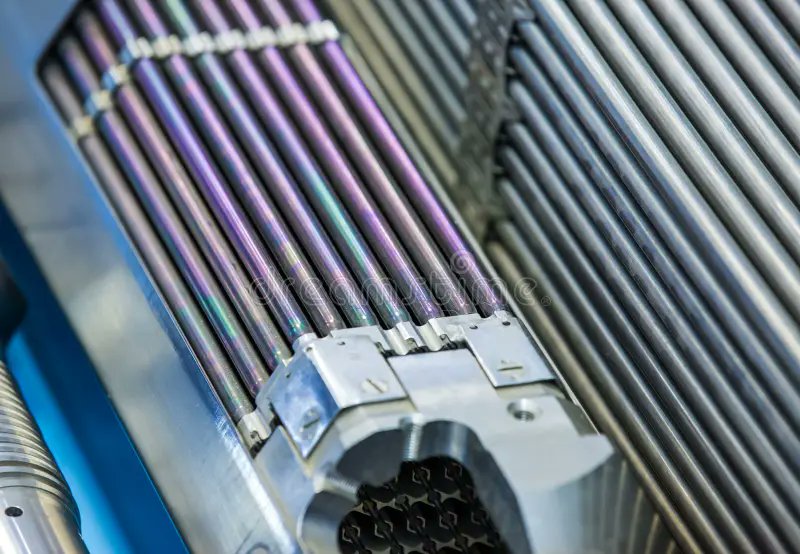
Nuclear Fuel Is The Swiss Watch of Energy and The Most Sophisticated Industrial Product You've Never Heard About.
Buckle up for a mega-🧵
There is a peculiarity at the heart of nuclear energy that rarely gets the attention it deserves. Every other thermal power plant in history destroys its fuel.
Coal goes in as a black rock and comes out as CO2, water vapor, and ash. Natural gas barely leaves a trace at all, just heat and gaseous combustion products dispersed into the atmosphere.
The fuel is gone, irreversibly transformed, its chemical identity obliterated in the furnace.
Nuclear fuel does almost none of that. The fuel elements that go into a reactor and the fuel elements that come out are, to a first approximation, the same material in the same geometry, sitting in the same place.
A spent fuel assembly pulled from a reactor after six years of operation looks nearly identical to the fresh one that went in.
The mass has changed by a tiny fraction of a percent, nuclear alchemy has occurred in which half the periodic table has been generated in the form of fission products within the ceramic pellets but the volume and geometry is essentially identical.
This one fact, that nuclear fuel must be preserved rather than destroyed, that the job of every layer of every system surrounding the core is to maintain the integrity of a material through years of radiation bombardment and extreme temperature gradients, shapes much of nuclear engineering.
It explains the cladding materials, the obsessive quality control in fabrication facilities, and the decades of slow, painstaking improvement that have transformed a fleet that routinely operated with failed fuel elements into one where a single leaker triggers a formal investigation.
I spent a long conversation with Michael Seely, the @AtomicBlenderYT, a nuclear enginner with a focus on fuel, going through what nuclear fuel actually is, how it is made, why it fails, and how the industry learned to prevent those failures.
What follows is my attempt to synthesize that conversation into something useful for anyone who wants to understand nuclear from the inside out.