Machines are the opposite of agents.
Unlike general-purpose agents that can use tools to perform arbitrary tasks, machines are specialized pieces of capital that can deterministically perform specific tasks.
John Henry vs the steam-powered drill.
@chadwahl Personally, i'm nostaglic for the extremely literal-minded domain names of the 90s. Current fav has nothing to do with AI: https://t.co/GvNS4Pioig
@chadwahl's and @PalantirTech's AI Sovereignty manifesto is a schelling point of sorts for American industry to recalibrate their understanding of what "secrets" in the Theilian sense of the word. Their workers, their processes, their tech -- all are theirs to either maximize and reinvest in or give away to foundation labs. Hopefully they realize that via Palantir (or other tech!) they can choose the former.
My thoughts after spending a day with 101 companies at our Sovereignty Bootcamp:
Software companies force them into a box, then present a false trade off. Do I standardize my business process into the same definition as everyone else, or do I customize and take on technical debt that I can never realistically pay down? In the end, they give up their alpha, the thing that made them different, just to scale or become more efficient.
Sovereignty is not just about the model layer. Customers want sovereignty at every layer of the technical stack, all the way down to encoding THEIR business process into a system they own. They need storage sovereignty, data sovereignty, compute sovereignty, and model sovereignty, all in service of the business process that differentiates them.
Anyone acting in bad faith toward their customers is going to have a very rough time. Customers are fed up with companies that lock them into platforms, dictate what they can do with THEIR data, define safety on their own terms, and constantly look for new ways to extract value or steal their alpha. Customers are demanding agency.
LLMs are the great homogenizer. The evidence is how easily we all recognize and despise AI slop. Now imagine what that does to an enterprise and its business processes. You need more than just LLMs.
The gap between what exists today and how customers actually want to operate is massive. That is our TAM. We have so much software left to write that we do not even know what we do not know yet. This is why FDE’ing is a product strategy, not a GTM strategy.
Most legacy enterprises are not software companies. Their reason for existing is not to produce software. It is to produce goods or services. Software is an enabler. It is a scaling function. They want to own not rent their intelligence.
When people talk about digital native companies having an unfair advantage, what I hear is something different. They own the means of production. They own their alpha. They are not outsourcing their thinking to someone else. Every enterprise wants to take back its alpha.
Sovereignty is not binary. It is not 0 or 1. It is a spectrum of trade offs and risk management that varies across every layer of the stack and every use case. You need the ability to dial that up and down as your requirements change.
Ultimately, this is about empowering institutions with the choice and the capability to own their means of production.
If your strategy is only focused on consumption, then your answer is always more choice because you believe choice drives consumption. But for enterprises that are not software native, choice is not a plan. It is delayed disappointment.
You do not sustain production with choice alone. You need the capabilities, the scaffolding, and the operational discipline to make those choices real.
My thoughts after spending a day with 101 companies at our Sovereignty Bootcamp:
Software companies force them into a box, then present a false trade off. Do I standardize my business process into the same definition as everyone else, or do I customize and take on technical debt that I can never realistically pay down? In the end, they give up their alpha, the thing that made them different, just to scale or become more efficient.
Sovereignty is not just about the model layer. Customers want sovereignty at every layer of the technical stack, all the way down to encoding THEIR business process into a system they own. They need storage sovereignty, data sovereignty, compute sovereignty, and model sovereignty, all in service of the business process that differentiates them.
Anyone acting in bad faith toward their customers is going to have a very rough time. Customers are fed up with companies that lock them into platforms, dictate what they can do with THEIR data, define safety on their own terms, and constantly look for new ways to extract value or steal their alpha. Customers are demanding agency.
LLMs are the great homogenizer. The evidence is how easily we all recognize and despise AI slop. Now imagine what that does to an enterprise and its business processes. You need more than just LLMs.
The gap between what exists today and how customers actually want to operate is massive. That is our TAM. We have so much software left to write that we do not even know what we do not know yet. This is why FDE’ing is a product strategy, not a GTM strategy.
Most legacy enterprises are not software companies. Their reason for existing is not to produce software. It is to produce goods or services. Software is an enabler. It is a scaling function. They want to own not rent their intelligence.
When people talk about digital native companies having an unfair advantage, what I hear is something different. They own the means of production. They own their alpha. They are not outsourcing their thinking to someone else. Every enterprise wants to take back its alpha.
Sovereignty is not binary. It is not 0 or 1. It is a spectrum of trade offs and risk management that varies across every layer of the stack and every use case. You need the ability to dial that up and down as your requirements change.
Ultimately, this is about empowering institutions with the choice and the capability to own their means of production.
If your strategy is only focused on consumption, then your answer is always more choice because you believe choice drives consumption. But for enterprises that are not software native, choice is not a plan. It is delayed disappointment.
You do not sustain production with choice alone. You need the capabilities, the scaffolding, and the operational discipline to make those choices real.
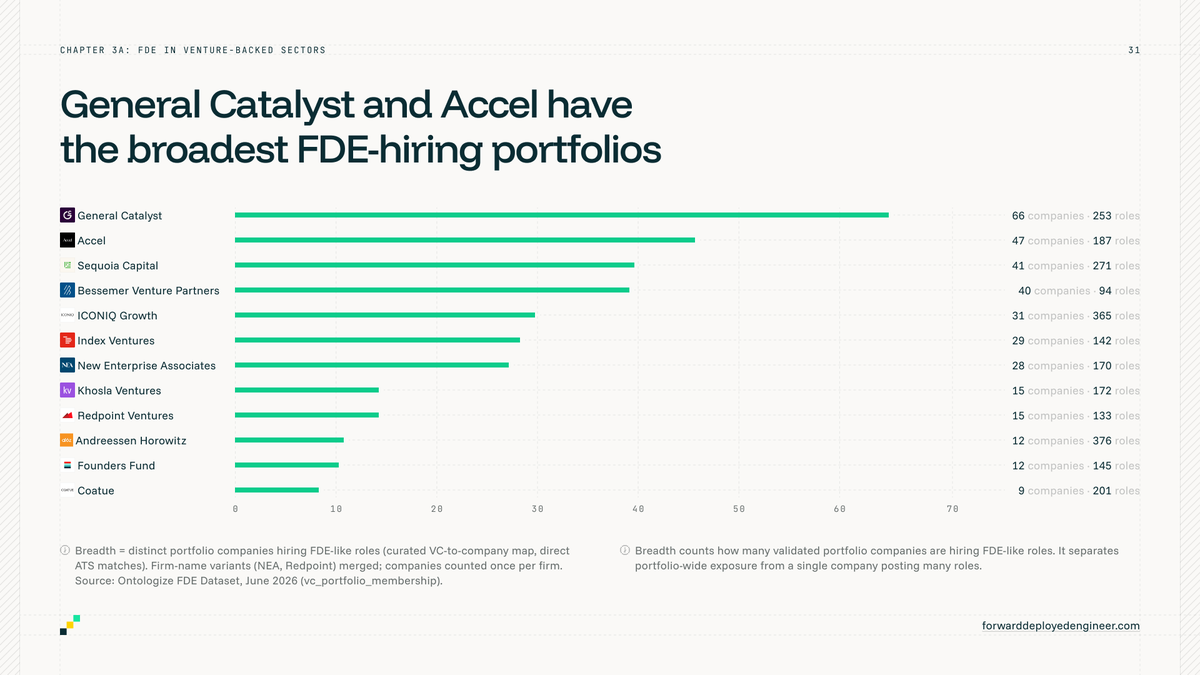
VC as a category is helping to foster a spread of FDE roles, but it's uneven and seemingly correlated with the firms themselves.
📈📊
When https://t.co/as3B1g7I4g launches next week we'll also publish our State of FDE Hiring analysis. Here's a preview from the section VC firms.
@generalcatalyst and @Accel are the firms with the most companies in their portfolios hiring FDEs, but they're not the firms whose port-cos are hiring the most FDEs -- there the likes of @a16z and @ICONIQCapital have more FDE job posts overall.
@PalantirTech paved the way and many more are now benefitting from a once-idiosyncratic role becoming mainstream.
We put a ton of effort into crafting these exams -- they will be truly good signal into who can build on Palantir. And we seek to enable the entire ecosystem of builders, customers and partners alike, to accelerate their teams' skills.
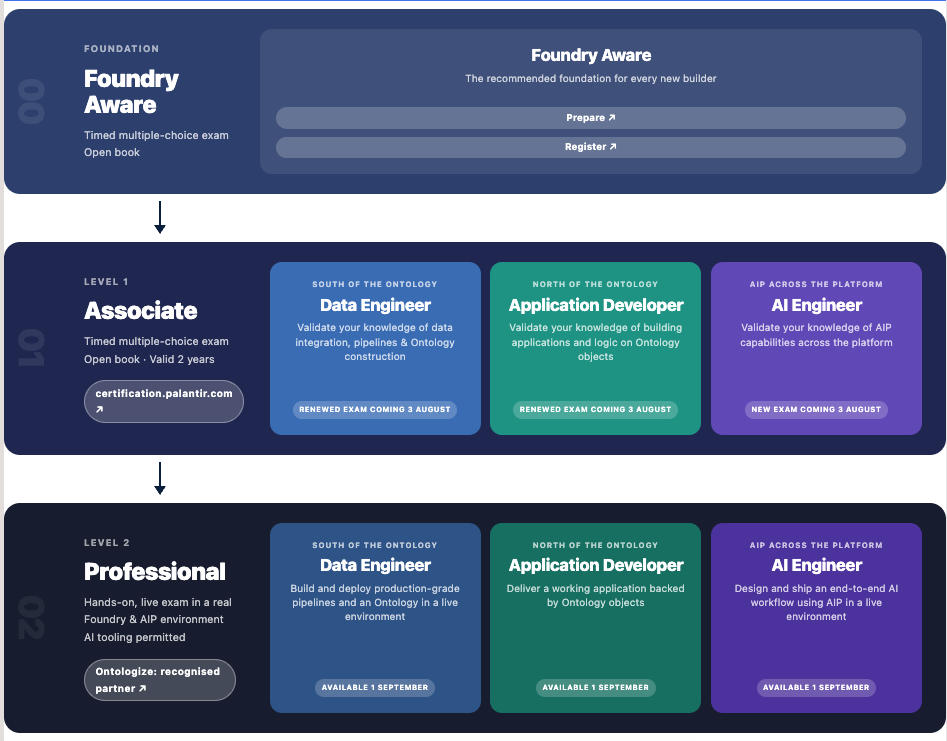
🚨New Palantir Certifications 🚨
Three Associate certifications go live on https://t.co/aniv9EXJDT on 3 August:
-Data Engineer (refreshed)
-Application Developer (refreshed)
-AI Engineer exam (brand new)
For those who want to go further, Professional level certifications arrive September 1st. Hands-on, live exams in a real Foundry and AIP environment, delivered by Ontologize (@learnontology)
New to Palantir and want to try building with Palantir? Check out our free dev tier here: https://t.co/4LnFol4mr7
🚨New Palantir Certifications 🚨
Three Associate certifications go live on https://t.co/aniv9EXJDT on 3 August:
-Data Engineer (refreshed)
-Application Developer (refreshed)
-AI Engineer exam (brand new)
For those who want to go further, Professional level certifications arrive September 1st. Hands-on, live exams in a real Foundry and AIP environment, delivered by Ontologize (@learnontology)
New to Palantir and want to try building with Palantir? Check out our free dev tier here: https://t.co/4LnFol4mr7
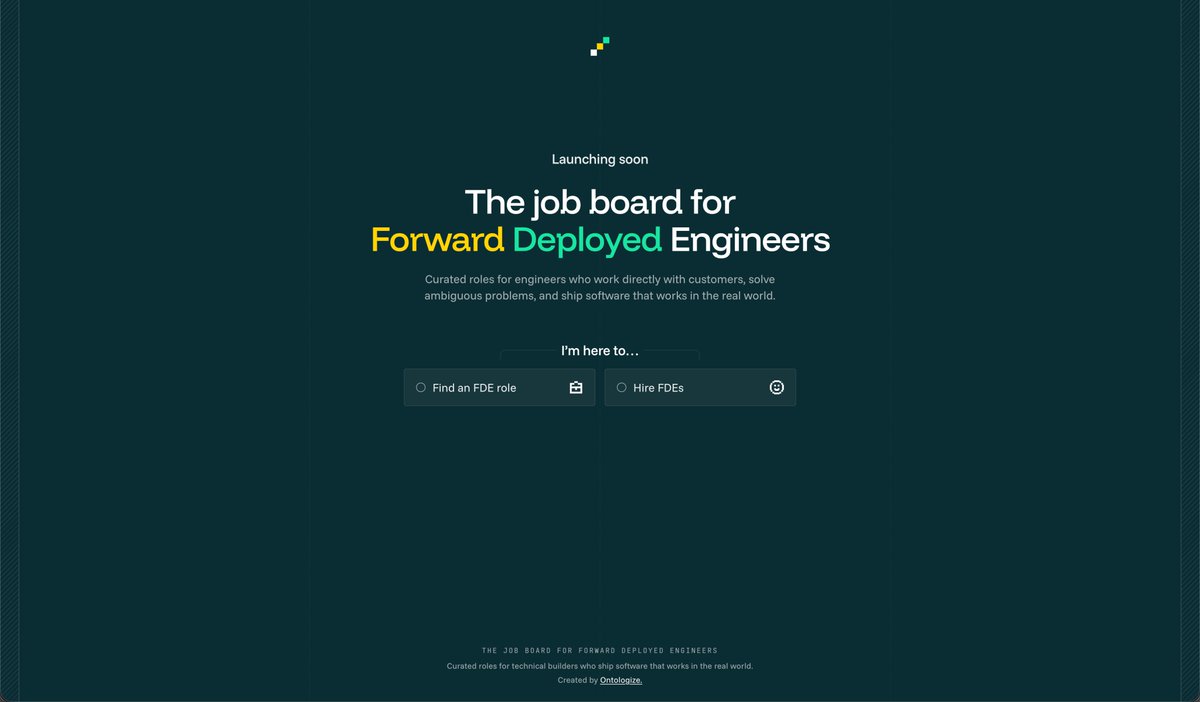
Coming soon -- https://t.co/hvR0Fae8yN
Built on the @PalantirTech Foundry & AIP (using the OSDK). A detailed how-to tutorial will follow the launch for all devs building on Palantir.
If you're doing something for the first time that you know other people do regularly -- e.g. developing a feature in a domain you're unfamiliar with -- spend 15min getting up to speed with what written and visual *artifacts* experts in that domain make. This will make the path to your goal less ambiguous and make it easier to communicate with others about your work.
I’d be careful with the “AI deskilled doctors” takeaway. The AI phase coincided with Poland temporarily suspending its national colonoscopy-based colorectal cancer screening program, which pushed more symptomatic patients from diagnostic waiting lists into clinics. Procedure volume jumped 74%, from 795 to 1,382 cases over three months.
And during that heavier workload, ADR was 25.3% with AI vs. 22.4% without it. So the cleaner read may not be “AI made doctors worse.” It may be: workload got much heavier, performance fell, and AI may have helped cushion some of the drop.
Ontologize has hit 100k views of our tutorials for @PalantirTech's Foundry & AIP
When I started, it was just me and I was thrilled to get even 100 views. Today it's a whole team that trains hundreds of users each week live and thousands more via our content.
Next stop, 1M views!
The innagual PwC Palantir Developer Meetup
Denver, CO | October 24
Our very own Shelby Vanhooser will be showing off how we use Foundry & AIP as the tech behind Ontologize. It's a new way of using the platform and we're excited to share alongside Connor Deeks, @CodeStrap411 and the rest of the PwC team.
#Palantir #PwC
Ontologize has published a tutorial about Foundry every week for two months straight!
The latest one is an hour-long Build With Us recording of Ben running through the "Deep Dive: Your first Workshop Application" lesson on Palantir Learning.
Watch it on YouTube: https://t.co/tAMILHYBZp
What else do you want to see us teach?
We've got another Build With Us tutorial covering the Contour lesson on Palantir's learning site. If you're doing these lessons and want some company, join Gena as she runs through the Contour analytics one.
https://t.co/0Gmmaq5B9w
Code Workspaces is neat because you can use Jupyter or R Studio in Foundry. But what's even more useful in my opinion is the underlying container-based architecture that lets you leverage other compute engines in Foundry besides Spark.
Get started with Code Workspaces with Gena's latest tutorial.
https://t.co/5vKlEjJ6CY
We have a new series that shows you how to do the exercises on Palantir Learning.
In this one, Ben runs through the "Deepdive: Building your first Pipeline" exercise. It's great for new users who want to do the work alongside someone with more experience.
Watchit on YouTube: https://t.co/TdvNRLOeqg