with claude code and codex shipping similar features, i was curious which one is actually leading so i made a timeline of features they both have like /goal, side conversations, subagents and the new "dreaming" feature
What happens when agents with all possible strategies compete? That's a question for ruliology. With some surprising answers...
https://t.co/5RdL27qQc3
Saas em poucos dias + diferencial competitivo
Sob as 5 forças de Porter qualquer Saas perderia pra qualquer empresa existente ou nova
A não ser que tenha recurso não facilmente replicável e escasso, tipo dados sobre os usuários (se é que já tem)
Ou algum segredo industrial
No capítulo 1, me chamou o topico de "defensabilidade do produto de IA" por falar de vantagem competitiva.
Com a baixa barreira de entrada na construção de produtos de IA, o que impediria do seu concorrente fazer o mesmo produto que o seu ?
(qual sua vantagem competitiva?)
agora em dados, "se uma startup conseguir chegar ao mercado primeiro e coletar dados de uso suficientes para melhorar seu produto continuamente, esses dados serão sua barreira (de entrada contra concorrência)"
A few matrices, a strange-looking equation, and a prediction that rewrote physics.
The Dirac equation remains one of the most beautiful examples of mathematics uncovering reality.
Resources to Review Linear Algebra for Deep Learning (Interview)
I've been asked many times by new grads on how to review linear algebra and deep learning fundamentals.
I found reading textbook particularly efficient and effective. Even after joining industry, I still read textbooks from time to time. I summarize resources, important topics, and my personal notes below.
The Jacobian matrix J(s,t,h) captures how small changes in parameters s, t, and h translate to movements in 3D space (x, y, z).
You can see the columns of this matrix visualized directly as the colored tangent vectors (blue for t_s, purple for t_t, red for t_h) lying along the parameter grid lines of the hemisphere.
This setup is a core tool in differential geometry for working with tangent spaces on curved surfaces. It lets you compute surface normals (via cross products of the vectors), area elements, and coordinate changes; exactly what’s needed for everything from realistic 3D rendering in graphics engines to modeling fluid flow over spherical domains in physics or handling spherical data in scientific computing.
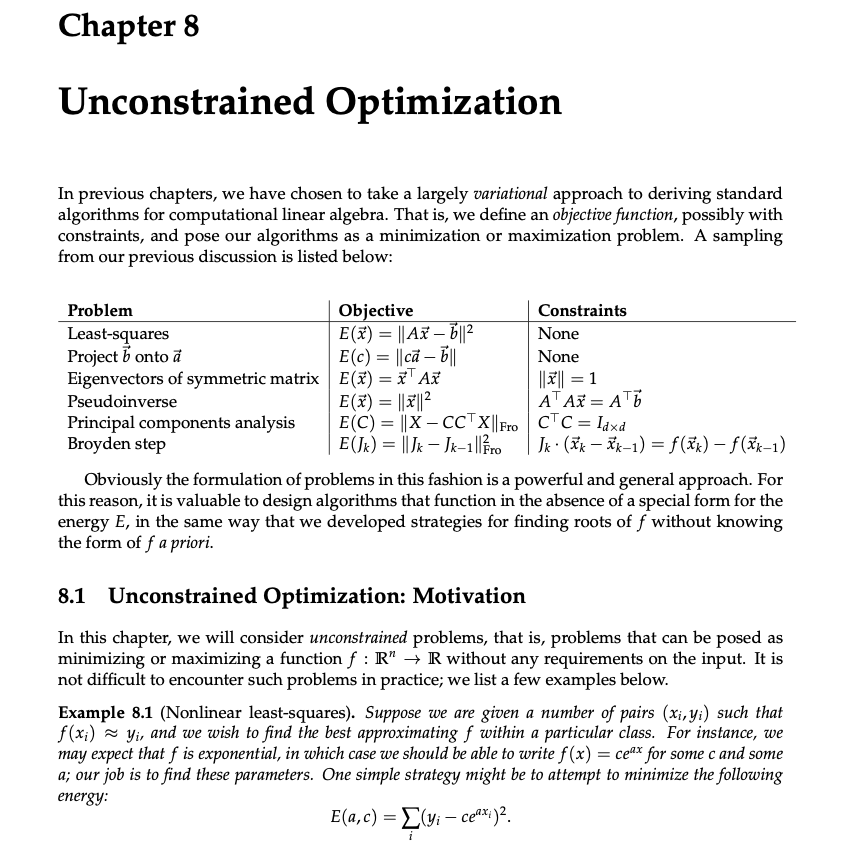
"Mathematical Methods for Computer Vision, Robotics, and Graphics" is a free Stanford resource with more than 200 pages of applied mathematics for modern technologies.
The notes cover linear algebra, multivariable calculus, optimisation, differential equations, numerical methods, Fourier analysis, and geometry, always with a strong connection to real computational problems.
What makes this material particularly interesting is that it bridges the gap between abstract mathematics and the technologies behind modern robotics, computer vision, computer graphics, and AI systems.
It is a resource I strongly recommend to both readers who already have a solid mathematical foundation and those who want to deepen their understanding through a rigorous yet accessible treatment of the subject.
https://t.co/yEEPWDqiH0