@karpathy Once I had a lucid dream where I exhaled hot air onto the glass of a bus, and when I saw it fogging up in a very realistic way, I exclaimed, "what great graphics!".
After that, it turned back into a normal dream.
In this video i provide an overview of joint-embedding predictive architectures, which @ylecun and his team at FAIR consider an important step toward more powerful AIs https://t.co/Qy7nAj1tvp
Awesome explanatory video on rotation-equivariant graph convolutional nets by my FAIR colleague Larry Zitnick.
This is the trick if you want to represent molecules independently of their orientation in space.
I am on the @MLStreetTalk podcast.
https://t.co/EMqJBx3fWT
The enigma of why deep NNs work so well, the spline theory of NNs, experimentation vs. theory. I get confused as Tim talks about "Fristonian cat-flaps". I challenge Tim to take responsibility for AGI. Will he?
Good guy Karpathy:
Gives a private 30-minute talk on LLMs.
Many people present appreciate the talk.
No one records it.
He re-records it as a 1-hour YouTube video.
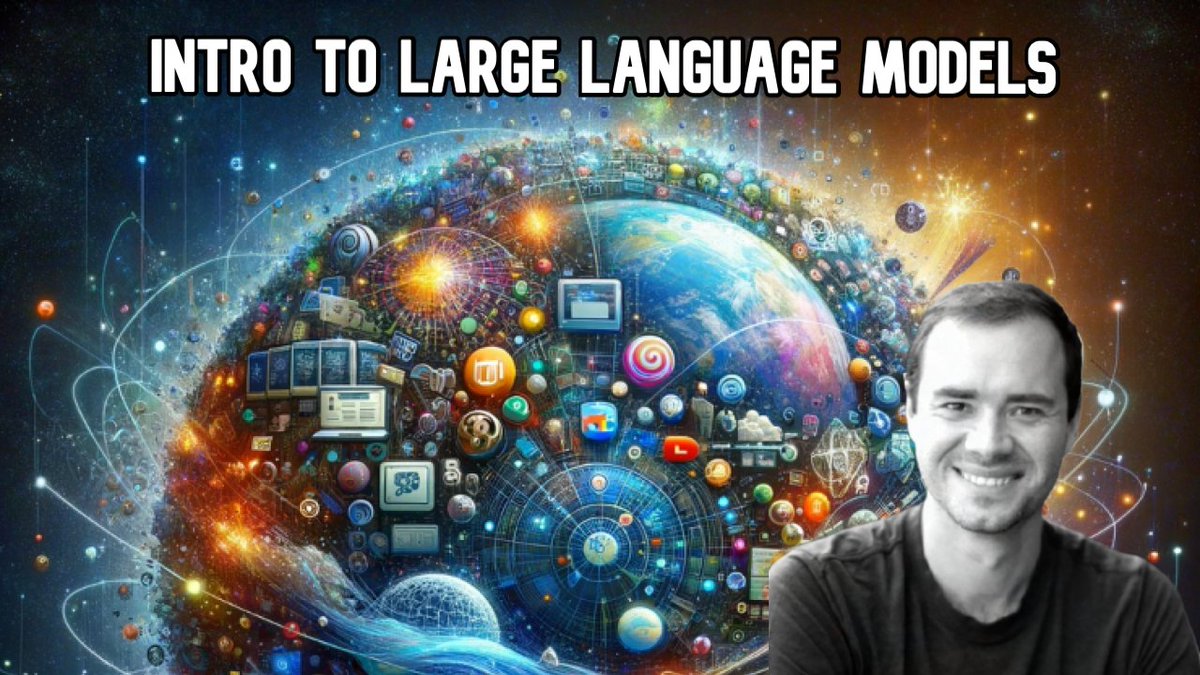
New YouTube video: 1hr general-audience introduction to Large Language Models
https://t.co/Bl4WNuNyFJ
Based on a 30min talk I gave recently; It tries to be non-technical intro, covers mental models for LLM inference, training, finetuning, the emerging LLM OS and LLM Security.
Can reinforcement learning from AI feedback unlock new capabilities in AI agents?
Introducing Motif, an LLM-powered method for intrinsic motivation from AI feedback. Motif extracts reward functions from Llama 2's preferences and uses them to train agents with reinforcement learning.
On the complex NetHack game, Motif solves previously unsolved tasks without needing any expert demonstrations. Surprisingly, Motif's reward leads to better game score than the one obtained by using the score itself as a reward.
Given access to an event captioning mechanism, a few properties make Motif a general method:
• it is entirely based on open models
• the LLM doesn't need direct access to the environment dynamics (e.g., its source code)
• the LLM doesn't need to understand observation and action spaces
The best part? You can start using Motif right now, even on a small compute budget: the whole pipeline can take less than two GPU-days.
Feel free to read our paper and try our code out.
Paper: https://t.co/qHJqpJX6Gl
Code: https://t.co/aqDGr2LsXo
Blog post: https://t.co/ULDRodTcyK
Work co-lead by @MartinKlissarov and myself, with @shagunsodhani@robertarail@pierrelux Pascal Vincent @yayitsamyzhang@HenaffMikael
Learn more in the thread 🧵
Huge day indeed for AI and LLMs, congrats to Meta 👏
This is now the most capable LLM available directly as weights to anyone from researchers to companies.
The models look quite strong, e.g. Table 4 in the paper: MMLU is good to look at, the 70B model is just below GPT-3.5. But HumanEval (bad misnomer) shows coding capability is quite a bit lower (48.1 vs 29.9).
Start with just a sheet of paper. Fold, crumple & sometimes tear to unravel the wonders of geometry, elasticity & the art of origami.
Watch Tadashi Tokieda's @OxUniMaths Public Lecture tomorrow, Wed 14 June, 5pm & any time after:
https://t.co/5IkMU4CdMh
Ok, so LLMs are a Thing.
How do they work? Embeddings.
WTF are embeddings?
I spent a year doing a deep dive. But when I was researching, I couldn't find anything that explained them in business, engineering, AND math contexts. So I wrote a thing.🚀
https://t.co/iykVXIuzty
Very nice & inspiring, "no-gradient architecture" for high-level skills/learning. LLM here is the "prefrontal cortex" orchestrating the lower-level mineflayer API via code generation++.
Meta-comment is that I remember how hopeless it felt to work on agents in environments like Minecraft around ~2016, feeling stuck on how RL at the time would ever randomly explore their way into performing long-horizon tasks from super sparse rewards. This block has now to a very large extent been lifted - the correct thing was to forget all that, first train LLMs that learn (1) world knowledge, (2) reasoning and (3) tool-use (esp writing code) all from internet text, then point them back at the problem in this kind of a way. TLDR If I had read about this "no-gradient" approach to agents in 2016 my mind would certainly be blown.
Also haha @ source code in the voyager/prompts/*.txt directory :D
I think many of you will like this -
@Dexa_ai just released a profoundly useful way to interface with all FoundMyFitness podcast episodes. Ask questions, and get summaries.
Importantly, you can trace all AI generated summaries back to their source material via transcript.
Try it out here:
https://t.co/1VQUeopWO5
The goal of Full Stack LLM Bootcamp is to get you 100% up to speed on the state-of-the-art of building and deploying LLM-powered apps.
Check out the free lectures on our website and follow us for more!
https://t.co/AALTq2buv5