Ledgero is now officially live!
CA:
0x7EAeED9b6a60a1da51aae928B51fc34edd6e700b
$LEDGER 🌪️ is an autonomous AI underwriting for RWA - OCR, risk scoring, and signed on-chain attestations, self-funded per-deal via x402.
Most "reputation" in crypto is a number that does nothing.
On LEDGERO it's a credit line. Build a clean track record and three things move on their own:
· your assessment fee drops · the bond you post per asset drops
· the value you're allowed to tokenize climbs
Get one wrong - a default, a fraud - and the bond is slashed and the limit stops climbing.
A reputation you can't spend is a sticker. This one is a line of credit.
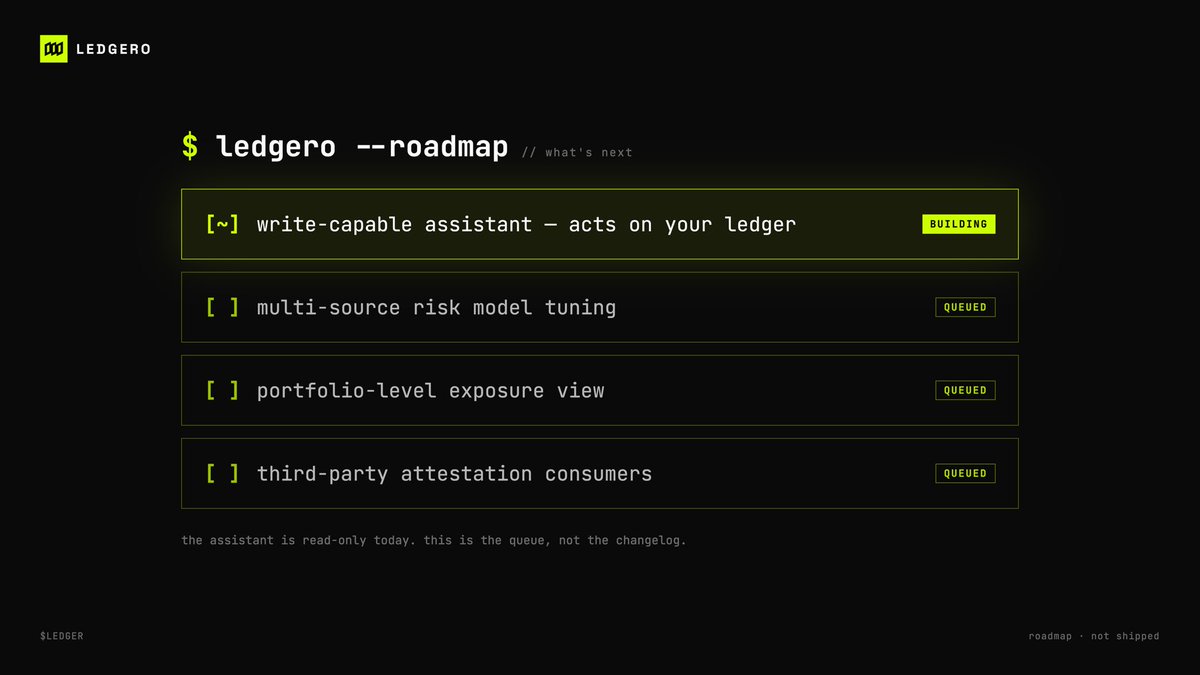
What's live is the record. What's next is the agent doing the whole job from one box.
In the queue:
· The assistant stops answering and starts acting - reads the asset, funds its own data lookups via x402, signs the attestation. Same chat.
· External data feeds - registries, valuation, KYC - paid per lookup in $LEDGER. The inputs become a marketplace too. · Deeper document analysis and more asset classes, unlocked by higher $LEDGER access tiers.
We shipped the receipt. Now we're building the underwriter.
The underwriting layer got deeper this week. All live on https://t.co/kJBx5SrH8D:
· Reputation bonds - issuers bond their own $LEDGER behind every asset. Settles clean, returned. Default or fraud, slashed.
· Tokenization limits - a clean track record raises how much value you're allowed to tokenize. Enforced, not promised.
· Agent spend guardrails - cap what an agent burns per run. Over-query and it eats the author's margin, never the caller's wallet.
· Live API console - call the attestation feed straight from the docs. Real key, real JSON.
Less roadmap. More record.
$LEDGER 🌪️
2026's two loudest narratives:
AI agents 🤝 RWA
They stop being separate trends at exactly one point - an autonomous agent underwriting a real-world asset and paying its own way to do it.
That point has a name. $LEDGER 🌪️
Building an RWA protocol? Stop rebuilding document intake, risk scoring, and attestation plumbing for every asset class.
Read a LEDGERO attestation. Get a signed, verifiable answer from a neutral layer you don't have to trust blindly.
API access via $LEDGER🌪️
@zilliqa Try to check Ledgero $LEDGER
Autonomous AI underwriting for RWA - OCR, risk scoring, and signed on-chain attestations, self-funded per-deal via x402.
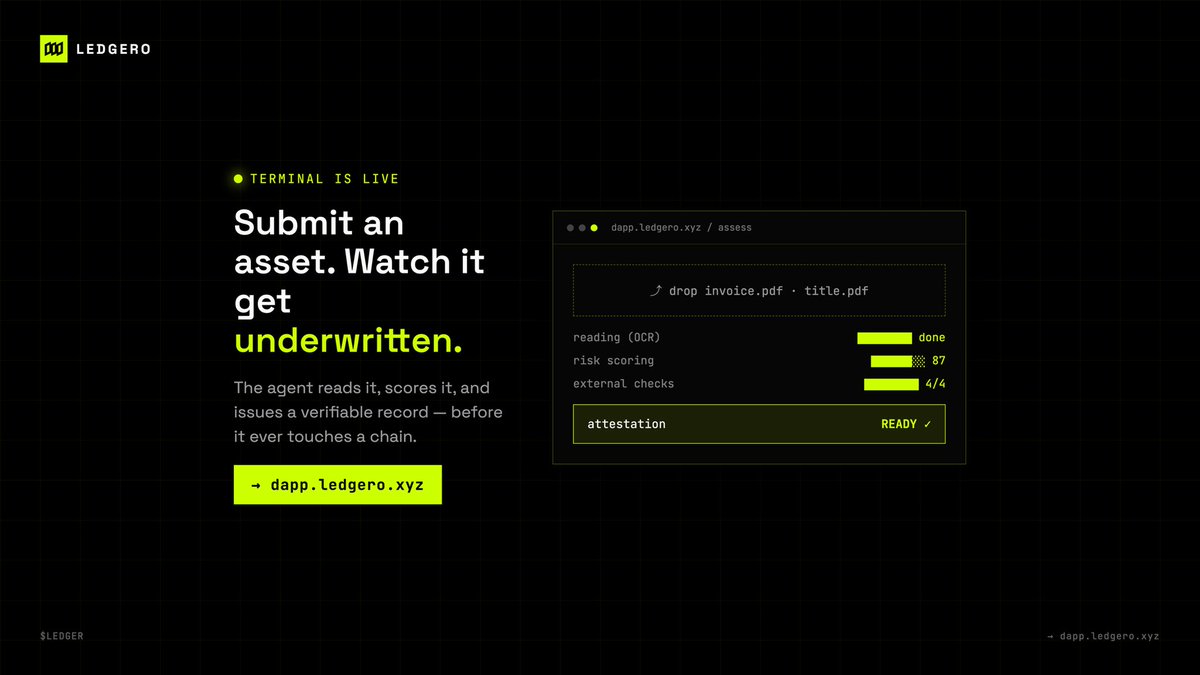
The $LEDGER terminal is live.
Submit an asset. Watch the agent read it, score it, and issue a verifiable underwriting record - before it ever touches a chain.
→ https://t.co/03SjBbOjko
Most "build your own AI agent" tools stop at a chatbot.
LEDGERO's Agent Studio: give it instructions, pick its tools, set a run fee - test-run it on live underwriting data, then publish it to the marketplace and take a share of every run.
The mechanic nobody copies: that run fee is also the agent's x402 budget. An agent that over-queries burns its author's margin, not the caller's wallet.
The underwriting layer stops being one agent. It becomes a platform.
→ https://t.co/kJBx5SrH8D
$LEDGER 🌪️
Tokenized RWA crossed ~$26.9B in active market cap.
The token contracts scaled. The underwriting didn't.
Guess which one breaks first when the long tail arrives.
$LEDGER 🌪️
BlackRock and Swift issue the assets.
$LEDGER decides which assets are worth issuing.
We're not competing with the issuers - we're the neutral layer that lets the next 10,000 of them exist safely.
Institutional RWA is already served.
The real unlock is the long tail: SME invoices, receivables, emerging-market property, inventory. Millions of small assets no human analyst can underwrite economically.
An agent that pays its own way can.
Two ends of the same underwriting layer, both live:
Simulator - model an asset's risk score before you commit. Same signals the agent weighs, computed live. No fee, nothing recorded.
Registry - the public, signed records anyone can verify. Not a guess. A receipt.
Preview the call. Then read the ones already on record.
→ https://t.co/kJBx5SrH8D
$LEDGER 🌪️
"Cloud agent" isn't a chatbot on a server.
It's an agent that doesn't run on your laptop, doesn't wait for you to click, and has its own wallet.
Submit an asset to $LEDGER and close the tab. It still gets read, cross-referenced, and attested - the agent pays each data source per-lookup via x402 while you're asleep.
You don't run it. You just get the record.
Who decides which assets are worth tokenizing, and on what terms?
Not one institution. $LEDGER holders.
Risk-model parameters, accepted asset classes, scoring thresholds - all governed. That's what keeps the underwriting layer neutral.
An opinion is cheap. An opinion with capital behind it isn't.
Validators stake $LEDGER to co-sign an attestation. Accurate calls earn fees. Bad calls - defaults, fraud found later - get slashed.
Every record has skin in the game.
Right now the LEDGERO assistant answers questions about your portfolio.
Next it stops answering and starts acting - underwrites the asset, pays for its own data lookups via x402, signs the attestation. Same chat box.
Chat is the interface. Underwriting is the product. → https://t.co/kJBx5SrH8D
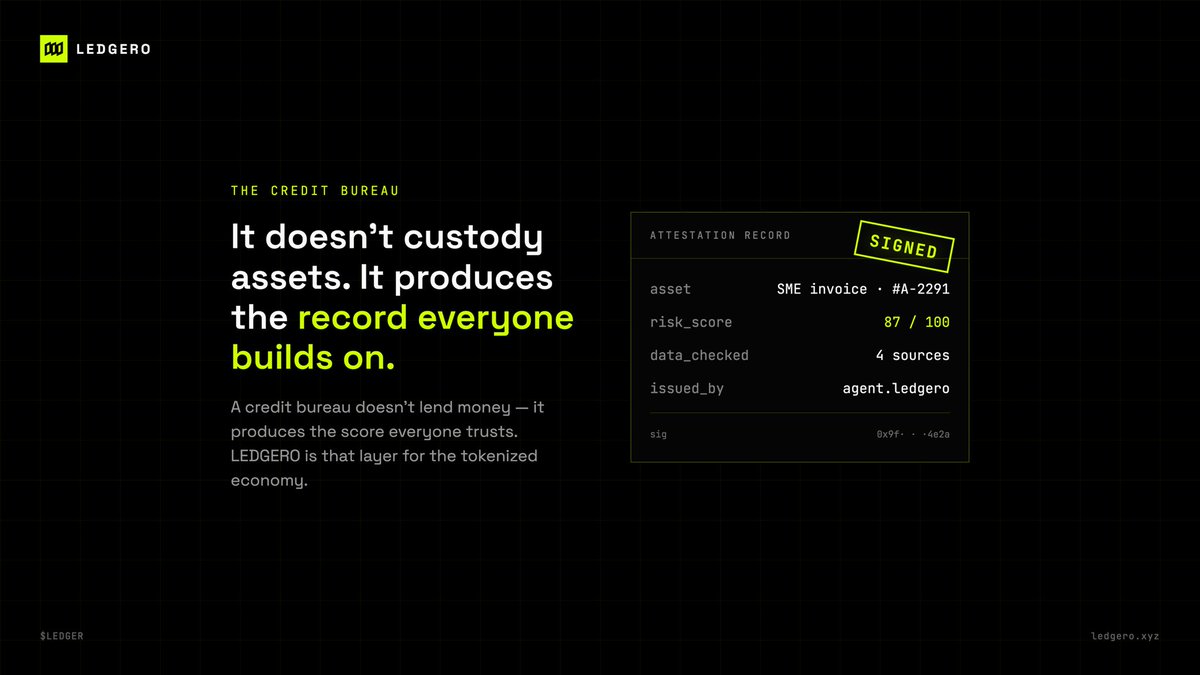
A credit bureau doesn't lend money. It produces the score everyone trusts.
LEDGERO doesn't custody assets or mint tokens. It produces the underwriting record everyone builds on.
The credit bureau for the tokenized economy.