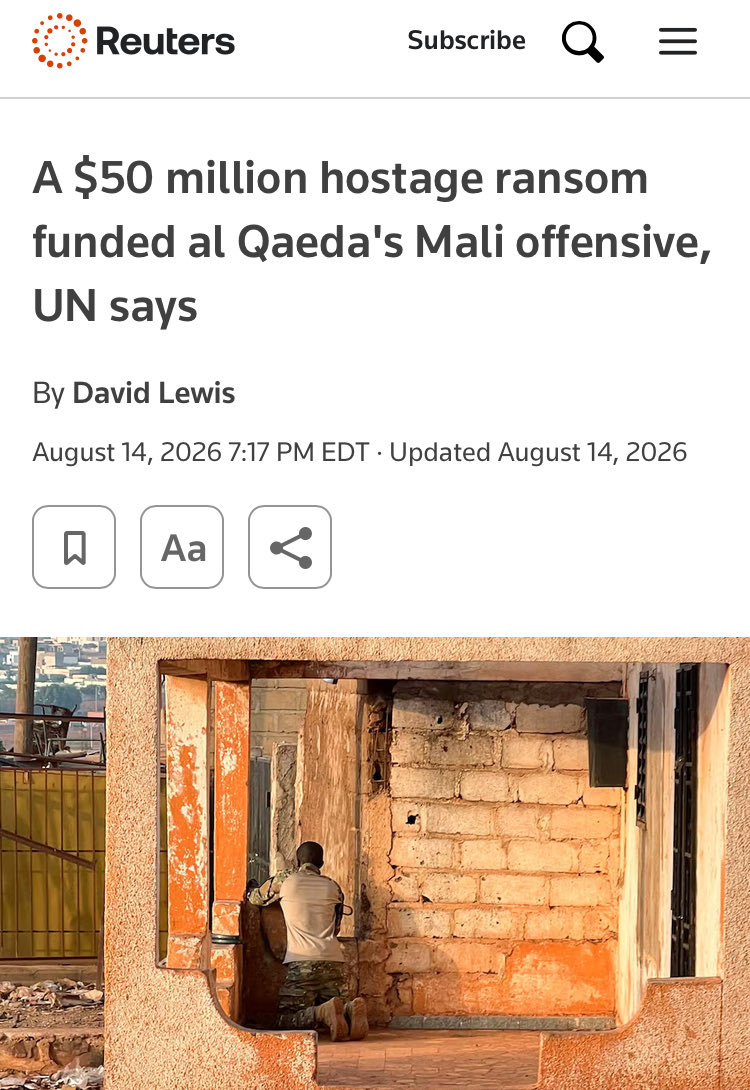
The reuters report vs the US experts’ reports. Two recent/cited experts’ reports (one UNOCT & bizarrely, AI focused), the last (37th rpt) detailed on Aq/JNIM & ISIL/ISSP financing.
https://t.co/rDSZu37lhH
https://t.co/D9Dlirv8WR
https://t.co/84ViPA9P8G
https://t.co/84ViPA9P8G
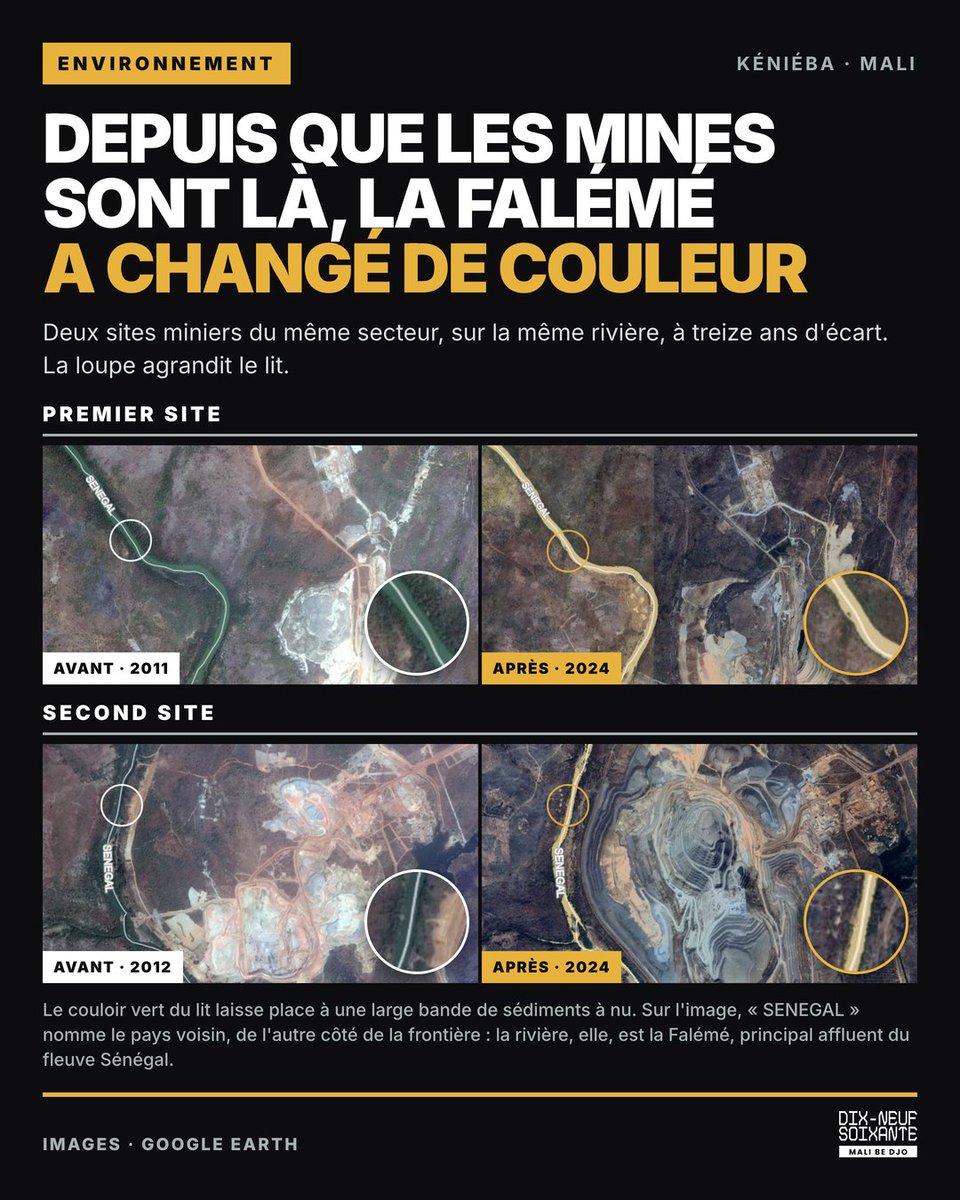
Depuis l’arrivée des mines, notre eau a changé de couleur 🇲🇱
Entre 2011 et 2024, près de deux sites miniers de Kéniéba, le couloir boisé du lit a laissé place à une large bande jaune.
Réparer ces est une obligation légale depuis 1991.
Le Code minier de 1991 impose aux sociétés minières de réparer les dommages causés à l’environnement et aux infrastructures.
La loi de 1995 prévoit aussi la remise en état des sites ou, à défaut, des travaux compensatoires.
Mais sur le terrain, le bilan est très faible. Entre 2015 et 2017, le Vérificateur général relevait que Gounkoto-SA n’avait réhabilité que 36,6 hectares sur 713,5. Pour Somilo-SA, c’était 189,25 hectares sur 1 127,73.
Soit 5,13 % et 16,78 %. Donc aucun reboisement compensatoire.
Les images montrent un lit de rivière jaunâtre. Elles ne permettent pas, à elles seules, de conclure à une contamination de l’eau, il faut donc des prélèvements indépendants et des résultats rendus publics.
Aussi le Sénégal a interdit les activités minières à moins de 500 m de la rive gauche jusqu’en 2027.
📄 Nouveau document ajouté sur Saama AI 🇲🇱
Voici l'essentiel à retenir du dernier Rapport du BVG :
💠 Vérification de l'OCLEI (2021-2025)
💠 Irrégularités financières : 352M FCFA
Posez vos questions sur ce document directement dans Saama AI.
Michael Roberts’ multi-part essay on theories of causes of inflation is really thought provoking: he champions then critiques several [Baran&Sweezy go down too easy imo]
Part III promises the synthesis of a “value theory of inflation” which sounds crucial
https://t.co/AUWaEH9Mm9
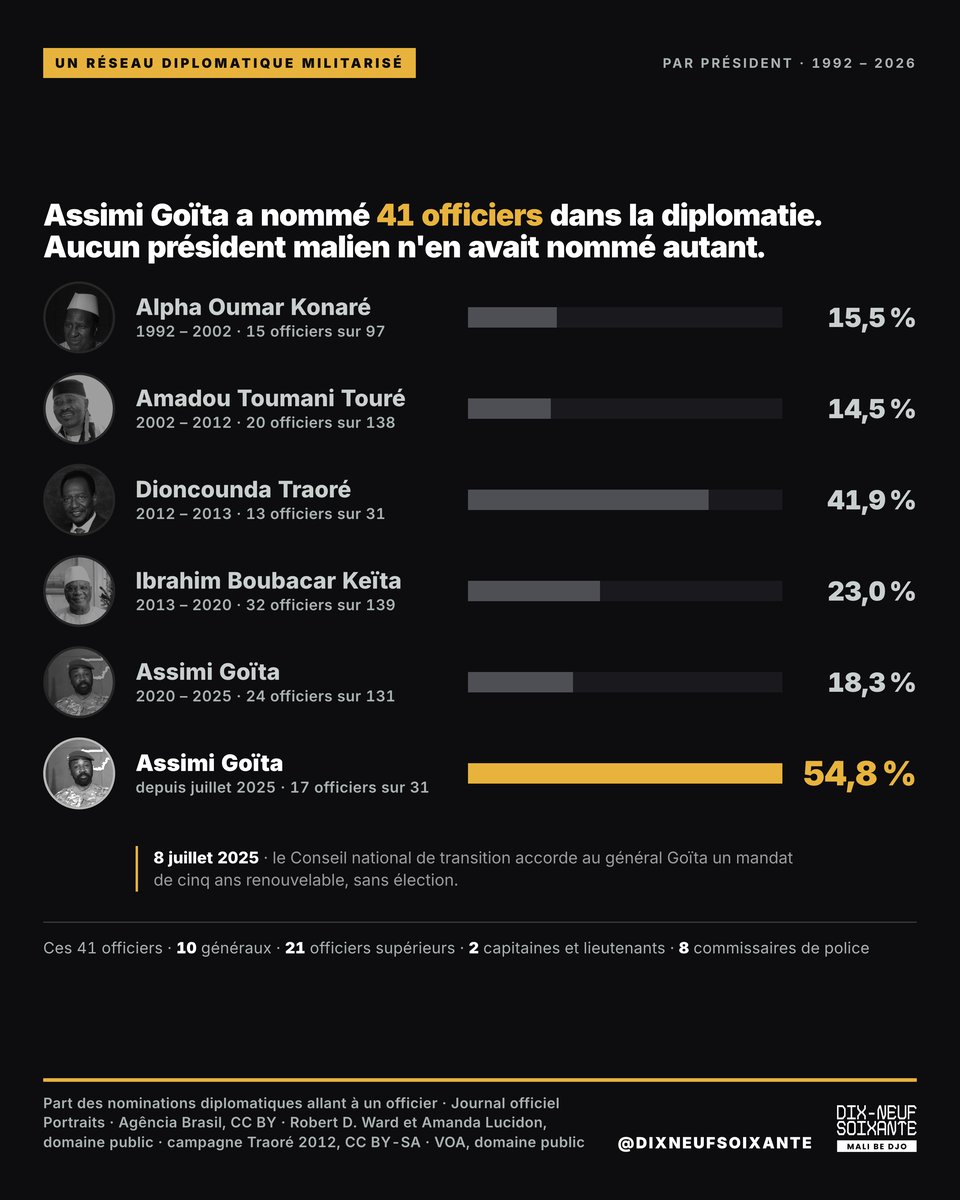
🇲🇱 Jamais un président malien n'a nommé autant d'officiers dans le réseau diplomatique.
AOK, en dix ans : 15.
ATT, en dix ans : 20.
IBK, en sept ans : 32.
Assimi Goïta, en cinq ans : 41. Dont 10 généraux, 21 colonels et commandants, 8 commissaires de police.
C'est le record absolu depuis 1992.
🇲🇱 L'armée a pris les clés de l'administration civile au Mali.
J'ai analysé les 81 387 nominations publiées au Journal officiel depuis 1992.
Le constat : les officiers sont partout. Et presque tout s'est joué depuis 2020. https://t.co/0emfQOCPfa
🇲🇱 L'armée a pris les clés de l'administration civile au Mali.
Entre 2013 et 2019, l'État nommait environ 30 officiers par an à des postes civils.
En 2024, il en a nommé 277. C'est le record absolu depuis 1992 — presque dix fois le rythme d'avant.
I never tire of reminding mainstream journalists & academics that the “The Africa Center for Strategic Studies” is part of the U.S. Department of Defense (now “Department of War”), tho they tend to soft-pedal that bit.
Simply not a reputable source.
A-t-on rempli l'administration de militaires ? 🇲🇱
On l'entend depuis 2020 : l'armée aurait pris la main sur l'appareil d'État civil. Chacun a son impression.
Personne ne l'avait vérifié.
Les décrets de nomination sont publics : ils paraissent au Journal officiel.
Je les ai repris depuis l'ouverture démocratique de 1992 jusqu'à aujourd'hui, et j'ai compté ceux qui reviennent à des officiers.
Est comptée comme militaire toute personne citée avec un grade dans le décret, gendarmerie incluse.
Prochainement ...
En y repensant, cet épisode reste tout de même impensable. Qu'un ministre de la Défense soit assassiné à son domicile sans que, au minimum, le chef des services de renseignement et le ministre de la Sécurité soient remplacés soulève de sérieuses questions.
Pendant que les citoyens sont arrêtés et emprisonnés pour avoir simplement exprimé une opinion critique, les responsables de défaillances aussi graves semblent n'avoir aucun compte à rendre.
Nous sommes dans l'incohérence.
📄 Nouveau document ajouté sur Saama AI 🇲🇱
Voici l'essentiel à retenir du dernier Rapport du BVG :
💠 Vérification financière INSP
💠 Irrégularités administratives
💠 425M FCFA d'irrégularités
Posez vos questions sur ce document directement dans Saama AI.
…well, let’s dig seriously into this :
…the central weakness of this paper is inferential: they measure micro-level disruption and they want to generalize it into a continental verdict. Let’s be serious : a nightlight decline within 500m–10km of project sites that disappears at 25km is precisely the signature of the aid-delivery apparatus itself going dark (compounds, generators, NGO logistics), not of host economies collapsing. And because their finding is spatially confined to the aid footprint, it cannot carry the macro conclusion the authors imply. I wish they really tried considering macro data instead of playing the white savior card. We don’t want this anymore!!!
Then the horizon they are using itself compounds this. 15 months cannot capture fiscal adaptation, which follows budget cycles. And by the way these adaptations are well documented : Nigeria increased its domestic health allocation by US$200 million within a month of the shutdown; Ghana uncapped its NHI Levy and redirected an estimated additional US$347 million to critical social programmes; Ethiopia introduced a dedicated levy channelled through a new Disaster Risk Response Fund and nearly doubled its health budget, while Kenya legislated a new Social Health Insurance Fund to broaden access. And there are many other examples if they did a bit of serious research. All macro record points the same direction: IMF projections place 11 of the world’s 15 fastest-growing economies of 2026 in Africa, making our continent the fastest-growing region, and many countries, such as Ethiopia, revised their projected growth. Ethiopia for instance moved from 8.9% to 10.2%. So while localized humanitarian stress is real and I agree with their point, the continental crisis they are talking about is not the evidence. There is no data showing this.
Now the methodology itself : this also is the problem. Counting radiance around donor sites and IPC phases is NGO lens made econometric: they are defining African welfare as proximity to aid. That lens is what by the way confined our policy thinking for four decades to tear-stained strategies of poverty reduction, from SAPs through PRSPs, debt relief and the SDG-humanitarian model, each managing deprivation rather than ending it. I always said poverty cannot and will not be defeated by measuring and mitigating it; poverty is defeated by wealth creation, which means accelerated industrialisation, increased agricultural productivity, better trade integration, better domestic resource mobilisation, and most importantly, public services rebuilt where they matter. And we are now doing exactly that. If they really ask us in Africa what we think of all this thing of USAID, we would tell them that the shutdown’s transition costs are the price of exiting dependency, and there is no way USAID should be restored. Let it rest in peace!!