We GoT a Filling…uuuuhoooo
𝗧𝗮𝗿𝗴𝗲𝘁𝗲𝗱 𝘀𝗲𝗾𝘂𝗲𝗻𝗰𝗶𝗻𝗴 𝗼𝗳 𝗺𝘂𝘁𝗮𝘁𝗶𝗼𝗻𝘀 𝘃𝗶𝗮 𝗥𝗡𝗔-𝘁𝗲𝗺𝗽𝗹𝗮𝘁𝗲𝗱 𝗴𝗮𝗽 𝗳𝗶𝗹𝗹𝗶𝗻𝗴 𝗼𝗳 𝗼𝗹𝗶𝗴𝗼𝗻𝘂𝗰𝗹𝗲𝗼𝘁𝗶𝗱𝗲𝘀 𝗳𝗼𝗿 𝘀𝗶𝗻𝗴𝗹𝗲-𝗰𝗲𝗹𝗹 𝗥𝗡𝗔-𝘀𝗲𝗾
Download here: https://t.co/CRAFwIFNqY…
1/ 🧬 New preprint! We developed GoT-Multi-Gap — a method to detect expressed mutations in single cells without needing to know the variant sequence in advance.
Built on RNA-templated gap filling.
Thread 🧵👇
2/ The problem: detecting mutations in scRNA-seq is hard. Coverage is sparse, and capture methods lose sensitivity the farther a mutation sits from the transcript end. Ligation-based approaches (like our earlier GoT-Multi) require allele-specific probes — limiting scalability.
3/ Our solution: exploit the dual enzymatic activity of Bst FL polymerase. It reverse-transcribes across a gap between flanking probes on mRNA, then uses nick translation to activate the downstream probe for ligation. No allele-specific design needed.
4/ The trick: the downstream probe starts with a 5’-OH (ligation-incompetent). After Bst fills the gap and nicks the terminus, a 5’-phosphate is exposed → SplintR ligase seals the nick. The mutation sequence gets written into the product automatically.
5/ We validated the chemistry in situ with padlock probes + rolling circle amplification on 18S rRNA. Key insight: exonuclease-resistant backbone mods on the downstream probe fine-tune polymerase vs. nick-translation competition, boosting efficiency.
6/ We then built this into 10x Flex (GoT-Multi-Gap). Three cell lines (MCF-7, SK-BR-3, LnCAP), 61 SNVs targeted across a range of gap sizes. Critically — the gap-filling step didn’t perturb Flex performance. UMI counts, gene counts, correlations all preserved.
7/ Results: among targets with ≥10 genotyped cells, mutant calls showed 80-100% specificity to the expected cell line. The main driver of detection sensitivity? Target transcript abundance (Pearson R=0.37, P<0.01).
8/ What didn’t matter much: gap length (4-12 bp), mutation position within the gap, and probe GC content (within the 44-72% window). The assay captures variants across the full gap with comparable sensitivity.
9/ Bottom line: GoT-Multi-Gap enables simultaneous whole-transcriptome + multiplexed mutation profiling from the same single cell, without prior knowledge of variant identity. Scalable, compatible with existing workflows, and ready for complex mutational landscapes.
10/ Huge thanks to all authors and absolute special shout out to @MircaSaurty, @lee_hower and @Kellieiswise and the incredible team @WeillCornell and @scilifelab.
Open-source, high-throughput targeted in situ transcriptomics for developmental and tissue biology
Read this Techniques & Resources Article by Hower Lee @lee_hower, Marco Grillo, Mats Nilsson @MatsNilssonLab@scilifelab & colleagues:
https://t.co/FqlsybMhWl
🎉 Exciting news! Our latest work is now published in @Dev_journal!
The open-source solution for RNA-targeted in situ sequencing provides an accessible and efficient method for spatially resolved gene expression analysis and spatial multi-omics.
🔗 https://t.co/RrmV3Aev6P
🚨Job Alert🚨
Our Staff Scientist position at @sangerinstitute is now up and running. Do not hesitate.
Apply today: https://t.co/UHKjd8I3ge
LinkedIn: https://t.co/iKBnfxUc4M
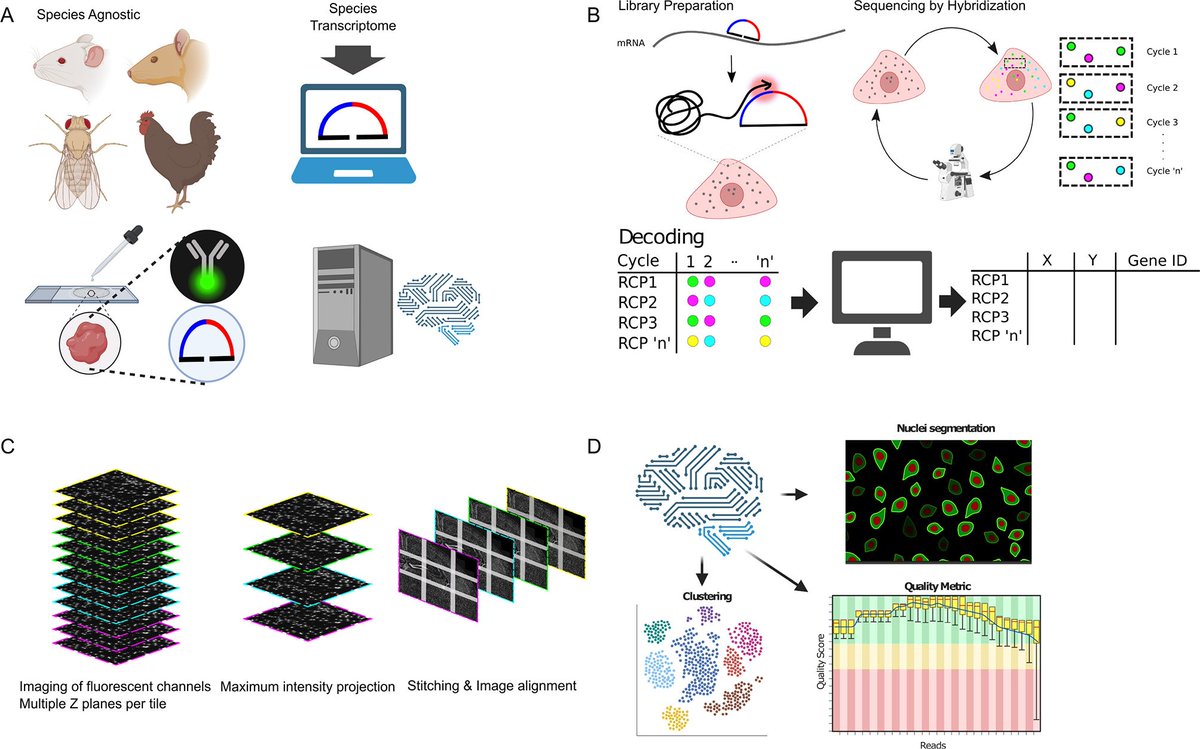
This is our humble attempt to democratize in situ transcriptomics for the masses. Here in this preprint, we @MatsNilssonLab have put together an end to end solution for targeted in situ transcriptomics that is compatible with immunostaining and other labelling methods. ... 1/N
We know the current commercial offerings for in situ transcriptomics are extremely pricey. Hopefully the community will find this useful and easy to implement on their model system of choice on a shoestring. ..3/N
🔬 LAB MANAGER WANTED 🔬
The Nilsson Lab at @scilifelab & @Stockholms_univ is seeking a talented Lab Manager to join our diverse and international team! 💻🧪
Apply now: https://t.co/GaYkmz42qR
🔥New publication🔥from @M_Hilscher together with @GoCasteloBranco@chrislangseth@PKukanja
Here, authors revealed spatial gradients and neighboring preferences of fine oligodendrocyte lineage cells in young and adult brain and spinal cord
@BMCBiology
https://t.co/cn5gqFXcOc
🚨 New Publication🚨
Anastasia Magoulopoulou et al in collab with @BeritCarow used #InSituSequencing to define the spatial distribution of immune environments surrounding Mycobacterium tuberculosis bacteria and clusters in infected mouse lung.
https://t.co/mQZnH5arSC
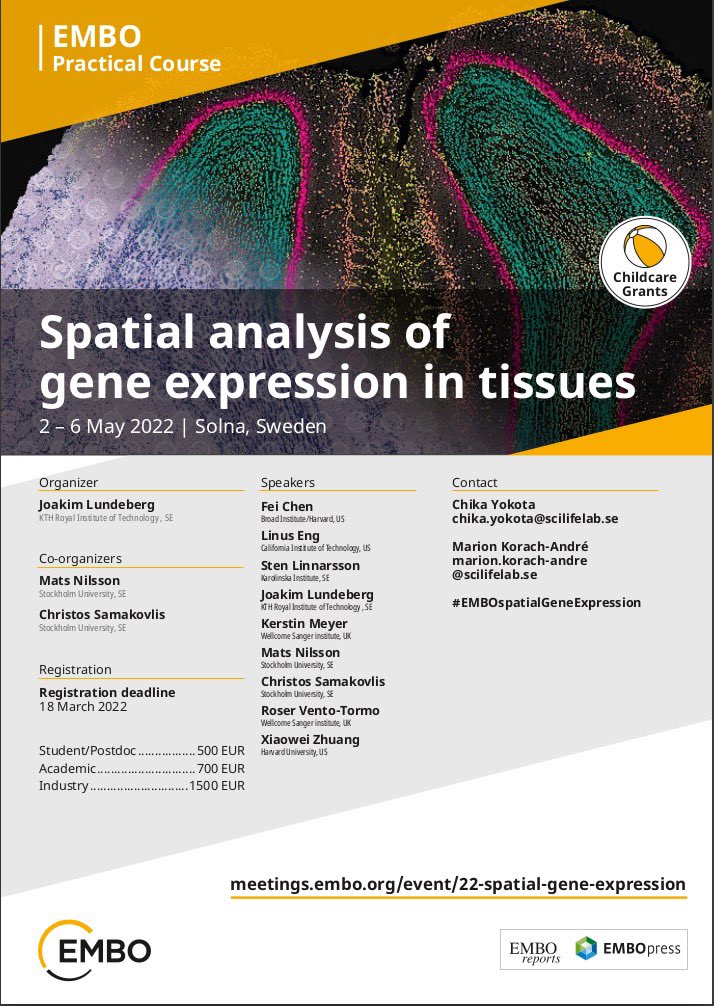
A pleasure of mine to be involved as a course instructor! Made a couple of friends while at it too 🥹. Hope to be a part of #EMBOspatialgeneexpression course again when it runs again!
Tgt w @joalunatkthse, @EMBO and Samakovlis Lab, we successfully concluded the first “Spatial Analysis of Gene Expression in Tissues” course @ @scilifelab last week. A huge thank you to all the course instructors and participants that made this event an overwhelming success 🤩