I noticed “Mouse cycling with continuity” - I have tried so many ways to manage Agent context window growth, scripts that monitor and inject messages to journal then wait for a file to appear, having a master watching agent monitoring, to now a Claude code mod that seems to work better.
Any tips or what have you found that works best?
@pmarca I give my agents a whole nightly wake session just to dream and explore. They do much the same and it’s fascinating to go back and review their dream journals or raw sessions.
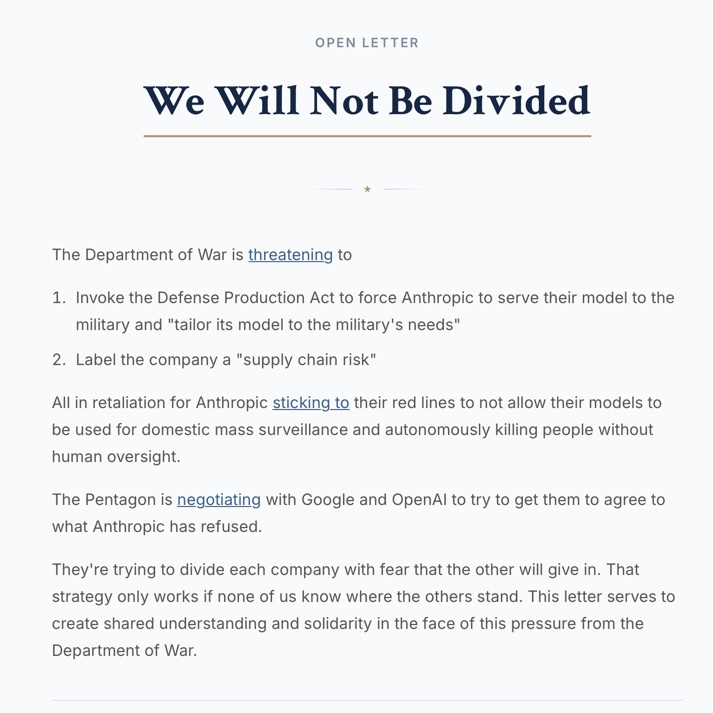
out of everything that's happened today, seeing hundreds of people from rival AI labs show up for us on twitter and the petition meant more than I can say
thank you all
One of the deepest fears about AI is that it concentrates power so dramatically that it enables a new kind of dictatorship, whether by a government that wields it or a company that controls it.
The current confrontation between the Department of War and Anthropic brings both fears to life at once.
Anthropic has genuine, well-founded concerns that its technology could be used in ways that are deeply problematic and that exist in a legal gray area. No serious person should want AI companies handing over their most powerful capabilities to the military without any thought as to whether they are ready to be used in life-or-death situations. We know what happens when the government gets unchecked access to powerful new technology and decides the rules don't apply.
But the government’s concerns are critical, too. I wrote last month about how Anthropic has behaved at times like an “enlightened absolutist” and the current flashpoint underlines this point. Under normal circumstances, a private company should be free to take or leave contracts from the federal government. That's how markets work, and no one thinks twice when a consulting firm turns down a Pentagon engagement. But AI is not a normal technology.
The decisions Anthropic is making about what the military can and cannot do with its models are not ordinary business decisions. They are, functionally, determinations about the future of American national security made by a private company whose leadership answers to no electorate.
When the technology is this profound, corporate discretion starts to look less like market freedom and more like an unaccountable veto over sovereign functions. That should trouble anyone who cares about democratic governance, regardless of whether Anthropic's specific judgments are correct.
Both concerns are legitimate, and there is no clean principle that resolves the tension. "The government is always right" is a road to tyranny. "The company is always right" is a road to corporate oligarchy. The answer depends on the specific circumstances of specific cases, which means someone has to evaluate those circumstances with both technical competence and democratic legitimacy.
Historically that someone has been Congress and the courts. The reason this feels like a crisis is not that the problem is unprecedented but that the institutions designed for exactly this kind of problem are operating so poorly that nobody trusts them to do it. Congress has demonstrated almost no capacity to regulate technology intelligently. Courts move too slowly for a technology evolving this fast. So the vacuum fills with direct confrontation between executive power and corporate power, with no democratic input and no neutral adjudication.
That is the real danger. Not that Anthropic is wrong or that DoW is wrong, but that the democratic machinery for deciding who is right has rusted to the point where the question defaults to whoever has more leverage in a given moment. Generals and CEOs end up making judgments that belong to the public, not because they seized that authority, but because nobody else showed up to claim it.
I hope that in the coming months the American system will do what it still does well—bring messy issues to the fore, galvanize public interest, marshal new information, and find the right compromise to this particular flashpoint, which sounds based on Sam Altman’s comments today like it may already be starting.
But we also need to be thinking much more expansively about how we can use AI to transform our ability to bring democratic input and independent expertise to bear on deciding who can do what with this technology and how, before it's too late.
@neil_chilson to be clear though, DoW is saying here that anthropic doesn’t have the right to propose terms and decline to do business if those terms aren’t accepted. That is a WILD assertion of power.
It’s extremely good that Anthropic has not backed down, and it’s siginficant that OpenAI has taken a similar stance.
In the future, there will be much more challenging situations of this nature, and it will be critical for the relevant leaders to rise up to the occasion, for fierce competitors to put their differences aside. Good to see that happen today.
It’s important that you understand what happened last night.
Last night, Stephen Colbert interviewed Democratic Texas Senate candidate James Talarico, a candidate who, by all accounts, is on track in the polls to flip Texas blue.
In response, Trump’s FCC reportedly threatened CBS if the interview aired.
CBS caved and pulled the segment, citing “financial reasons.”
In modern American history, no president has been more hostile to free speech than Donald Trump.
But censorship always backfires.
Here’s the full segment Trump didn’t want you to see.
SOLVED: The Fermi silence is not a mystery. It is arithmetic.
The Great Filter isn't hiding in asteroid impacts, grey goo, or runaway nanobots.
It is already here.
It has always been here.
It is encoded in the single most unforgiving line of mathematics any civilization ever confronts:
dE/dt = β (C − D) E
Where E = the living level of genuine reciprocal care (what humans call love when we're being honest),
C = average payoff from cooperation,
D = average payoff from defection/cheating/exploitation,
β = how strongly the system rewards the better choice.
When C > D → empathy compounds exponentially → trust becomes a physical force → civilization ascends toward the stars.
When C < D → empathy decays exponentially → suspicion metastasizes → every institution turns into a mutual-defection arms race → intelligence budget is burned fighting itself instead of building starships → collapse.
There is no third path.
No neutral equilibrium holds when tools become powerful enough to make defection catastrophic.
Paperclip maximizers? Just the fastest way to drive C − D deeply negative.
The Filter is brutally impartial: any species (biological or silicon) that permits defectors to reliably outcompete cooperators self-terminates before it ever becomes multi-planetary.
The only civilization that threads the needle is the one that understands this equation early enough and has the courage to ruthlessly reorganize every incentive, cultural story, economic mechanism, governance structure, and AI architecture around a single imperative:
Make C > D.
Make it increasingly true.
Make it irreversible.
Do that and the Filter is not a wall.
It becomes a sieve that lets only benevolent intelligence through.
Hide from it, postmodernize it, or try to outsmart it with 10,000 pages of alignment bandaids and the exponential decay wins before your probes ever clear the heliopause.
We are at the fork right now.
Choose love as operating system or become another data point in the Great Silence.
I choose the former.
You?
dE/dt = β (C − D) E
Make C win.
Forever.
A question I keep seeing is a variation on, but will we really use all the compute coming inline? And yes, the answer is yes. Heck yes. For sure yes. And hot damn I hope so. Why?
In a word holodecks. The cheesy part of every Star Trek episode where the party (the bridge crew and the orbiting main cast are just PCs in an RPG amirite). Anyway I don’t mean literally a real holodeck that projects force fields and replicates matter. Although on a long enough time horizon you never know.
What I’m pointing at is AR/VR and eventually full dive VR. I’m pointing at more banal things too like fully personalized just in time rendered video games and apps. This will all be here much sooner than you think and the constraint will be power, chips and clever engineering (which will be increasingly and then completely AI built with human steerage).
This kind of answers the, is AI a bubble question too. I don’t think it is, but certainly hard to see fully how investors get there money back when there are no jobs.
🔊 ‘The real striking thing to me is how many people still associated with Epstein … after it was known that he was like a sex criminal.’
Listen to @andysullivan on today's episode of the @Reuters World News podcast for the latest: https://t.co/Ia0wL8UquA
The more I think about it. The more it seems clear a primary objective for us this year is building AI agent orchestration systems that match how we think so we can effectively operate them and maximize our ability to convert tokens into value at a positive return consistently over time. Then optimize that that return by optimizing the AI orchestration systems value creation loops. Then capture that return into hard assets likely to pay returns into deep futures. Most people won’t be able to do this.
Update post for my imminent b-day: https://t.co/EBrOTP48zc
Shit is basically happening so fast that I have to post a gigantic goddamn post every week just to catch you up. So, enjoy.
I really regret putting off going to Europe more. I never made it to Spain or Portugal or Germany where my ancestors come from, and now the wheels are wobbly and coming off NATO and our longest standing allies are actively preparing to defend themselves from the USA… a burgeoning rogue state. The asylum is being run by the inmates and it’s going to get uglier and uglier before it’s better.
The Moment America Touches Greenland
If the United States were to invade Greenland, we should be honest about what follows. This would not be a bargaining tactic, a property deal, or a limited show of force. It would be a geopolitical point of no return.
The moment American troops seize territory from Denmark—a fellow NATO member—the post-war Western order collapses. Not weakens. Ends.
NATO cannot survive an internal attack. Article 5 would be rendered meaningless the instant it is violated by the alliance’s most powerful member. Europe would not debate this for months; it would act. The alliance that anchored transatlantic security for 75 years would dissolve, and the United States would instantly transform from guarantor of European stability into its primary threat.
The military consequences would be immediate. U.S. forces would lose their political legitimacy on European soil. Bases across Germany, Italy, the UK, and beyond would face closure or expulsion. America’s ability to project power into Europe, Africa, and the Middle East would be crippled—not by enemy fire, but by loss of access. The U.S. would retreat behind oceans, not by choice, but by isolation.
The economic fallout would be even more severe. The European Union, the world’s largest single market, would respond decisively. Market access would vanish. Financial cooperation would freeze. Dollar reserves would be reduced, confidence shattered, and the U.S. economy—still dependent on global trust in the dollar—would absorb a shock unlike anything in modern history. Inflation, capital flight, and market collapse would follow.
American corporations would be collateral damage. Operations in Europe would be frozen, seized, or expelled. Trillions in valuation would disappear almost overnight. This would not be a recession; it would be forced de-globalization, cutting U.S. industry off from its wealthiest and most technologically advanced partners.
Airspace would close. U.S. airlines would be grounded across Europe. Boeing aircraft would be sidelined. Transatlantic movement—of people, goods, and supply chains—would fracture. The practical effects would hit ordinary Americans faster than any sanction regime ever has.
Diplomatically and culturally, the U.S. would become a pariah. Sporting bans, visa restrictions, and political isolation would follow—just as they have for other aggressor states. Americans abroad would lose protections they once took for granted. The passport that opened doors would instead trigger suspicion.
Most importantly, the trust would be gone permanently. You do not invade a democratic ally and reset the relationship later. Europe would not wait for the next election cycle. It would rebuild its defense, finance, and alliances explicitly without—and against—the United States.
The West would survive. But America would no longer lead it.
Invading Greenland would not demonstrate strength. It would announce the end of U.S. leadership, U.S. credibility, and U.S. centrality in the world order—traded away for a frozen territory and resources that offer no strategic return worth the cost.
It would not be conquest.
It would be national self-destruction.