Trinity Bridge in Crowland, Lincolnshire 🏴🇬🇧, a rare three-way stone bridge dating back to the 14th Century AD. This illustration from the 1800s shows the river under the bridge in the 1600s.
It was originally built between 1360-1390 AD, to replace earlier wooden bridges spanning the junction of the River Welland and a distributary.
Constructed from Barnack stone, the bridge provided an innovative solution to crossing two waterways at their divergence.
The rivers were rerouted in the 17th Century AD, leaving the bridge standing over dry ground.
Now a scheduled monument and Grade I listed, it remains a striking historical landmark in the town.
#archaeohistories
a rare snippet of the divas of Benaras, Siddeshwari Devi (1908-1977) & Rasoolan Bai (1902-1974) performing together a dadra "Raaja dar laage". Their peculiar melodic explorations complement each other's artistry set in a competitive spirit.
🇵🇰 Arshad Nadeem - 92.97
🇮🇳 Neeraj Chopra - 89.45
🇬🇩 Anderson Peters - 88.54
One of the most thrilling men's javelin finals of all time!
https://t.co/sT1lyQb6Tu | #Paris2024
For me #ArshadNadeem is such a legend that you can’t put his achievement in words.
Coming from a country with limited means, his entire village donating money for his preparation. His achievement will go down in history not just of Pakistan 🇵🇰 but the world. 🗺️
ARSHAD NADEEM. WOW!
At the Olympics, he is the
◾ First Pakistani track-and-field athlete to qualify
◾ First Pakistani to make any track-and-field final
HE NOW WINS THE FIRST-EVER INDIVIDUAL OLYMPIC GOLD FOR PAKISTAN!
That too with an Olympic record of 92.97. Madness! 🔥
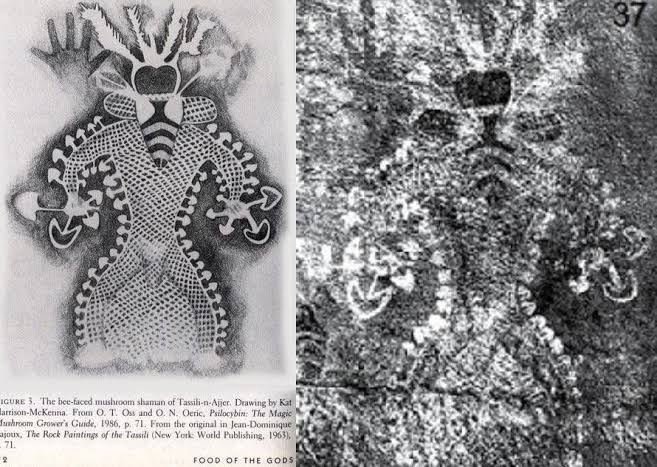
The 9000 year-old cave painting in Tassili Cave - Algeria :
Deep within rugged landscapes of the Sahara Desert lies a treasure trove of prehistoric art that has captivated archaeologists and historians for decades. Tassili n'Ajjer cave complex in southeastern Algeria, a UNESCO World Heritage site, is renowned for its rich collection of rock art. Among these, a particular painting estimated to be around 9,000 years old stands out due to its intriguing depiction of a shaman engaged in what appears to be the use of psychedelic mushrooms. This extraordinary artwork provides a rare window into the spiritual and cultural practices of ancient hunter-gatherer societies.
Tassili n'Ajjer plateau stretches over 72,000 square kilometers and boasts more than 15,000 engravings and paintings. These artworks chronicle the lives, beliefs, and environments of the people who once inhabited this region. The cave paintings span several millennia, with some of the oldest dating back to around 12,000 years ago. They offer a visual narrative of the transition from a lush, verdant landscape to the arid desert we see today.
The shamanic painting in question was first documented by French archaeologist Henri Lhote during his expeditions in the 1950s. Lhote and his team were struck by the vividness and complexity of the imagery, which included human figures, animals, and enigmatic symbols. The depiction of the shaman, however, has garnered particular attention due to the distinct presence of mushrooms and the associated trance-like postures. In painting, shaman is adorned with elaborate headgear and body paint, common indicators of a ritualistic or ceremonial role. Surrounding the figure are representations of mushrooms, which appear to be of the Psilocybe genus known for their psychoactive properties. The shaman's posture and facial expression suggest an altered state of consciousness, a hallmark of shamanic journeys facilitated by the consumption of psychedelic substances.
Shamanism is one of the oldest spiritual practices known to humanity, with evidence dating back tens of thousands of years. Central to shamanic traditions is the belief in the ability to access otherworldly realms and communicate with spiritual entities. Psychedelic plants and fungi have played a significant role in these practices, serving as catalysts for trance states and visionary experiences.
The use of psychoactive substances by ancient shamans is well-documented across various cultures. For instance, the indigenous peoples of the Americas have long utilized peyote, ayahuasca, and psilocybin mushrooms in their rituals. The Tassili painting suggests that similar practices existed in North Africa, highlighting a broader, possibly global, prehistoric tradition of using psychedelics for spiritual purposes.
Tassili shaman's depiction is rich in symbolic meaning. The elaborate headdress and body paint likely signify the shaman's elevated status within the community. The presence of mushrooms, depicted with careful detail, emphasizes their importance in the ritual. The trance-like state of the shaman points to a journey beyond the physical realm, a common theme in shamanic practices where the practitioner seeks guidance, healing, or knowledge from the spirit world.
The painting also reflects a deep connection between humans and nature, where natural elements like mushrooms are revered not merely as food but as sacred tools. This reverence underscores a worldview in which all aspects of nature are imbued with spiritual significance, a perspective that is often lost in modern times.
#archaeohistories