NY is trying to plug a budget hole by retroactively taxing startup exits (by decoupling from QSBS)😔
California did something similar in 2012, but fun fact: it was not for budget reasons.
CA used to offer QSBS tax breaks only if companies did most of their business in California. In 2012, it was ruled unconstitutional because it discriminated against out-of-state businesses.
So instead of fixing it, California repealed its QSBS benefits entirely and applied that change retroactively, clawing back money from people who had exits years earlier.
California’s ecosystem gravity is too strong for a 13.3% state tax difference to overcome, but it does accelerate the relocation calculus for individual founders approaching a liquidity event, I know plenty of people who moved before a liquidity event, and the same is likely to happen in NY.
NY, CA, and WA are all trying their hardest to see who can be the least entrepreneur-friendly.
New York is about to make a $28.5B mistake #QSBS
NY Senate Bill S8921 would tax startup gains that are tax-free federally and in most states. Retroactive to Jan 1, 2025.
The data on what's at stake:
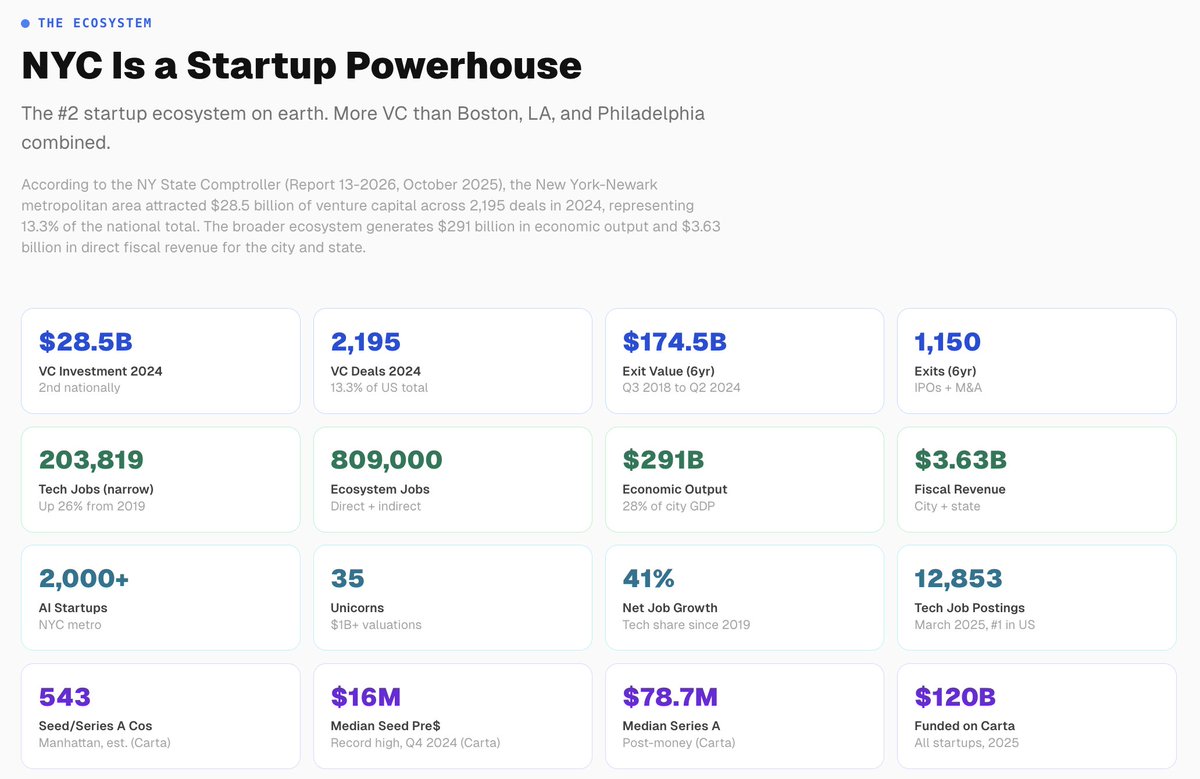
1. $28.5B in NYC VC investment in 2024 (2nd in the US)
2. $174.5B in startup exit value over 6 years
3. 809,000 ecosystem jobs, $291B in economic output
4. A founder with a $10M exit would owe $1.48M in new state/city tax
5. NY already lost $111B in AGI to interstate migration over the past decade
6. The feds just EXPANDED QSBS benefits. NY wants to eliminate them.
7. NJ just adopted QSBS conformity. NY would move against its own neighbor.
I built a full research-backed analysis with interactive stress testing (not perfect but good enough to show the impact and make a point)
https://t.co/hh8Wr0qOqI
Listening to @CathieDWood on @bankless I can’t help but think that the Mag-7 era is ending, and the Musk-4 era is just beginning - Tesla, SpaceX, Xai, Neurolink
@BillAckman@KamalaHarris@realDonaldTrump@billackman thoughts on @CurtisSliwa ? Seems to be running on a largely single issue campaign around making nyc safe, and is already on the ballet. R candidate also defaults to at least 30% of the vote, that’s not far from winning if moderates align around him.
@Hadley 1000%. Wish all investors saw it this way! We have taken a little liquidity at each round. In my experience the game of being successful in startups is very long, and the more base resources you have, the longer you can play it.
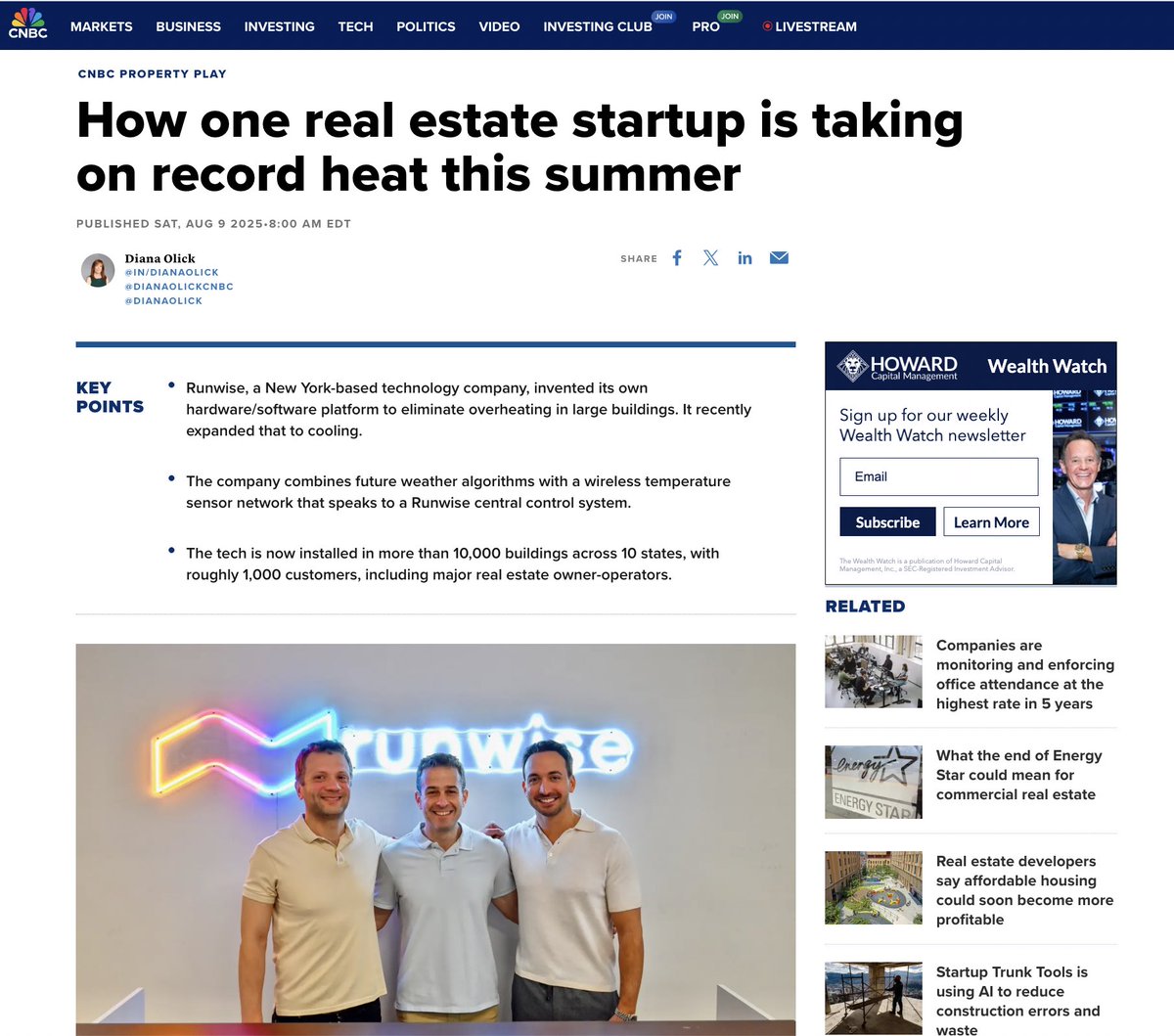
Runwise, a NYC-based smart operating system company for buildings, recently raised $55 million in Series B funding led by Menlo Ventures, with participation from MassMutual Ventures, Nuveen Real Estate, Multip...
Big news for @wearerunwise: We’ve officially closed our Series B and a new round of growth debt to help us bring Runwise from 10,000 buildings to all 50,000,000.
Thank you @axios and @alneuhauser for the write-up.
https://t.co/a9YHDQU0Fn
Today we welcome @wearerunwise to the Menlo portfolio!
We’re proud to lead their $40M Series B— Runwise is modernizing building ops with AI-powered systems that cut energy use by up to 30%.—transforming operations that haven't changed in 60 years.
Thrilled to back founders @leemhoffman, Jeff Carleton and the entire Runwise team. AI meets the built environment—one of the decade's most important frontiers.
For more on why @Bad2theSloane was excited to lead this round:
🔗https://t.co/mOgGgrJktJ
Housing in NYC is difficult and expensive. Co-op’s are feeling the pinch just like all other building owners.
But I’ve never seen a scenario where a co-op had to implement a special assessment fee ($) to cover unpaid rents from other tenants.
This is a perfect example of how costs get shifted.
Imagine 3 inches ruining a multi-hundred million dollar development.
This high-rise apartment building in Lower Manhattan, called 1 Seaport, sits abandoned and unfinished.
What happened?
In short, the building is leaning about 3 inches at the top, and up to 10 inches on some floors depending on when you measure.
All skyscrapers in lower Manhattan are built on pilings driven into the bedrock.
But not 1 Seaport.
Part of the lot, which the developer purchased as a parking lot for $64 million in 2013, was originally under the East River.
Even as far back as the times of New Amsterdam, inhabitants of the city used infill to expand the island. We’ve filled the riverbeds with sand, dirt, and stone to make new lots on the rivers.
The bedrock foundation for most skyscrapers sits 50 feet below the surface; but the bedrock at this site is about 150 feet below the ground.
To build 1 Seaport into a 60-story highrise with 80 luxury condos, most of which would sell for several million dollars, the developers used a rare foundation construction method that involved injecting concrete into the ground to make it more solid.
To date, the partially-constructed site sits abandoned, and has since been sold off for pennies on the dollar.
The building likely can’t be inhabited without some very expensive fixes (if it can be fixed at all).
12 years after the original purchase of the lot for development, we’re as far as ever from people living there.