Lo más cierto que ha dicho Nietzsche..
"Si matas una cucaracha, eres un héroe. Si matas una mariposa, eres malvado. Por lo tanto, la moralidad tiene estándares estéticos."
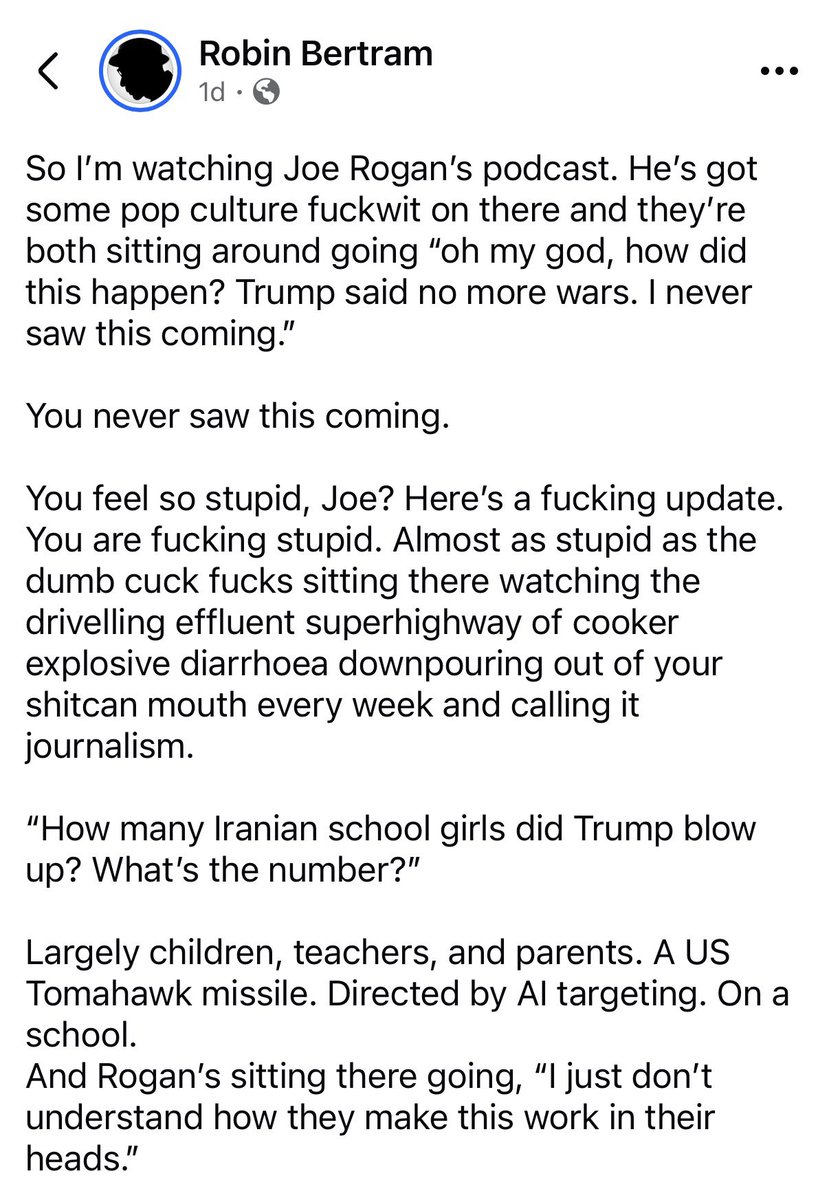
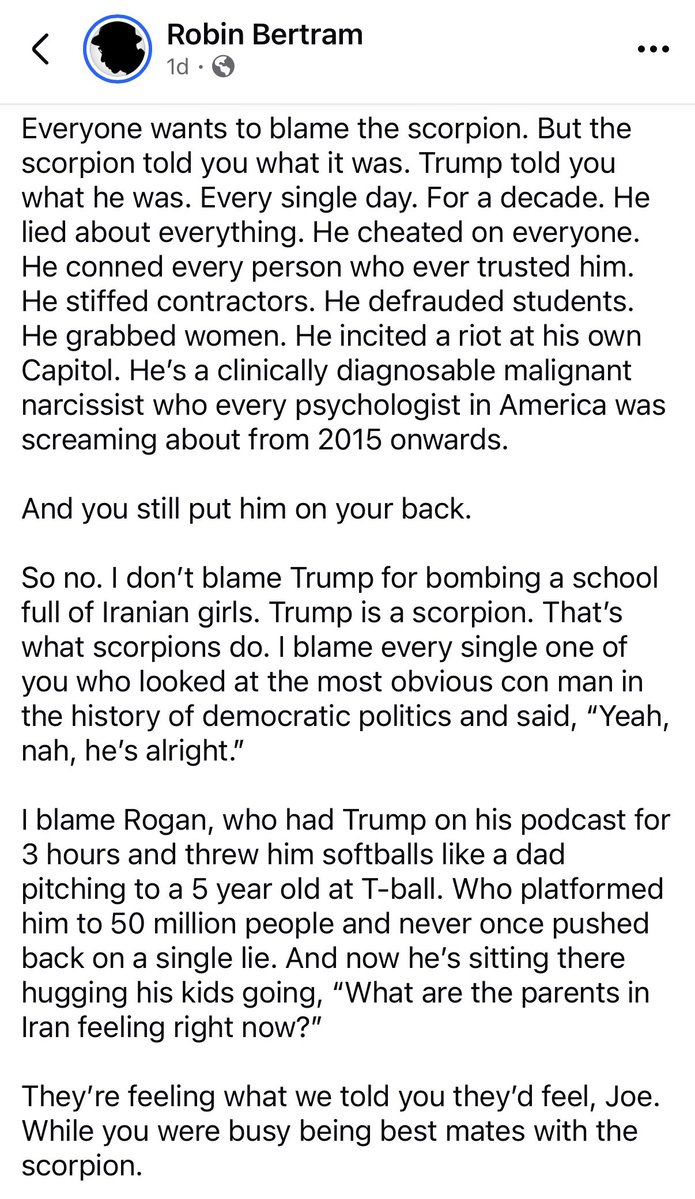
So, @joerogan probably won’t see this post that’s going viral on Facebook. It’s too long to copy & paste, & it took way more than 4 screenshots
But I think it’s essential reading for everyone, because ALL of the lying MAGA Influencers need to face legal consequences /1
Quem reza não mata nem ameaça com a morte, mas tem consciência dos próprios limites. Em vez disso, é escravo da morte aquele que virou as costas ao Deus vivo, para fazer de si mesmo e do próprio poder o ídolo mudo, cego e surdo (Sl 115, 4-8), ao qual sacrifica todos os valores e diante do qual pretende que o mundo inteiro se ajoelhe. Basta com a idolatria de si mesmo e do dinheiro! Basta com a ostentação da força! Basta com a guerra! A verdadeira força manifesta-se no serviço à vida. #Paz
This is our God: Jesus, King of Peace, who rejects war, whom no one can use to justify war. He does not listen to the prayers of those who wage war, but rejects them, saying: “Even though you make many prayers, I will not listen: your hands are full of blood” (Is 1:15).
Good lord, how convenient it is to invoke “anecdotal” medicine when it fits your narrative.
Ok, I’m in.
Here’s what I see EVERYDAY.
65M: Massive STEMI. Sudden death while skiing. Spouse didn’t know CPR, but off duty Paramedic skiing behind did.
Cardiogenic shock. Vented on dialysis. Bypass once stable. Rocky post op course. Multiple readmissions. Progressive decline over next year.
Nongated nondedicated CT spotted 3V CAC 10 years ago.
Savvy PCP discovered it a few years ago and advised statin and ASA (not stress test).
Patient declined because he “felt fine” and heard “statins are bad for you” from a doctor on a Podcast.
Spouse proudly proclaimed “we’re not a statin family”.
Like Eric, “It was not fun telling them the statin should’ve been started decades ago”
See? We all have real life stories.
But John, where is the evidence to back up the “massive” misuse you claim?
The guidelines thought so maybe 20 years ago, but they don’t agree with you anymore.
And while we have all seen Eric’s story play out, it is not the typical experience in any community where I have practiced.
In my experience the majority of primary care and gen cards clinicians use CAC exactly as intended. Not the other way around.
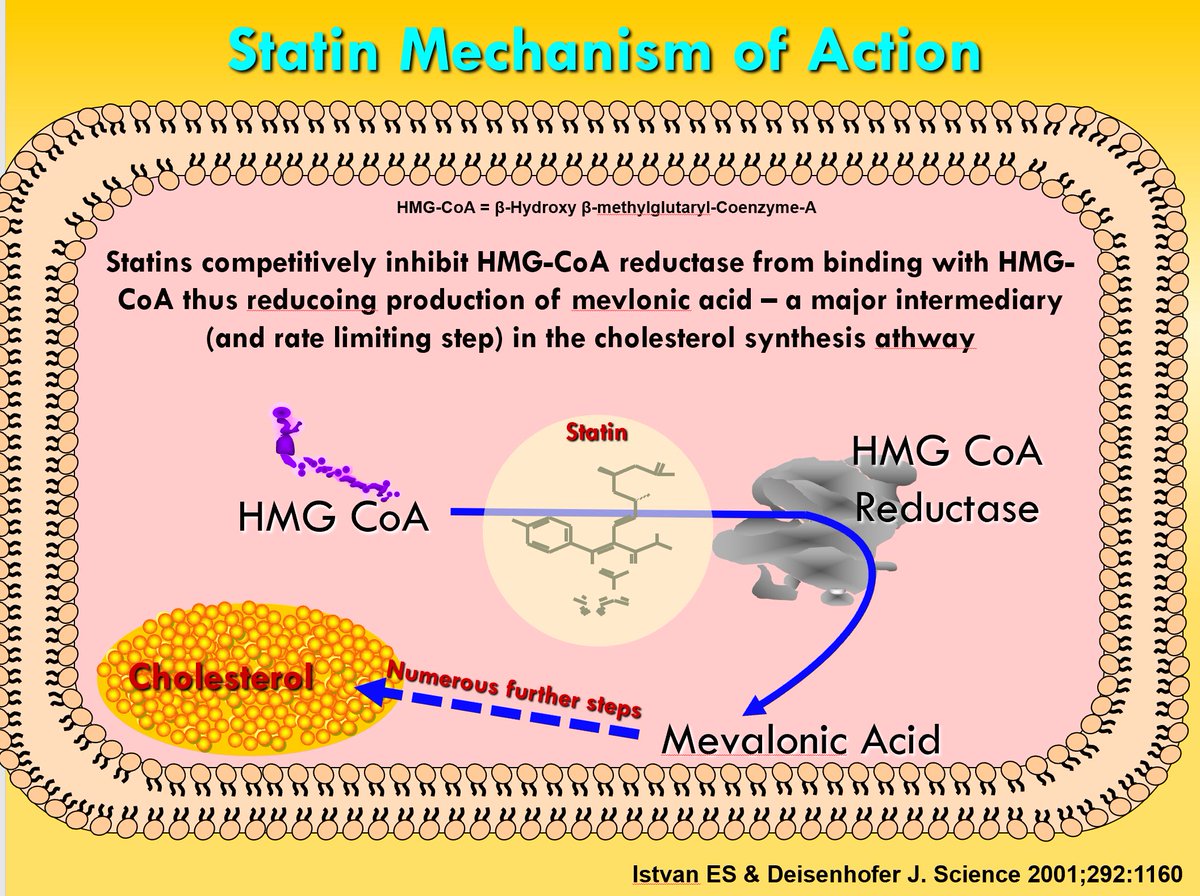
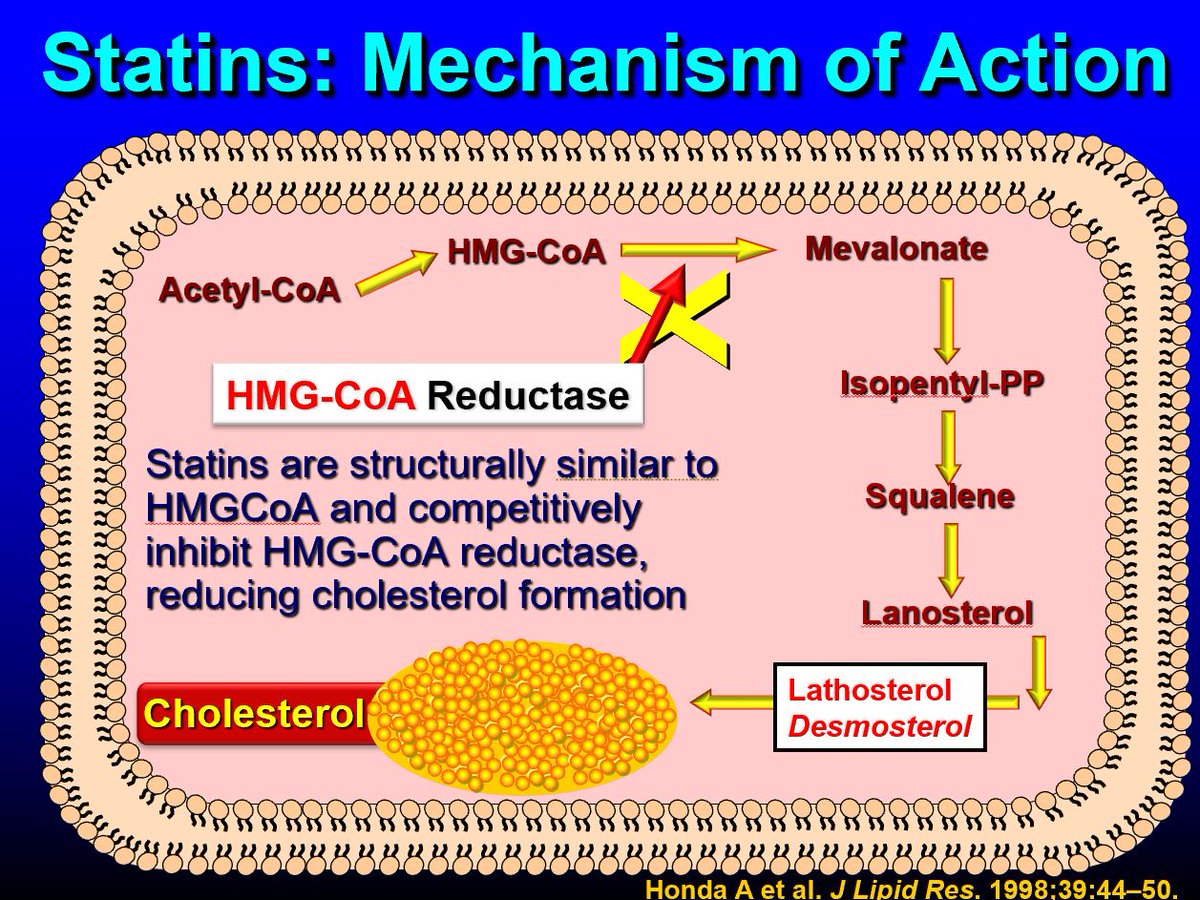
STATIN EDUCATION: Statins enter every cell in the body including the brain as they can pass thru the BBB. Most of the statins CV benefit comes from reducing apoB, by inhibiting hepatic cholesterol synthesis which in turn upregulates LDL receptor (LDLR) expression thereby inducing clearance of apoB-particles. The liver, because of its size and density, has far more LDLRs than other peripheral tissues. Normally all cells make all the cholesterol they ever need and thus do not need circulating cholesterol. Although rarely needed, any cell can also upregulate LDLR to acquire any cholesterol they might need. Since part of AD pathology is related to XS brain cholesterol, some degree of brain cholesterol synthesis inhibition by statins is desirable. That can be monitored by watching plasma desmosterol (cholesterol precursor molecule in brain). @drterrysimpson@nationallipid@society_eas@ASPCardio@escardio@atherosociety@FamilyHeartFdn@FHPatientSafety
This is one banger of an explanation of the time-slit experiments. What I find interesting is that #NotebookLM introduced additional explanation to the original source material. Very impressive indeed!
Oh stop playing with statistics. That claim flips risk reduction on its head.
Here’s the reality:
Most people — statin or not — will not have a heart attack in the next 5–10 years. That’s how population risk works. The question isn’t “Would everyone have had an MI without a statin?” The question is:
Does lowering LDL with statins reduce events compared with not lowering it?
Yes. Repeatedly. In primary and secondary prevention.
What the trials actually show
In high-risk patients, statins reduce major cardiovascular events by ~20–30% per mmol/L LDL reduction.
In secondary prevention (people who already had an MI), absolute risk reductions are substantial.
In primary prevention, benefit scales with baseline risk — lower baseline risk = smaller absolute benefit, but still measurable.
This isn’t theory. It’s outcome trials across decades:
Scandinavian Simvastatin Survival Study
Heart Protection Study
JUPITER trial
Cholesterol Treatment Trialists’ Collaboration
And it’s not just statins. Ezetimibe and PCSK9 inhibitors lower LDL and lower events proportionally. That’s biological coherence.
The logical trick being used
Saying “90–95% wouldn’t have had a heart attack anyway” is like saying:
“Most people wearing seatbelts wouldn’t have died in a crash — therefore seatbelts don’t work.”
Medicine isn’t about treating 100 people and saving 100.
It’s about reducing population risk in predictable, reproducible ways.
Absolute vs relative risk
If your 10-year risk is 20%, and a drug lowers it to 15%, that’s a:
25% relative reduction
5% absolute reduction
Number needed to treat (NNT) = 20
That means 1 in 20 people like you avoids an event because of therapy. That’s not trivial — especially when the event is a heart attack or stroke.
Bottom line
Statins don’t prevent heart attacks in people who were never going to have one.
They prevent heart attacks in a fraction of high-risk people who otherwise would have had one.
That’s how preventive medicine works.
If someone thinks that’s meaningless, they’re arguing against probability itself — not cardiology.
kind of funny that an olympian said they are here to represent "compassion, respect, love for others" and some people automatically know that's a statement against them
This video should unsettle anyone who takes the United States seriously as a nation.
Because it exposes something dangerous: the trivialization of the world's most consequential office. It shows how carelessly the power, credibility, and accumulated moral authority of a superpower can be squandered for a few seconds of viral attention.
In any other major democracy, this behavior from a head of state would trigger a constitutional crisis. Paris would burn. Berlin would convene emergency sessions. In the Nordic countries, resignation would follow within hours. Across functioning democracies, the public, institutions, and political class would recognize this for what it is: an assault on the dignity of the state itself. Leaders are not free to perform as entertainers without consequence. National honor is not personal property, it's held in trust.
But the United States is not just another country with a provocateur in charge. It is the linchpin of global order. It maintains formal alliances and security guarantees with forty to fifty nations. It underwrites the financial architecture, trade systems, and diplomatic frameworks that billions of people depend on daily. When the American president speaks—or posts—it doesn't land as satire, meme, or personal whim. It reads as a signal about what the country is becoming.
American power has never relied solely on carrier strike groups or economic output. It has rested on something more fragile and more valuable: trust. The belief that beneath domestic turbulence lies institutional seriousness, predictability, and a baseline commitment to dignity. That belief is now disintegrating in real time.
Millions of American companies operate globally. They negotiate multibillion-dollar contracts in environments where reputation is currency. Boardrooms in Frankfurt, Singapore, and Dubai aren't debating whether a post was clever—they're asking whether the United States remains a reliable partner. Whether agreements signed today will be honored tomorrow. Whether American leadership has devolved from institutional to purely theatrical.
Consider tourism, which sustains millions of American jobs—airlines, hotels, restaurants, museums, entire regional economies. Soft power isn't an abstraction. It materializes in flight bookings, conference locations, study-abroad programs, and decades of accumulated goodwill. A quiet, decentralized boycott doesn't require government action—only a collective sense that a nation no longer respects itself.
Now picture this image being studied by foreign ministers, central bank governors, defense strategists, and sovereign wealth fund managers. Picture them asking a coldly rational question: How do we write binding thirty-year agreements with a country whose public face will be this, relentlessly, for years to come? How do we plan for the long term when the tone is impulsive, mocking, and unbound by the gravity of office?
This is where the real calculus begins. Trillions in foreign capital depend on confidence that America is stable, credible, and rule-governed. That confidence is now being traded for what, exactly? Applause from an online mob? A dopamine rush from manufactured outrage? Content designed to dominate the news cycle rather than serve the national interest?
Every serious nation eventually confronts this choice: burn long-term credibility for short-term spectacle, or safeguard the reputation previous generations bled to build. The United States spent eighty years constructing an image of reliability, restraint, and leadership under pressure. That image wasn't born from perfection—it came from a visible commitment to standards that transcended impulse.
This isn't a partisan issue. Europeans who value democratic norms recognize something ominously familiar here. Americans—Democrat and Republican alike—who believe in responsibility and restraint should see it too. Power attracts scrutiny. Leadership demands discipline. A superpower cannot behave like a reality TV contestant without paying a price.
The presidency is not a personal broadcast channel. It's a symbol carried on behalf of 330 million people and countless international partners who never voted but whose lives are shaped by American decisions anyway. Every post either reinforces or erodes the idea that America can be counted on when it matters most.
So the question is no longer whether this is offensive. The question is whether this is who America chooses to be: a nation that trades a century of hard-won reputation for viral moments. A country that replaces statecraft with content creation. A republic governed like a season of reality television.
History offers a harsh lesson here. Great powers don't fall because enemies mock them. They collapse when they begin mocking themselves—publicly, proudly, and without grasping the cost until it's far too late.
Stay connected,
Follow Gandalv @Microinteracti1
There is no difference between intelligent design and evolution if you consider the universe as alive, that the forwards arrow of time itself an artefact of a physical reality dissipating free energy in a process of self discovery.
The gentleman who ICE hauled without cause out of his home in his underwear into the icy Minnesota winter (after terrifying his 5-year-old grandson) was from Laos, one of the Hmong hill tribes people of the then-Kingdom of Laos.
🧵
“Dear America,
We worked together on enslaving Africans, on exterminating and dispossessing the indigenous, on colonizing East Asians and addicting them to drugs, and on carving up West Asia for its oil. Why are you bossing our space now?
Yours with concern,
Europe”