Artificial intelligence is not an oracle, let alone a doctor. Today, it is treated as an ‘authority on the truth’ without realising that the entity we are interacting with is an algorithm, not a person. We need awareness and literacy.
More than 60% of people use AI for mental health support
According to a new survey, 63% have used AI tools for mental health questions. However, 45% reported being dissatisfied with advice, highlighting concerns about the quality of AI guidance.
https://t.co/1zsCQtAf1Y #FrAIday
Interested in data protection?
Apply for a #BlueBook traineeship to work in the legal sectors of the EDPB Secretariat.
You will focus on the importance of data protection and the GDPR across Europe! 🇪🇺
✅ Apply from 8 to 10 June: https://t.co/zDL3l2WR4P
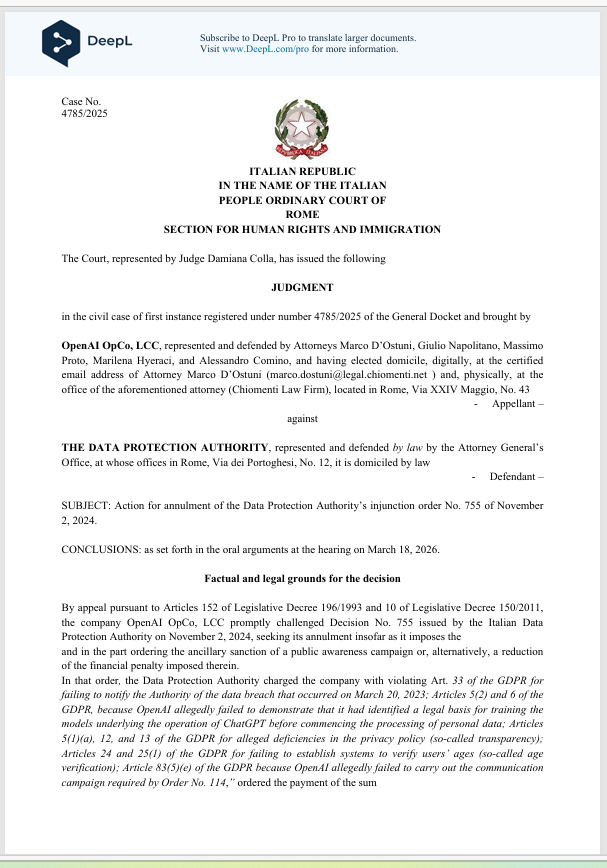
The decision we've been waiting for has finally arrived.
I'm reading the decision from a Rome court, which overturned the 15-million-euro ($17 million) fine that Italy's data protection authority imposed on OpenAI for failing to comply with the GDPR. https://t.co/dy2arGQDj9
As part of their partnership, the CNIL and the @PIPC_PC have produced a poster explaining how to protect your personal data when using generative AI services 👉 https://t.co/8KzCIPSrbu
The CNIL would like to extend its warmest thanks to the PIPC for this collaboration.
The draft regulation on digital euro is currently being voted on in the @Europarl_EN and the Eurosystem is preparing for its issuance by 2029. The CNIL and the BfDI🇩🇪 discuss the issues at stake and the work being done to protect the privacy of Europeans 👉https://t.co/e3IjhVW1o9
CalPrivacy thanks @CAgovernor for today’s Executive Order on AI’s workforce impacts. We appreciate the recognition of our ADMT regulations and remain committed to safeguarding Californians’ personal information.
🚨 The EU ratified the Council of Europe Framework Convention on AI, the FIRST international legally binding treaty in this field. What you need to know:
1. The goal of this Framework Convention on AI
It aims to ensure that AI development and deployment are consistent with human rights, democracy, and the rule of law.
It complements existing international standards on human rights, democracy, and the rule of law and aims to address the legal gaps that may arise from rapid AI development.
2. Fundamental principles:
- Human dignity and individual autonomy
- Equality and non-discrimination
- Respect for privacy and personal data protection
- Transparency and oversight
- Accountability and responsibility
- Reliability
- Safe innovation
3. Remedies, procedural rights, and safeguards:
- Document the relevant information regarding AI systems and their usage, and to make it available to affected persons;
- The information must be sufficient to enable people concerned to challenge the decisions made through the use of the system or based substantially on it, and to challenge the use of the system itself;
- Effective possibility to lodge a complaint to competent authorities;
- Provide effective procedural guarantees, safeguards, and rights to affected persons in connection with the application of an AI system where an AI system significantly impacts upon the enjoyment of human rights and fundamental freedoms;
- Provision of notice that one is interacting with an AI system and not with a human being.
4. Risk and impact management requirements
- Carry out risk and impact assessments in respect of actual and potential impacts on human rights, democracy, and the rule of law, in an iterative manner;
- Establishment of sufficient prevention and mitigation measures as a result of the implementation of these assessments;
- Possibility for the authorities to introduce bans or moratoria on certain applications of AI systems.
5. Signatories
- Andorra
- Armenia
- Bosnia and Herzegovina
- Georgia
- Iceland
- Liechtenstein
- Montenegro
- North Macedonia
- Norway
- Republic of Moldova
- San Marino
- Switzerland
- Ukraine
- United Kingdom
- Canada
- European Union
- Israel
- Japan
- United States of America
- Uruguay
-
👉 Bookmark the Framework Convention below.
👉 To learn more about AI's legal and ethical challenges, join my newsletter's 95,200+ subscribers (link below).
��� The CNIL has published its 2025 annual report!
The report highlights the key moments and numerous achievements in protecting everyone’s personal data. Read it here 👉 https://t.co/vDZ53WorvO
Chrome users last week were shocked to learn that a 4GB local AI model had been added to their browsers.
The good news is that this can be easily uninstalled.
Google being Google, it's not something they're just going to tell you; so let's look at the steps involved...
1/3
When your organisation develops or provides services for connected vehicles and mobility related applications, it may collect and record a wide range of personal data, such as driving habits or biometric data.
Read the summary of the EDPB guidelines: https://t.co/VDBRcWyG8s
Happy #EuropeDay! 🇪🇺
A continent more digital than ever.
94% of Europeans are online, that’s why we’re building a better digital future:
✔️Safer online platforms
✔️Support for startups & innovators
✔️Fair competition in the digital markets
& more!
🔗https://t.co/EuvrvOU8wf
Due mesi di lavoro per ricostruire e ricontrollare ogni singolo evento, tempo sottratto agli interessi personali e alle persone a cui voglio bene.
La mia fortuna è che capiscono e mi assecondano.
Ora c'è tutto anzi, qualcosa in più rispetto alle piattaforme conosciute: il cuore.
Non è un piattaforma in senso stretto, sicuramente si poteva fare di meglio, ma è funzionale ed aggiornata.
Oltre al cuore, ovviamente ci sono anche le rivendicazioni 😅
La trovate qui:
🔗 https://t.co/Et8McI27s6
On April 15, Ursula von der Leyen declared the EU's new age verification app "technically ready" and built to "the highest privacy standards."
On April 16, a security researcher bypassed it in under two minutes.
Il #GarantePrivacy ha adottato le Linee guida sull’uso dei pixel di tracciamento (#trackingpixel) nelle email, per rafforzare la trasparenza e il controllo degli utenti sui propri dati ➡️ https://t.co/D7sNSAzwkG
🚨 Work gives billions of people a sense of purpose, belonging, and mental stability.
It also helps to build and strengthen institutions and the social fabric.
A future of 'NO WORK' is bad for society.
Read my article: