Тупість та ницість такої українофобної пропаганди полягає не тільки в дешевих маніпуляціях (замість історичних фактів) - а й в тому, що все це врешті-решт працює проти самої ж Польщі.
Чи можемо ми показати фото з поляками, які радіють нацистам?
Однозначно можемо!
⬇️⬇️⬇️
The editor-in-chief of the Polish portal Kultura Liberalna has published a thoughtful article titled "Poland Is Not Ready for Ukraine's Agency."
Here are its main points:
1. Outside Poland, the decision to strip Volodymyr Zelenskyy of the Order of the White Eagle turned into a communications failure for Poland.
2. Poland behaved as if simply believing it was right should have been enough for the rest of the world to accept its position.
3. For most Western societies, disputes over the interpretation of events that happened 80 years ago are far less important than today's challenges. When Western media covered the controversy at all, it appeared as a vague and confusing story, especially against the backdrop of Poland's earlier solidarity with Ukraine and without a clear understanding of the historical context.
4. The history of the Polish-Lithuanian Commonwealth was fundamentally transformed by the Khmelnytsky Uprising, which marked the beginning of its decline. Today, Eastern Europe is experiencing a new "Khmelnytsky moment." Its essence is that Ukraine has evolved from a junior partner into an independent geopolitical actor. It negotiates directly with the G7 and the E3, commands respect in Washington, and possesses military experience unmatched anywhere else in Europe.
5. If Russia emerges weakened from this war, Ukraine will become a regional power with its own ambitions and its own historical policy. Polish society, the author argues, is not yet prepared for that reality.
6. Another Polish mistake has been treating politics like an accounting ledger—believing it can present Ukraine with a "bill for solidarity." But politics does not work that way. Successful states are not those that settle scores, but those that create long-term political advantages for themselves.
7. After 2022, Poland had an opportunity to become the regional leader and the center of military and, eventually, postwar cooperation. Instead, a different mindset prevailed: "Since we helped Ukraine, let's immediately start demanding concessions—from economic issues to historical memory." A state that behaves this way does not build lasting influence and is likely to end up disappointed.
8. The weaker Russia becomes, the louder Polish-Ukrainian disputes may grow. Polish support for Ukraine has been driven in large part by fear of Russia. At the same time, Ukraine will no longer depend on Poland as much as it once did. This could create mutual disappointment: many Poles may come to see Ukrainians as "ungrateful," while many Ukrainians may conclude that Poland cannot accept Ukraine as an equal and fully sovereign partner.
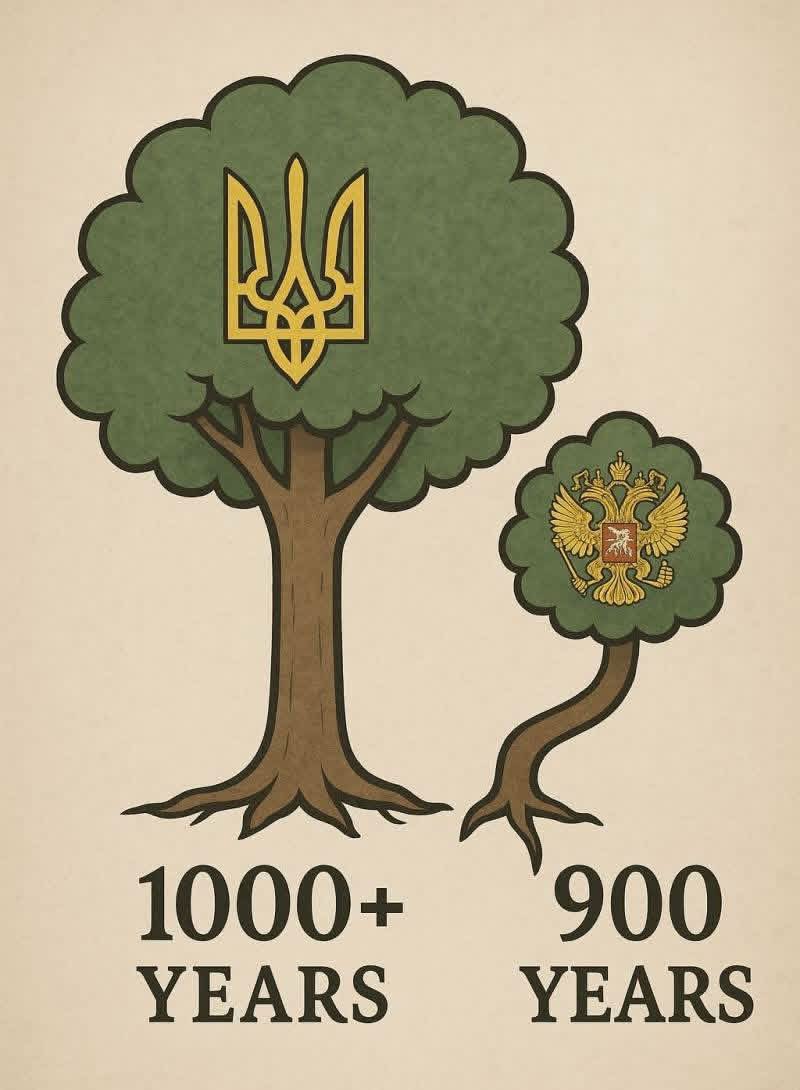
Russia is not over 1,000 years old, as some claim. At most, it is 900 years old – if we count from the establishment of the first political unit in the area of Moscow. The Vladimir-Suzdal Principality, founded in 1125, is where we should begin the political history of the country now known as Russia. Before the arrival of colonizers from Kyiv, the region was mostly inhabited by Finnic tribes.
Rus’ began in Kyiv in the 9th century, which makes Ukraine its direct descendant, while Russia is more of a spin-off – a branch heavily influenced by the Golden Horde. Moscow was under Kyivan Rus’ influence for barely 100 years, but it remained under the rule of the Golden Horde and other Turkic powers for over 400 years. This raises the question: from whom did they actually inherit most of their political culture and traditions?
We don’t say that the United States began with the Kingdom of Wessex in the 6th century. We don’t say Argentina started as the Kingdom of Aragon in 1035, or that Brazil was founded in the days of the Portuguese Reconquista. You get the point. We draw a clear line between the colonizing civilization and the colony that later gained independence and went its own way.
Likewise, Russia did not begin with Kyivan Rus’. It was a remote colony, and that does not make it the heir to Kyivan heritage. In fact, prior to 1721 the country wasn’t even officially called “Russia” – its name was “Moscovia.” They renamed themselves after conquering Rus’-Ukraine, in a deliberate attempt to appropriate its history. Sadly, many people still fall for that story.
When I pass by the 1,000-year-old St. Sophia Cathedral – built while the area of Moscow was still populated mostly by bears and frogs – and then hear someone talk about “Russia’s 1,000+ year history,” I honestly shudder. That is Ukrainian history, not Moscow’s.
The trident was the coat of arms of Volodymyr the Great of Kyiv, who reigned from 978 to 1015. The double-headed eagle, often cited as Russia’s imperial symbol, wasn’t even originally Muscovite – it was appropriated from Byzantium after its fall. Tsar Ivan IV, “the Terrible,” even fabricated a story claiming he was a direct descendant of Julius Caesar. Naturally, that was fake – like so much else in their official mythology.
Author: Volodymyr Kukharenko
The Poles seem to have completely forgotten that the days of the Polish–Lithuanian Commonwealth are long gone.
The level of arrogance and Great Polish chauvinism has recently become overwhelming. Watching Warsaw try to dictate terms to Ukraine, lecture us on history, and tell us how to name our military units and whom we should consider heroes raises only one question: have you completely lost your sense of proportion?
Yes, we are deeply grateful for the extraordinary support that the Polish people provided at the beginning of Russia's full-scale invasion in 2022 and for everything they continue to do today. But let's settle one thing once and for all: UKRAINIANS IN POLAND ARE NOT FREERIDERS.
This is not charity—it is a mutually beneficial process. Ukrainian businesses, the massive relocation of major Ukrainian companies, the creation of thousands of new enterprises, the integration of millions of hardworking people, and the billions in taxes Ukrainians contribute to the Polish treasury every month have given Poland's economy a tremendous boost. Poland is significantly stronger economically today than it was before 2022. You helped us in war; we injected fresh energy into your economy. The accounts are balanced. Nobody owes anyone eternal gratitude or submission.
Now, let's talk about history—the subject Polish politicians seem to enjoy reshaping to suit their narrative.
The next time you want to lecture us about morality, remember Operation Vistula. Remember how your government deported Ukrainians, uprooted them from their ancestral lands, and forcibly resettled entire communities.
When you drive through Chełm—the gateway to Poland for millions of refugees today—learn its history. This is not merely "Chełm." It is the historic Ukrainian city of Kholm, founded by Prince Danylo Romanovych of Galicia–Volhynia and at one time the capital of the Galician–Volhynian state. The Kholm region and Trans-Curzon territories are historically Ukrainian lands from which Ukrainians were expelled and erased.
But does Ukraine run around demanding the return of territories? Do we print Polish cities on our banknotes? No. Yet Poland allows itself to issue commemorative coins depicting the Ukrainian city of Lviv and considers this perfectly normal.
The fighters of the UPA fought against the Home Army, but at times they also fought against the same Russian imperial threat. At the same time, the Home Army committed documented atrocities against Ukrainian civilians, destroying entire villages. And yet in 2023 Poland officially named a military unit after the Home Army. Did Ukraine issue ultimatums demanding a renaming? Did we interfere in Poland's sovereign affairs? No. So why do some Polish politicians believe they have the right to tell Ukrainians how to honor those they consider heroes—people who are dying today to ensure that Russian tanks never roll toward Warsaw?
Let's be honest. Historically, Poland was often as much an occupier of Ukrainian lands as Russia was. Remember the forced Catholicization, aggressive Polonization, harsh serfdom, and the suffering of Ukrainians under the old Polish–Lithuanian system. Those realities helped ignite the uprising led by Bohdan Khmelnytskyi.
We Ukrainians proved capable of rising above the grievances of the past. We showed maturity, forgave historical injustices, and chose a common European future. Yet in return we increasingly hear arrogance and attempts to speak to us from the position of "master and servant." That will not be accepted.
I have never been a supporter of President Zelenskyy and still have many domestic political disagreements with him. However, in the way he is currently dealing with Warsaw—defending Ukraine's sovereignty and national dignity—I fully support him.
Independent Ukraine is in no way inferior to Poland, either historically or politically. We are equals. And we will not allow anyone to speak to us in the language of ultimatums.
Another controversy has erupted in Poland.
This time, the trigger was a Polish historian.
Kazimierz Wójcicki attempted to explain to his fellow citizens why Ukrainians view the UPA differently than Poles do.
The result?
After a single television appearance, the state broadcaster TVP Info reportedly decided to stop inviting him to its programs, while Poland's media regulator demanded an explanation from the channel.
What exactly did the historian say?
During a discussion about the UPA, he stated:
> "The Home Army (AK) and the UPA were two national liberation armies."
In his view, regardless of how particular chapters of history are assessed, both organizations saw themselves as forces fighting for the independence of their respective nations.
Wójcicki also recalled a fact that is rarely mentioned in public debates:
> "Veterans of the 27th Volhynian Division of the Home Army met with UPA veterans and shook hands."
When an opponent raised the issue of the Volhynia tragedy, the historian responded:
> "You are characterized by a shameful lack of knowledge about Ukraine."
After references to UPA crimes against Polish civilians, he added that the victims of the Polish-Ukrainian conflict were not only Poles. Ukrainians also suffered at the hands of Poles, he argued, pointing to the destruction of Orthodox churches and attacks on Ukrainian villages.
The following day, in an interview with Rzeczpospolita, he elaborated on his position:
> "A significant part of the Polish reaction to the UPA is based on a lack of knowledge of Ukrainian history."
According to him, many Poles view the UPA exclusively through the lens of the Volhynia massacres.
For many Ukrainians, however, the memory of the UPA is primarily connected with its long struggle against Soviet rule, political repression, deportations, and resistance to the USSR after World War II.
The historian also observed:
> "Every nation-state creates its own pantheon of heroes."
This, he argued, helps explain the attitude of part of Ukrainian society toward the UPA and the decisions of Ukrainian authorities regarding historical memory.
Another of his remarks provoked particularly strong reactions:
> "The identification of the Bandera movement with Nazism is the result of Russian propaganda."
These comments were received very negatively in Poland.
Agnieszka Głapiak, head of Poland's National Broadcasting Council, stated that historical memory requires special responsibility and demanded explanations from TVP Info.
Meanwhile, deputy channel director Jan Józefowski responded even more sharply:
> "His equating the Home Army with the UPA is not only a historical falsehood and simply nonsense, but a thesis that I oppose as a Polish journalist."
Following the controversy, TVP Info ended its cooperation with the historian.
This story is significant not only because it represents yet another dispute over Volhynia.
It revealed something broader.
Even in Poland, where people have spoken for decades about the need for Polish-Ukrainian reconciliation, an attempt to explain the Ukrainian perspective on the UPA can become politically toxic.
And it increasingly appears that the main problem is no longer that Poles and Ukrainians hold different views of the past.
The problem is that the very attempt to understand the other side's perspective is increasingly perceived as a threat to one's own historical memory.
Фото з часів, коли у всіх були мізки.
Зліва направо:
- Анджей Жупанський, голова Асоціації солдатів 27-ї Волинської піхотної дивізії Армії Крайової;
- Єжи Рейт, голова Обʼєднання українців в Польщі;
- Генерал Василь Кук, останній головнокомандувач УПА.
(Волинський університет, Луцьк, 1997 рік)
Yesterday, the President of Poland noted that the Order of the White Eagle is not an ordinary award. It is a symbol of the highest trust of the Republic of Poland. It signifies a special bond with the Polish state and the special gratitude of the Polish People. Such a symbol requires not only merit, but also respect for the values that form the foundation of our community.
Therefore, if it is considered that this special symbol may remain with Catherine II, Benito Mussolini, and Gerhard Schröder, then we in Ukraine will not argue with that.
Ukraine is grateful to the Polish People for their support and cooperation, which play a significant role in the struggle for our and your independence from Russia.
Ukraine never forgets solidarity and understands that cooperation between states and peoples in our region is one of the tangible security guarantees for Ukrainians and for each neighboring state.
Ukraine will continue to defend itself in this war unleashed by Russia, and we will undoubtedly achieve a dignified peace.
Ukraine is grateful to all peoples, states, and leaders who will continue to stand with us in the defense of freedom and who, together with Ukraine, will serve as guarantors of postwar peace in Europe and a new, real security.
Ukraine will remain open to all meaningful formats of engagement with Poland in order to try to avoid conflicting interpretations of the difficult and painful chapters of our shared past and to ensure proper respect for all innocent victims of the 20th century.
And Ukrainians are doing everything in our power to ensure that Europe does not suffer defeat in this century.
I am proud of our people and of EVERY Ukrainian warrior – of the millions of Ukrainian men and women who deserve unquestionable respect for the heroism the Ukrainian People have shown in defending themselves against Russian aggression.
We believed that the Order of the White Eagle, awarded in 2023, was meant for the Ukrainian People and our army. That is what was said at the time. Today, I sent the Order back to the President of Poland.
I believe the future will confirm the respect Ukrainians deserve.
Glory to Ukraine!
🕯️ Volhynia: The Asymmetry of Memory
Volhynia (Ukraine), a cemetery of the Polish Home Army (Armia Krajowa), which killed about 20,000 civilians in Volhynia. This is not their only crime against the Ukrainian people; however, despite this, Ukrainians maintain the cemetery and do not protest against the army's symbols.
In Poland, on the other hand, the graves of Ukrainians who defended Ukraine from Polish occupation are constantly desecrated, and there is opposition to UPA symbols...
I do not understand why it is impossible to live peacefully and leave history to historians, and not allow politicians to speculate on historical topics, especially Russia and its puppets?
The French philosopher Ernest Renan once famously remarked that "getting history wrong is part of being a nation." He meant that nations are often built on myths that conveniently forget certain painful truths. When Poland demands recognition for the Volhynia tragedy while actively erasing the memory of Ukrainian resistance fighters, it is an attempt to define the "moral geography" of the region in a way that serves current nationalist narratives rather than historical truth. By stoking historical resentment, Russia prevents a unified regional front. As the historian Timothy Snyder has often argued, the "bloodlands" between Germany and Russia—which include Ukraine and Poland—are constantly being weaponized by external powers to keep these nations divided.
True reconciliation, as seen in the post-WWII Franco-German model, requires a "mutual surrender" of the narrative. It requires both sides to acknowledge their own atrocities. The current Polish-Ukrainian dynamic is lopsided: one side offers respect as a path toward peace, while the other uses historical revisionism as a tool for domestic political legitimacy. As Immanuel Kant suggested in Perpetual Peace, lasting stability cannot be built on the selective application of justice; it requires a categorical imperative—treating the memory of the "other" with the same dignity one demands for one's own. The tragedy here is that by fighting over the ghosts of the past, both nations risk failing the living, who need unity more than ever. To leave history to historians is the ideal, but in a world of populism, history is a currency, and politicians are rarely willing to stop spending it.
😔🕯️❗️Five State Emergency Service rescuers have been killed in Kharkiv as a result of a second (!) Russian attack. At least five more have been injured – the strike occurred whilst they were fighting a fire, according to Interior Minister Klymenko.
Russia hit the Kyiv-Pechersk Lavra today (UNESCO site)
Lavra’s Cathedral dates 1073, almost 90 years before Notre-Dame and over 400 years before Moscow’s red-brick Kremlin
Russia steals history when it can, rewrites what it cannot, and burns what refuses to become Russia
Prepare for takeoff. ✈️ Flight simulator is now available globally on web to all users. https://t.co/hQP0No142P
We've recently added many our most powerful professional desktop features to web. Elevation profiles, new import types, but there's always been one other feature you've been asking us to add to the web version of Google Earth, just for fun...
Where will you fly? Share your best maneuvers, views, and flyovers with us!
People keep saying we’re in Idiocracy but President Dwayne Elizondo Mountain Dew Herbert Camacho at his core wanted what was best for his people and when evidence presented itself he listened to experts to solve the problem. By all accounts a better leader than this.
Today is the Day of Remembrance for the Children Killed by Russia. Officially, it has a different name. But in the language of truth, this is exactly what it is. This day is about the most painful episodes of the war, about the greatest injustice and the evil Russia inflicts when the most vulnerable and the most innocent are killed. Children.
Currently, that figure is at least 707 Ukrainian children. And there are also thousands of children whom Russia has wounded, abducted, and thousands of children whose fate remains unknown. These are important and horrifying figures, but behind them lies something greater than statistics about Russian crimes alone. These were children's dreams, plans, and hopes that were simply erased. This is the pain of every mother and every father who does not know how to go on living with that. Living with such pain.
Our Ukrainian children. Some were only a few days old. Some had just started first grade. Others should have been celebrating their graduation. This is who a sick state is waging war against. This is who the so-called second army of the world is fighting – an army incapable of winning on the battlefield and seeking to assert itself by targeting children.
Eternal memory to every child who was killed. It is our enduring duty to remember, to protect our children, and to do everything possible to ensure that the evil Russia has brought is punished.
The Irish government’s agreement to supply Russia with vast quantities of alumina is even more concerning than it first appears :
Australia banned the export of alumina to Russia, citing its critical role in the Kremlin's war machine. Meanwhile, Ireland’s exports of alumina to Russia have skyrocketed since the 2022 invasion of Ukraine, now providing 99% of all alumina from the EU.
Ireland also approves approx 95% of all Russian visa applications - an extremely high percentage.
Ireland's Russian embassy in Dublin is widely viewed by security sources as a hub for Russian intelligence (GRU/SVR) and influence operations in Western Europe. It has an unusually large staff relative to bilateral ties, and Ireland's neutrality, location (back door to the UK), and open society make it attractive for hybrid activities
Ukrainian attack drones opened this year's Russian Saint Petersburg International Economic Forum, successfully striking the city's fuel and oil maritime terminal this morning.
Seen here, numerous Ukrainian drones slam into the terminal.
Another horrific night in Kyiv.
Russia’s missile and drone attack killed at least three people, injured 35 others — including three children — and damaged homes, schools, businesses and critical civilian infrastructure across multiple districts of the city.
Families were pulled from the rubble. Fires burned through apartment buildings. Rescue workers are still searching for survivors.
This is what Russia’s war looks like: not military targets, but homes, families and civilians trying to live their lives.
Kyiv endures. Ukraine fights on. But the human cost grows with every night of terror.
Fucking Russian scums. Shelled playground with MLRS in Kherson. There were father, mother and two daughters: 3 and 6-years-old. Father didn't survive. Mother and daughters severely wounded. 3-years-old girl is taken to a hospital. She doesn't have an eye. Cries: "I don't want".
Killed father had 4 children.
Source: https://t.co/rjHun1xla7
You may not treat Polish citizens who have committed no crime in this way.
In the democratic world we do not abuse and gloat over people in custody.
We demand justice for our citizens and consequences for you.
1/ Today at #GoogleIO, we’re releasing Gemini 3.5, our latest family of models combining frontier intelligence with action.
We’re starting by releasing 3.5 Flash, which is built to help you execute complex, long-horizon agentic workflows.
Gemini 3.5 Flash is our strongest model for coding and agent https://t.co/m62cBJhIjJ outscores 3.1 Pro on agentic and coding benchmarks like Terminal-Bench and MCP Atlas, while running 4x faster than other frontier models.
Used in Google Antigravity, 3.5 Flash is even further optimized to be up to 12x faster. It’s a powerful engine to deploy sub-agents that collaborate, run high-frequency iterative loops, and solve real-world problems at scale.
Some highlights we’re excited about 🔽
1/ 1/ Just back from Turku, Finland — 200 miles from Russia — where I spoke at the Baltic Sea Region Forum.
The room: intelligence officers, diplomats, and cabinet officials from Finland, Estonia, Latvia, Lithuania.
What I told them as an American was painful but necessary. A thread.