Announcing Discovery Loop!
I am very excited to announce that, along with my longtime friends and collaborators @Sanjay_Ghemawat, @OriolVinyalsML and @quocleix, we are founding Discovery Loop (@DiscoLoopAI), a Public Benefit Corporation whose mission is to automate machine learning, science, and engineering to accelerate discoveries and progress. The four of us have worked together for 14 to 30 years, and have helped build some of the world’s most used products, infrastructure and AI models, and we’re excited to turn our attention to this ambitious endeavor.
♾
Learn more at: https://t.co/Rv3LMdLluK
@JeffDean Jeff, good luck with the new adventure! Without your help, long context in Gemini wouldn’t have been released as fast as it was - eternally grateful to you and admire your love for ambitious 0 -> 1 technology!
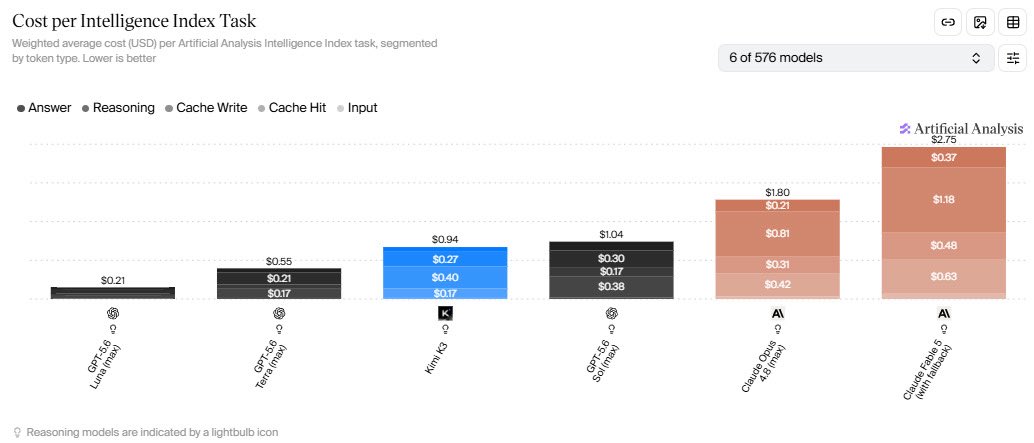
Kimi K3 may be an important inflection point for AI. Potentially negative for Anthropic and OpenAI while being net positive for essentially every other company in the world. I mean that very literally. Although the real “Sputnik moment” would be an open-source frontier model that was also token efficient unlike Kimi K3 which is 50-70% more expensive to run than GPT 5.6 per Artificial Analysis.
Rationale:
A world where there are only 2-3 dominant frontier labs with 90% inference margins is net negative for every other layer while being awesome for those 2-3 labs. Those labs would become monopsonies for power, data centers, semiconductors and hyperscalers and would obviously vertically integrate over time into all those layers while also completely subsuming the application/software layers.
Anything that lowers margins and increases competition at the model layer is good for every other AI layer: power, semiconductors, hyperscalers, neoclouds and yes even software.
This is why Jensen is so supportive of open-source. An open-source model requires the *exact* same amount of compute to run as a closed frontier model of similar size and architecture. Kimi K3 is roughly the same price as GPT 5.6 Terra on a per token basis, which actually suggests that it is less computationally efficient as I am sure that GPT 5.6 is priced to a higher margin than K3. And given that K3 is a token wastrel, i.e. token inefficient, it is significantly more expensive per task than GPT 5.6 and Grok 4.5, which are much more token efficient. Cost per token and token efficiency (i.e. intelligence density per token) are the drivers of intelligence per unit of cost. The winning AI companies will be those that offer the most intelligence per $ over time.
Lower margin % at the model layer = more margin $ at every part of the infrastructure layer and is a godsend for software. This can happen either through open-source models like K3 at the frontier *or* having a vertically integrated model company like Meta, SpaceX or Google at the frontier. Both outcomes result in a lower margin % at the model layer as vertically integrated model companies don’t really care where the margin $ come from. This is why it was so painful for OpenAI and Anthropic when Google was right there with them from a model competitiveness perspective and why Grok 4.5 and Muse 1.1 were just as important as Kimi K3.
The reason Kimi K3 is only *potentially* negative for Anthropic and OpenAI is 1) the @ericvishria point that the Claude and ChatGPT products and harnesses may be more important than their models today and 2) the hypothesis that they have much more advanced model checkpoints internally that are already being used for RSI. In the latter scenario, reaching RSI even a few months ahead of other labs might be enough to cement a permanent lead.
Time will tell on both points. And likely fairly quickly.
Caveat would be that since Kimi K3 is not token efficient and thereby actually more expensive than ChatGPT 5.6, we may need to see a more token efficient open-source model at the frontier or see Grok 5/Composer 4/Muse 2 at multiple points on the Pareto frontier for this potential risk to Anthropic and OpenAI to play out. And I am sure they will both vertically integrate as quickly as possible while continuing the product/harness strength they have shown over the last 8 months.
⛔️ Just remember when Dot Com popped it wasn’t the first 40% drawdown that killed the tech Bulls…
It was the 4-month-long dead cat rally they threw everything they had left at before the 75% drop that got them…
Novak Djokovic: “I refused lots of big brands and huge paychecks because I can’t represent something that I do not believe in. I also rejected the most famous drink in the world. I care about integrity. If I do not drink something, I can’t represent it.”
H2 of this fire horse year marks the inevitable reversal and systemic backlash of a "fire" structure that has reached its absolute peak.
We are looking at a hard structural pivot:
▪️ Internal crises mutating into external conflicts (or vice versa)
▪️ H1 stability collapsing into H2 chaos
▪️ Mutiny following successful suppression; immediate downfalls post-coronation
▪️ Recessive (Yin) variables abruptly infiltrating established systems
▪️ A complete reversal in trade, markets, and warfare as previously underestimated factors enter and alter the entire board.
Historically, this exact structural signature manifests as:
Loss of authoritative control;
Loyalty weaponized as betrayal;
Strategic pivots in warfare;
Rapid cooling of overheated markets;
Urban, financial, or food systems pierced by Black Swans.
This is not standard volatility. It is the forced redistribution of power, wealth, influence, and control from a central structure that simply ran too hot. The macro (global geopolitics) and the micro (individual factions) will mirror each other completely.
As Warren Buffett said: "What we learn from history is that people don't learn from history."
On February 14 250,000 Iranians marched for freedom in Munich.
A surprise guest took the stage: Lindsey Graham.
The crowd erupted in chants of: "USA! USA! USA!"
The Senator was visibly moved. He grabbed the Lion and Sun flag and waived it proudly.
Iranians will never forget.